
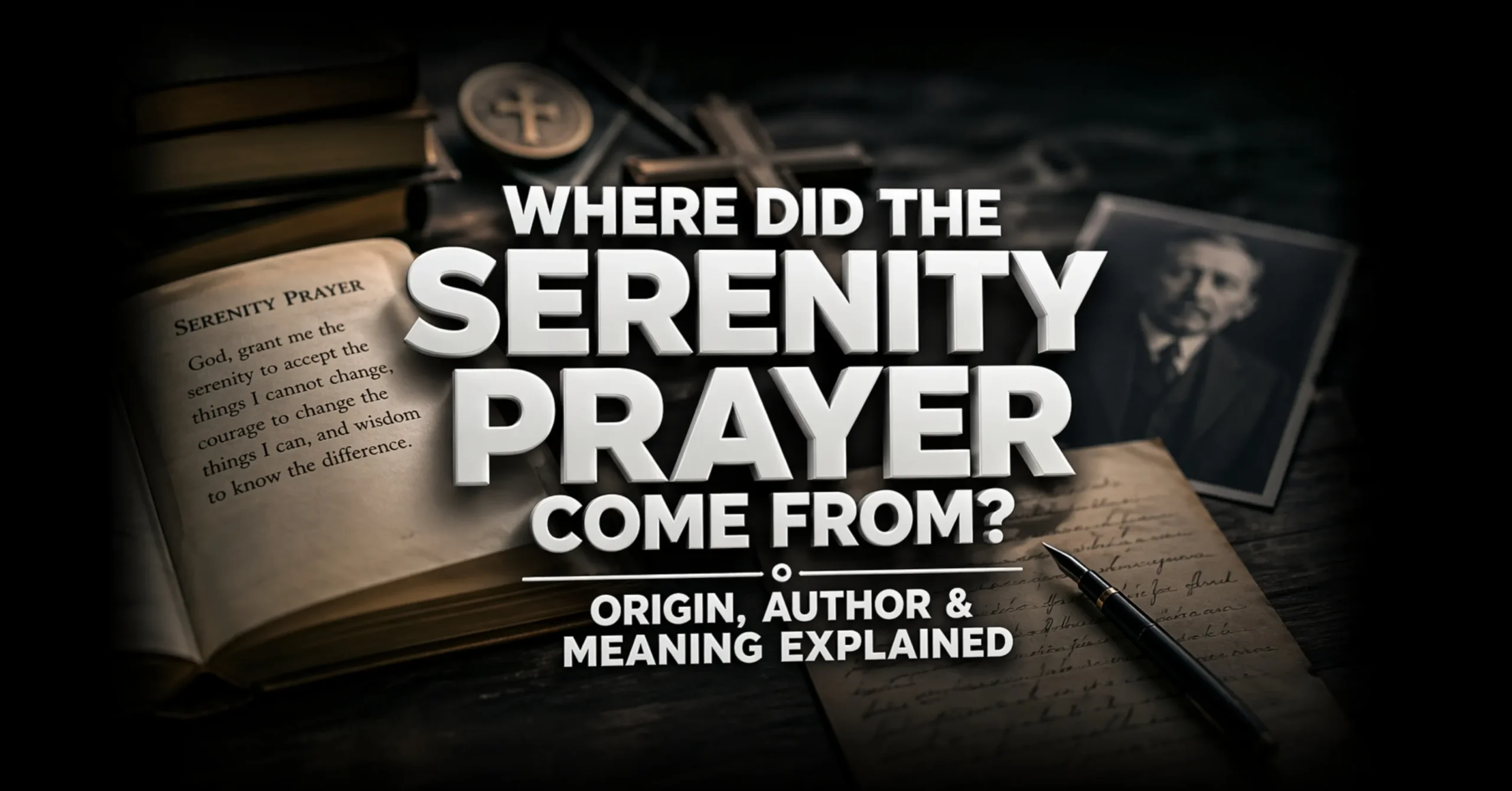
Most people who love this prayer have never heard the actual story behind it. What they’ve heard is a name Reinhold Niebuhr and maybe a decade, somewhere in the 1930s or 40s. That’s usually where the story stops.
But the real history is more interesting than that, and a little more complicated. It involves a personal diary, a magazine article, a church service, and a debate among historians that’s still going on today. None of it is guesswork. Almost every piece of this story comes from something written down at the time, which is rare for a prayer this well known and this widely repeated.
Where Did the Serenity Prayer Come From? The Short Answer
The Serenity Prayer traces back to the early 1930s, to a circle of people connected to Union Theological Seminary in New York. The prayer is most often credited to Reinhold Niebuhr, a theologian who taught there.
That credit is well supported. It’s also genuinely disputed, and has been for years, by researchers who’ve looked closely at the written record left behind. The dispute isn’t about whether the prayer is meaningful or true. It’s simply about who deserves credit for putting it into words. Here’s what that record actually shows.
The Earliest Written Record (1932)
The earliest known trace of the prayer isn’t a sermon or a published article. It’s a personal diary entry.
On October 31, 1932, a woman named Winnifred Crane Wygal wrote in her diary. Wygal was a YWCA official who had studied under Niebuhr at Union Theological Seminary. In that entry, she quoted her teacher, referring to him simply as “R.N.”
The line she recorded was this: “The victorious man in the day of crisis is the man who has the serenity to accept what he cannot help and the courage to change what must be altered.”
Look closely and you’ll notice something. Two pieces of the prayer are already there serenity to accept, and courage to change. The third piece, wisdom to know the difference, hadn’t been added yet. Whatever Niebuhr said that day, it seems the full three-part shape we know now came together sometime after this.
This diary entry sat quietly for decades until a researcher at Harvard’s Schlesinger Library, an archivist named Sarah Guzy, located it while searching through fourteen volumes of Wygal’s personal diaries. It’s now considered the earliest documented reference to the prayer in any form. No church record, no letter, and no earlier newspaper clipping has ever surfaced to challenge it.
First Time in Print (1933)
Five months after that diary entry, the prayer appeared in print for the first time.
In March 1933, Wygal published an article titled “On the Edge of Tomorrow” in The Woman’s Press, a national YWCA publication. This time, all three pieces were present, in something very close to the form we recognize today: “Oh, God, give us courage to change what must be altered, serenity to accept what cannot be helped, and insight to know the one from the other.”
Interestingly, Wygal didn’t credit anyone in this printed version. Niebuhr’s name doesn’t appear next to the words. Readers picking up that issue of The Woman’s Press in 1933 would have had no way of knowing the prayer had any connection to him at all.
The prayer didn’t stay confined to one YWCA magazine for long. On March 9, 1933, The Atlanta Constitution covered a YWCA conference address by the organization’s national president, Mrs. Harrie R. Chamberlin, using similar language. Then on March 15, The Santa Cruz Sentinel reprinted Wygal’s words on its front page, carrying them well beyond church and YWCA circles for the first time.
In the space of about two weeks in March 1933, then, a prayer that had only existed in one woman’s private diary five months earlier was already reaching newspaper readers across the country.
Wygal Credits Niebuhr in Print (1940)
Seven years later, Wygal settled the attribution question, at least as far as she was concerned.
In 1940, she published a book called We Plan Our Own Worship Services. On page 25, she printed the prayer again, and this time she named her source directly: “(Reinhold Niebuhr).”
This is a meaningful piece of evidence. Wygal had every reason to know where the words came from. She had studied under Niebuhr, worked alongside him, and quoted him privately eight years earlier. When she put her name behind a book, with her own reputation attached to it, she chose to give him the credit rather than claim the words as her own.
That choice matters when we get to the modern debate over authorship later in this article. Wygal herself, on two separate occasions, seven years apart, pointed back to Niebuhr as the source.
The Niebuhr Family Account (1943)
The version of this story most people have actually heard comes from Niebuhr’s daughter, Elisabeth Sifton.
According to Sifton, her father delivered the prayer during a Sunday service at Heath Union Church, in Heath, Massachusetts, where the Niebuhr family spent their summers. She places this in 1943 and later wrote an entire book about it, drawing on family memory and her father’s own papers.
This is one part of a longer story, not the whole of it. By 1943, as the record above shows, versions of the prayer had already been circulating in print for a full decade. The Heath sermon may well have been the moment Niebuhr himself spoke the prayer in something close to its now-familiar wording, even if he wasn’t the very first person to put those words on paper.
From Church Prayer to Wartime Print (1944) and Niebuhr’s Own Publication (1951)
Whatever happened in Heath that summer, the prayer soon found a much wider audience than any single congregation could give it.
In 1944, it appeared in A Book of Prayers and Services for the Armed Forces, published by the Federal Council of Churches. Niebuhr’s friend Howard Robbins is credited with suggesting it be included, which placed the prayer directly into the hands of military chaplains during the war, at a moment when its message of accepting what can’t be changed would have carried particular weight.
Niebuhr himself didn’t publish the prayer under his own name until 1951, when it appeared in a magazine column. This version included the word “grace,” a detail that later got dropped as the prayer was shortened for everyday, personal use. It’s a small change, but it shows how much the wording kept shifting even after Niebuhr’s name was finally attached to it.
How Alcoholics Anonymous Adopted the Prayer
Alcoholics Anonymous found the prayer early, and independently of the church publications above.
Members of AA are believed to have come across a version of the prayer in the early 1940s, possibly through a newspaper notice, and began using it informally within their meetings. By the early-to-mid 1950s, it had become a fixture of twelve-step gatherings, recited at the opening or close of meetings all over the country.
What’s notable is that AA’s adoption ran on its own track, separate from the church publications and the Niebuhr family story. Nobody at AA needed to settle the authorship question to find the words useful. The prayer simply worked for what they needed it to do, and it spread through recovery communities largely on its own momentum, carried by word of mouth from one meeting to the next.
That connection between the prayer and recovery has only grown since then. If you’d like to know how the prayer is used today, both in recovery communities and in everyday Christian life, our guide to what the Serenity Prayer is covers that in full.
Is the Serenity Prayer’s Authorship Really Disputed?
Yes, and the disagreement is still active among historians today.
For years, reference books simply listed Niebuhr as the author. The Yale Book of Quotations, edited by Fred Shapiro, did exactly that in its 2006 edition. In 2008, Shapiro publicly raised doubts, pointing to Wygal’s earlier material as evidence that the story wasn’t as simple as everyone assumed. That announcement alone made headlines, since it challenged something almost everyone had taken for granted.
Then, in 2010, after digging further into the diary entry and Wygal’s 1940 book, Shapiro changed his position again. He came to see the 1932 diary line, with Wygal directly quoting “R.N.,” as strong enough evidence to reconfirm Niebuhr as the prayer’s true source. For a while, that seemed to close the question.
That might have settled things, except it didn’t. In 2017, a researcher named William FitzGerald, from Rutgers University–Camden, made a different argument. He pointed out that no matter who first spoke the words aloud, Wygal is the person who actually wrote down the complete, three-part prayer and put it into print. On that basis, he argued, she deserves the credit, not just a footnote in someone else’s story.
That argument has carried real weight. The New Yale Book of Quotations, published in 2021, now lists Wygal as the prayer’s author, with Shapiro walking through the full, tangled history in his introduction rather than presenting a single tidy answer.
So where does that leave things? Confirmed: Wygal is the first person on record, by several years, to write the prayer down in something close to its full and final form. Also confirmed: she credited Niebuhr as her source, both privately in 1932 and publicly in 1940. Disputed: whether “authorship” belongs to the person who first spoke the idea, or the person who first gave it lasting written shape. Unknown: exactly what words Niebuhr may have used out loud before 1932, since no written record from before that date has ever surfaced, and no letter or sermon note from Niebuhr himself has been found that predates Wygal’s diary.
Most historians still refer to it as Niebuhr’s prayer, and that’s unlikely to change any time soon. But if you ever wondered why a few sources credit Wygal instead, now you know exactly where that comes from, and why reasonable historians can look at the same evidence and land in different places.
FAQs
Who really wrote the Serenity Prayer – Niebuhr or Wygal?
It depends on how you define authorship. Niebuhr is the person Wygal credited as her source, both in a 1932 diary entry and again in a 1940 book. Wygal, however, is the first person known to have written the complete prayer down and published it, back in 1933, a full decade before Niebuhr’s own name was ever attached to it in print. Some modern scholarship, including the 2021 New Yale Book of Quotations, now credits her directly.
What is the earliest written record of the Serenity Prayer?
A diary entry by Winnifred Crane Wygal, dated October 31, 1932, in which she quotes a partial version of the prayer and attributes it to Reinhold Niebuhr. It was later discovered at Harvard’s Schlesinger Library among fourteen volumes of her personal diaries.
When did Alcoholics Anonymous start using the Serenity Prayer?
AA members are believed to have encountered the prayer in the early 1940s, separately from its use in church publications. It became a widely adopted part of twelve-step meetings by the early-to-mid 1950s, a tradition that has continued ever since.

Hi, I’m Juganta Kumbhar — a blogger, content creator, and a believer who genuinely loves God.
I hold a postgraduate degree, but honestly, the most important thing I’ve learned didn’t come from a classroom. It came from faith. From prayer. From those quiet moments when God showed up in ways I never expected.
This blog started with one simple desire to share the life of Christ with others. Not in a complicated, religious way. Just honestly. Warmly. The way one friend talks to another.
I also believe in giving back. I do social work freely, because I’ve learned that a life poured out for others is never wasted. That’s not just something I write about it’s something I try to live every day.
Every prayer, every blessing, every word on this site is written with one hope that someone, somewhere, reads it and feels a little less alone and a little closer to God.
I’m glad you’re here. This place was made for you.