

Learning how to pray the Serenity Prayer starts with finding a quiet moment, then speaking it slowly instead of reciting it from memory. Pause after each line serenity, courage, wisdom and picture one real situation it applies to right now. Close by naming that situation to God in your own words.
If you’ve ever wondered whether you’re really praying these words or just repeating them, you’re not alone.
That’s the short version. Here’s how to actually make it part of your life, not just something you say once and forget.
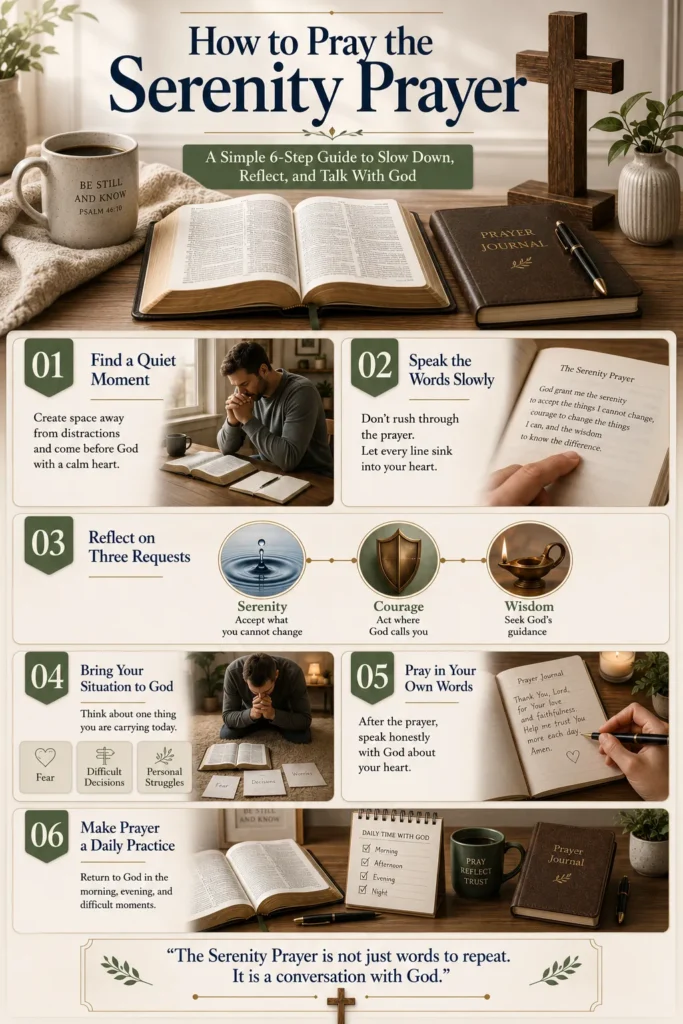
How to Pray the Serenity Prayer, Step by Step
Start by finding a quiet moment. That might be your bedroom before the house wakes up, your car before you walk into the office, or a few minutes on your lunch break. Jesus taught His followers to go somewhere private to pray, away from distraction (Matthew 6:6). It doesn’t need to be long or perfectly silent. It just needs to be a moment where you can actually hear yourself think. If you don’t already have the full text of the prayer in front of you, read it once alongside these steps.
Speak the words slowly. Don’t rush through them like a phrase you’ve memorized. Say each line like you mean it.
Pause after each request. Serenity. Courage. Wisdom. Let each one sit for a second before moving to the next.
Picture one real situation while you pray. Not everything at once. Just one thing you’re carrying right now that fits somewhere in this prayer maybe a hard meeting later today, some bad news you just received, or a conversation you’ve been putting off.
Close in your own words. After the prayer itself, tell God plainly what you need help with today. That’s often the part people skip, and it’s the part that matters most.
Is the Serenity Prayer a Mantra, or Is It Prayer?
Some people treat the Serenity Prayer like a mantra, something to repeat for a calming effect. You’ll even see it described that way in a few places.
But for a Christian, this is prayer, not a mantra. A mantra works by repetition alone. Prayer works because Someone is actually listening. Paul tells us to bring our requests to God directly, not into the air, and promises His peace in return (Philippians 4:6-7). James adds that wisdom isn’t something we generate ourselves. It’s something God gives, through His Spirit, to anyone who asks Him honestly (James 1:5). If you want to see every Scripture behind this prayer’s three requests, this breakdown covers them fully.
That difference matters. You’re not repeating words to quiet your mind. You’re talking to God, and pausing on what each line of the prayer means as you go is part of what makes it prayer instead of repetition.
Techniques to Make It Part of Your Daily Life
A few simple habits can turn this from something you say once into a real spiritual discipline.
Try writing the prayer by hand. Copy it into a journal each morning for a set stretch, maybe thirty days, even if it’s just once through before you start your day. Writing slows you down in a way reading never quite does, and it helps the words settle somewhere deeper than memory.
Try praying it in a few short rounds instead of once. Say it, pause, then say it again, letting a different line stand out each time. Christians have done this for centuries. It’s simply sitting with a few words instead of rushing past them.
Keep a prayer journal nearby. After you pray, jot down three short lines: today’s situation, today’s courage, today’s wisdom. You don’t need more than a sentence for each. Over weeks, you’ll start to notice patterns in what you’re really carrying. Paul’s instruction to “pray without ceasing” isn’t about praying every second of the day.
It’s about making prayer a steady rhythm you return to (1 Thessalonians 5:17), and Colossians describes that same rhythm as devoting yourself to prayer with a thankful heart (Colossians 4:2). So after you pray, name one specific thing you’re grateful for, even something small like a good night’s sleep or a kind word from a friend. Over time, this becomes less like an exercise and more like a habit you don’t have to think about starting.
When to Pray the Serenity Prayer
Morning works well if you want to set the tone before the day gets noisy. Pray it right after you wake up, before you check your phone.
Evening works well as a review. Pray it while you think back over the day. Was there a moment you needed more serenity? A moment that called for courage instead?
In the middle of a hard moment, pray it right where you are. Before a difficult phone call. Right after hanging up from bad news. In a parking lot before you walk into a hospital. Sitting in your car for two minutes before a hard conversation or a tense meeting. Scripture doesn’t limit prayer to a set time of day. Paul tells believers to pray “on all occasions,” not just scheduled ones (Ephesians 6:18). Be still long enough to actually pray it, rather than rushing the words out (Psalm 46:10).
Your body can help too. Sit up, kneel, or fold your hands if that helps you focus. There’s no required posture, but a small physical cue can help your mind settle into the moment.
Praying It With Others
This prayer isn’t only for private moments. Recovery meetings often recite it together out loud, and that shared voice carries its own kind of strength.
Families can pray it together too. Try saying it before dinner some nights: one person reads the first line out loud, everyone pauses in silence for a moment, then another person closes with a short prayer in their own words. It’s a small thing, but it turns a private habit into something you carry together.
You don’t need everything figured out to start. You don’t need the perfect moment, the right words, or a calm mind before you begin. Pray it once today, slowly, over whatever you’re carrying right now. Let God hear it, not just yourself. Tomorrow, pray it again, even if it feels no different than the day before. That’s really all this takes: showing up, one honest prayer at a time, and trusting God with whatever you can’t carry on your own.
FAQs
How often should you pray the Serenity Prayer?
As often as you need it. Many Christians pray it daily, in the morning or evening, while others turn to it mainly during difficult moments. Both are fine.
Is the Serenity Prayer a mantra?
Not for a Christian. It’s addressed to God, not repeated for its own effect.
Can you pray the Serenity Prayer with a group or family?
Yes. It’s common in recovery meetings and works well as a shared family prayer too.
What’s the best time of day to pray the Serenity Prayer?
Whenever it’s useful. Morning, evening, or right in the middle of a hard moment all work.
Can I change the words of the Serenity Prayer when I pray it?
Yes. Praying it in your own words, once you know the original, is often more honest than reciting it exactly. If you’d like to know more about the prayer itself, including who wrote it, you can read the full story here. And if you want to understand what the Serenity Prayer is at its core before you start praying it, that’s a good place to begin.

Juganta Kumbhar is a Christian pastor, blogger, and content creator who serves in ministry and a local church. He holds a postgraduate degree and has spent significant time writing and publishing Christian and Bible-related content across multiple websites. He also volunteers in social work, believing a life poured out for others is never wasted. He created ChristianPrayerLife to share the life of Christ honestly and warmly the way one friend talks to another hoping every reader who visits feels a little less alone and a little closer to God.
2 thoughts on “How to Pray the Serenity Prayer”