
Maybe someone you love is sick right now, and you’ve been praying every night, wondering if you’re praying the right way. Or maybe you read James 5:15 and it stopped you: “the prayer of faith shall save the sick.” You want to know what that verse really means, and if you’re honest, you also want to know something deeper: is your faith strong enough? What is the prayer of faith, and does praying it the “right” way guarantee an answer? Those two questions one about meaning, one about the heart belong together, and this article won’t separate them.
This is one of those phrases that sounds simple until you actually need it. When someone you love is in a hospital bed, or you’ve carried the same request to God for months, the words start to feel heavier. You need more than a definition you need to know what God is actually asking of you, and what He isn’t.
Quick Answer: What Is the Prayer of Faith?
The prayer of faith is a prayer offered with genuine trust in God’s power, goodness, and will not a formula, and not a measure of how strong your emotions feel. James 5:15 says, “And the prayer of faith shall save the sick, and the Lord shall raise him up.” It’s a prayer prayed by people who believe God is able to act, and who bring their need to Him honestly, trusting His character even when they don’t know His plan.
That’s the short version. The rest of this article walks through where that definition comes from, what it does and doesn’t promise, and how you can pray this way yourself.
What Does James 5:14–16 Actually Say?
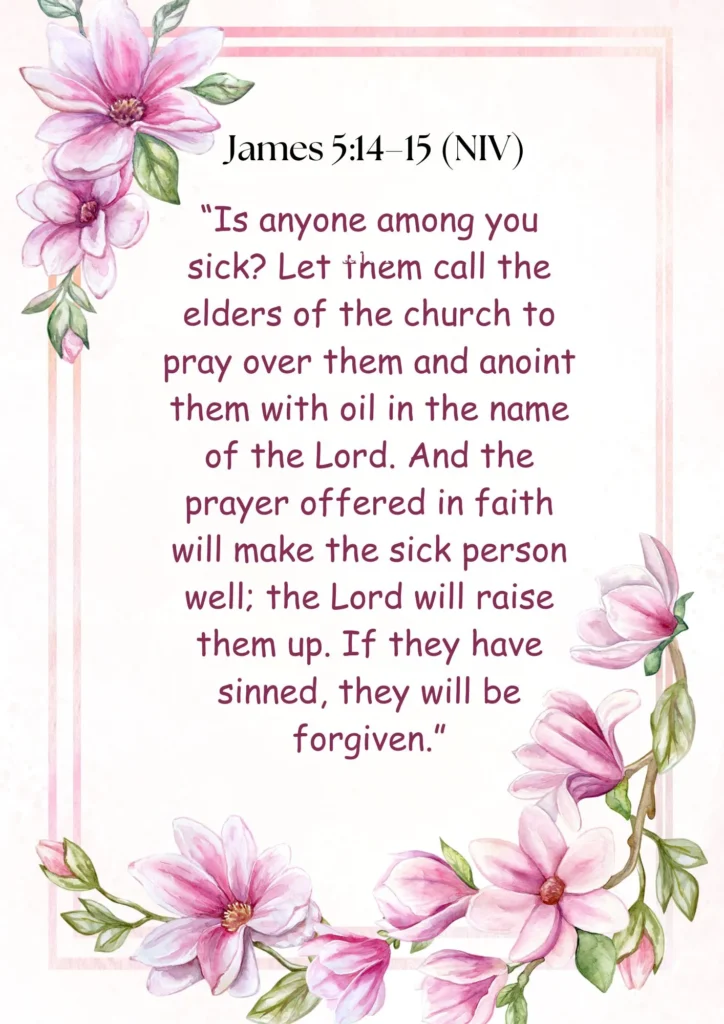
James wasn’t writing a stand-alone verse for us to quote out of context. He was giving real instructions to a real church. Verses 13 through 16 read almost like pastoral counsel: if you’re suffering, pray. If you’re joyful, sing. And if you’re sick, call for the elders of the church to pray over you and anoint you with oil in the name of the Lord.
That last part matters. James doesn’t say “work up enough faith on your own.” He says call the elders bring your need into the community of believers instead of carrying it alone. This is one reason people sometimes wonder whose faith James is even talking about: the elders praying, or the sick person believing, or both together. Scripture doesn’t spell out a strict answer, and most careful readers see it as both the elders bringing their faith and care to the moment, and the sick person invited into that same trust, not left to prove anything on their own.
Notice, too, that James places this instruction right alongside prayer for suffering and prayer for joy. He’s not treating illness as a special spiritual category that requires a different kind of faith than everyday prayer does. Whatever season you’re in suffering, rejoicing, or sick and afraid the response is the same: bring it to God, and bring it with others who will pray alongside you.
Why Elders and Anointing with Oil?
In the first-century church, oil wasn’t medicine, and it wasn’t magic. It was a physical sign a way of setting someone apart before God and declaring, in a way the whole room could see, “we are asking God for this person.” The elders’ presence did something similar. It meant the sick person wasn’t facing their illness in isolation. Their pain was carried, visibly, by people who loved them and prayed for them by name.
Does the Prayer of Faith Guarantee Healing?
Here’s the honest answer: no, it doesn’t guarantee physical healing every time and that’s not bad news, even though it might feel like it at first.
Scripture is honest that this isn’t an automatic guarantee. Faithful, godly people have prayed earnestly for healing and still lost someone they loved deeply. That was never a verdict on their faith. It points to something we have to hold onto carefully: God answers prayer according to His will, not according to how perfectly we perform our faith.
First John 5:14 says we can approach God with confidence “that, if we ask any thing according to his will, he heareth us.” Faith isn’t about forcing God’s hand. It’s about trusting His hand, even when we can’t see where it’s leading.
That’s actually a comfort, once you sit with it. If healing depended entirely on the intensity of your faith, prayer would become a performance something you could get wrong, something that would leave you wondering, every single time, whether you’d done it well enough. But that’s not the God James is describing. He’s describing a Father who hears His children, who is moved by their need, and who responds according to what is truly best even when His timing and His reasons are things we can’t fully see from where we’re standing.
What “Save” (Greek: Sōzō) Actually Means
The word James uses for “save” in verse 15 is the Greek word sōzō. It’s a rich word, and the New Testament uses it in more than one way for physical healing, for spiritual salvation, and for being rescued or made whole in a broader sense. James connects it directly to physical sickness in this passage, so healing is genuinely part of what’s in view.
But the word itself doesn’t lock the promise down to only mean “the disease disappears.” When James says the prayer of faith will “save” the sick, he’s pointing toward God’s complete care for a person body, soul, and spirit worked out according to His own wisdom, not a single guaranteed outcome we can predict in advance.
What This Passage Does NOT Teach (and Why Christians Read It Differently)
This is worth saying plainly: James 5:15 is not a formula. It doesn’t say “pray hard enough and healing is automatic.” It doesn’t say your loved one’s illness is your fault, or that unanswered prayer proves you didn’t believe enough. If you’ve ever quietly wondered whether your faith wasn’t strong enough because healing didn’t come, please hear this that idea isn’t what this passage teaches, and it isn’t the God of the Bible.
Faithful Christians do read parts of this passage differently, and it’s worth being honest about that instead of pretending everyone agrees. Some understand “the Lord shall raise him up” as pointing mainly to physical healing.
Others, noting the broader meaning of sōzō and passages like 2 Corinthians 1:3–5, where God is described as “the God of all comfort,” understand it more broadly as God’s promise to restore and comfort a person completely, which sometimes looks like physical healing and sometimes looks like being carried through suffering with unshakable peace. Both readings take Scripture seriously. Neither one gives anyone the right to say a sick or grieving believer simply didn’t have enough faith.
You’ll also find some believers who treat this verse almost like a spiritual transaction pray this way, and healing is owed to you. That view usually comes from a good place, a real desire to trust God fully.
But it can quietly turn prayer into pressure, and it can turn a season of sickness into a season of guilt, which is the opposite of what James is trying to give the church. The wiser reading holds both truths together: God is fully able to heal, and He is fully good even when He chooses a different path than the one we asked for.
Elijah’s Prayer of Faith – A Covenant Example, Not Just a Faith Example
James doesn’t end at verse 16. He goes on to remind us of Elijah “a man subject to like passions as we are” who prayed it wouldn’t rain, and it didn’t, for three and a half years. Then he prayed again, and the rain came back.
It’s easy to read that and think, “Elijah must have had superhuman faith.” But look at 1 Kings 17–18, and you’ll notice something different: Elijah wasn’t inventing a request out of nowhere. He was praying in line with what God had already declared through His covenant with Israel that disobedience would bring drought, and repentance would bring rain. Elijah’s prayer of faith wasn’t emotional intensity. It was confident agreement with what God had already promised to do.
That changes how we should think about our own praying. The prayer of faith isn’t about generating enough spiritual energy to move God. It’s about praying in step with who God already is and what He has already revealed His character, His promises, His care for His people. That’s something any of us, ordinary and tired as we are, can actually do.
James makes a point of calling Elijah “a man subject to like passions as we are” not a spiritual superhero. He got discouraged. He got afraid. He once asked God to let him die. Yet God used his prayers powerfully, not because his emotional faith was flawless, but because he kept turning back to God and praying in line with what he knew to be true. If Elijah’s story is meant to encourage anyone, it’s meant to encourage the ordinary, tired person praying today which is most of us.
Prayer of Faith vs. Prayer of the Faithful – What’s the Difference?
If you’ve searched this topic, you may have also come across the phrase “prayer of the faithful,” and wondered if it’s the same thing. It isn’t, though the two are easy to mix up.
Prayer of the Faithful – Quick Definition
The prayer of the faithful is a structured, spoken part of many church services, especially in Catholic Mass, where the congregation prays together for the needs of the church, the world, and people who are suffering. It’s a shared, public moment of intercession, usually led by a reader who names specific requests aloud.
Key Differences at a Glance
| Prayer of Faith | Prayer of the Faithful | |
|---|---|---|
| Biblical basis | James 5:15 | General intercessory tradition |
| Who prays it | Elders, individual believers | The gathered congregation |
| Personal or liturgical | Personal, situational | Structured, part of a worship service |
| Typical occasion | Illness, urgent need | Regular church gatherings, Mass |
Both are real and meaningful expressions of Christian prayers. One is a biblical principle about trusting God in a specific need. The other is a shared practice of praying together as a church family. Knowing the difference just helps you read Scripture and understand church tradition more clearly.
It’s easy to see how the two phrases get tangled together they share three of the same four words, and both are genuinely about intercession. But the prayer of faith is something you can pray alone, in a hospital hallway or at your kitchen table, trusting God with a specific need. The prayer of the faithful is something you take part in together, shoulder to shoulder with a congregation, praying for needs far beyond your own. A healthy prayer life usually includes both the quiet, personal kind and the shared, communal kind.
How to Pray a Prayer of Faith Today
You don’t need special training to pray this way. You need honesty and trust.
Start by naming your need to God clearly don’t soften it or dress it up. Then pray in confidence in who God is, not in how strong your feelings are that day. Faith isn’t the absence of fear; it’s choosing to trust God even while the fear is still there. Submit the outcome to His will, not because you don’t care about the answer, but because you trust the One you’re asking.
And keep praying. Hebrews 11:6 reminds us that without faith it’s impossible to please God, “for he that cometh to God must believe that he is, and that he is a rewarder of them that diligently seek him.” Praying in faith is simply seeking Him steadily, honestly, and without giving up.
If you can, don’t carry this alone. Call someone a pastor, an elder, a trusted friend and ask them to pray with you, the same way James described the early church doing for one another. There’s something about praying out loud with someone else that steadies a shaking heart in a way praying alone sometimes can’t. You don’t need perfect words. You need honesty, and you need people around you who will keep bringing your need before God even on the days you’re too tired to.
A Short Prayer of Faith You Can Pray
“Dear Lord, I bring You this need, and I won’t pretend it’s small. I believe You are able to help, and I trust Your goodness even when I can’t see the way forward. Please act according to Your will, and give me peace as I wait on You. Amen.”
Key takeaway: The prayer of faith is confident trust in God’s power and character not a guaranteed outcome. Pray specifically. Trust His will. Rest in who He is, not in how strong you feel.
Frequently Asked Questions
Can anyone pray the prayer of faith, or only church elders?
James specifically instructs the sick to call for the elders, but that doesn’t mean only elders can pray this way. Any believer can bring a need to God with genuine trust. The elders’ role reflects the value of praying together, not a restriction on who’s allowed to pray in faith.
What if I prayed in faith and the person wasn’t healed?
It does not mean your faith failed. God hears every prayer offered in faith, but His answers are shaped by His will, not a fixed formula sometimes the answer is healing, and sometimes it’s strength, peace, or comfort in the midst of the struggle. Many believers have found real comfort in that hard place, which is part of what “save” (sōzō) points toward.
Is the prayer of faith the same as “faith healing”?
Not quite. “Faith healing” often implies that healing is guaranteed if faith is strong enough, which isn’t what James 5:15 teaches. The prayer of faith is about trusting God’s character and bringing a need to Him honestly the outcome remains in His hands, not in the strength of our belief alone.
A Closing Word
If you’re praying for someone right now, or praying through your own illness, know this: the prayer of faith was never meant to be a test you might fail. It’s an invitation to bring your need honestly to a God who hears, who cares, and who is good whatever the outcome looks like. Pray with confidence, not in your own strength, but in His. And keep praying. You are not alone in this.
Understand the difference between Bible-based prayers and common devotional prayers

Hi, I’m Juganta Kumbhar — a blogger, content creator, and a believer who genuinely loves God.
I hold a postgraduate degree, but honestly, the most important thing I’ve learned didn’t come from a classroom. It came from faith. From prayer. From those quiet moments when God showed up in ways I never expected.
This blog started with one simple desire to share the life of Christ with others. Not in a complicated, religious way. Just honestly. Warmly. The way one friend talks to another.
I also believe in giving back. I do social work freely, because I’ve learned that a life poured out for others is never wasted. That’s not just something I write about it’s something I try to live every day.
Every prayer, every blessing, every word on this site is written with one hope that someone, somewhere, reads it and feels a little less alone and a little closer to God.
I’m glad you’re here. This place was made for you.
1 thought on “What Is the Prayer of Faith? Biblical Meaning (James 5:15)”