
If you’re asking, “Where are the Ten Commandments in the Bible?” the two main passages to read are Exodus 20:1–17 and Deuteronomy 5:4–21. Exodus 20 records the commandments in the setting of Israel’s covenant at Mount Sinai, after God brought the Israelites out of Egypt. Deuteronomy 5 records Moses’ later restatement of these commands as the Israelites prepared to enter the Promised Land.
These are the two main passages where the Ten Commandments are presented together as a complete set. The New Testament also quotes and refers to several individual commandments, but it does not reproduce the entire list as one complete passage.
Where Are the Ten Commandments in the Bible?
The clearest places to find the Ten Commandments are Exodus 20:1–17 and Deuteronomy 5:4–21.
Exodus 20:1–17
Exodus 20:1–17 is the first major passage containing the Ten Commandments. The setting begins in Exodus 19, when the Israelites arrive at Mount Sinai after God brings them out of Egypt.
Exodus 19 introduces the covenant setting at Mount Sinai, and Exodus 20 records the commandments God spoke to Israel. They address Israel’s worship of God, the use of God’s name, the Sabbath, family relationships, murder, adultery, stealing, false testimony, and coveting.
If you’re wondering which book of the Bible contains the Ten Commandments, Exodus is the first place to look.
Deuteronomy 5:4–21
The second major passage is Deuteronomy 5:4–21. Moses is speaking to Israel as the people prepare to enter the Promised Land.
Moses restates the covenant commands given at the mountain rather than introducing a completely different set of commandments.
| Passage | What it records |
|---|---|
| Exodus 20:1–17 | The commandments in the Sinai covenant setting |
| Deuteronomy 5:4–21 | Moses’ later restatement of the commandments to Israel |
Reading both passages shows how the commandments fit into two important moments in Israel’s history.
Why Are the Ten Commandments in the Bible Twice?
The Ten Commandments appear in Exodus 20 and Deuteronomy 5 because the two passages present the covenant commands at different moments in Israel’s history.
Exodus 20 belongs to the Sinai covenant setting. Israel had been brought out of Egypt, and Exodus 19 describes the events leading up to the giving of the commandments.
Deuteronomy 5 comes later. Moses is addressing the Israelites before they enter Canaan. He reminds them of the covenant and the commands they are to follow as they live as God’s people in the land.
It is more precise to say that Exodus records the giving of the commandments at Sinai, while Deuteronomy records Moses’ later restatement of them. The two passages are closely related, but they belong to different moments and serve different purposes in the biblical narrative.
Are the Ten Commandments Exactly the Same in Exodus and Deuteronomy?
The two passages present the same Ten Commandments, but they are not word-for-word identical in every detail.
One of the clearest differences concerns the Sabbath. In Exodus 20:11, the Sabbath command is connected with God’s work of creation and His rest. In Deuteronomy 5:15, Moses connects the Sabbath with Israel’s deliverance from slavery in Egypt.
Exodus begins with “Remember the Sabbath day,” while Deuteronomy uses wording such as “Observe the Sabbath day” in many English translations. The underlying Hebrew verbs are also different, so this difference is not simply a matter of English translation.
The commands concerning coveting also differ in wording and order.
These differences do not mean that Exodus 20 and Deuteronomy 5 contain two different sets of commandments. Deuteronomy presents the covenant commands again in a later setting, with Moses speaking to Israel before they enter the land.
What Are the Ten Commandments in Order?
The biblical passages contain the Ten Commandments, but the verses themselves do not label each command with modern numbers from one to ten. Jewish and Christian traditions have developed different ways of grouping and numbering them.
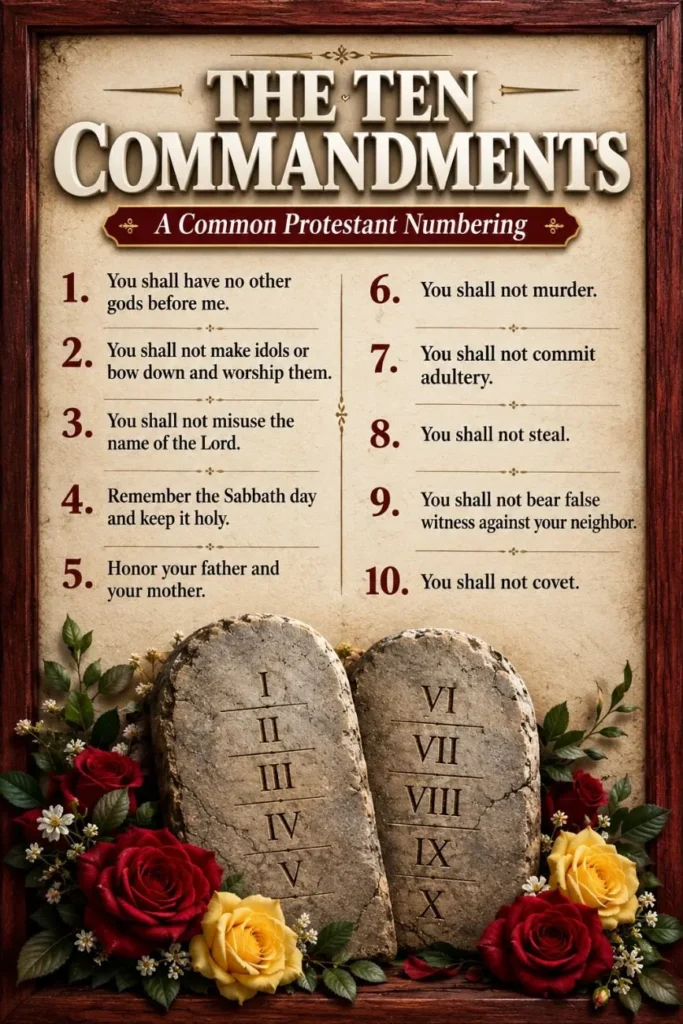
A common Protestant numbering is:
- You shall have no other gods before me.
- You shall not make idols or bow down and worship them.
- You shall not misuse the name of the Lord.
- Remember the Sabbath day and keep it holy.
- Honor your father and your mother.
- You shall not murder.
- You shall not commit adultery.
- You shall not steal.
- You shall not bear false witness against your neighbor.
- You shall not covet.
These are concise summaries of the commands found in Exodus 20:1–17, rather than complete quotations of every verse in the passage.
If you compare different Christian resources, you may notice that some commandments have different numbers. Catholic and Lutheran traditions, for example, divide and number some of the commands differently from many Protestant traditions. The difference concerns how the commands are grouped and numbered; it does not mean that the Bible contains different sets of commandments.
When studying the Ten Commandments, it is helpful to read the actual biblical passages rather than relying only on the numbers attached to each command. If you’re new to studying Scripture, our guide on how to read the Bible can help you approach biblical passages with a simple, practical method.
Where Did Moses Receive the Ten Commandments?
The Ten Commandments were given in the setting of Mount Sinai. Exodus 19 describes Israel’s arrival at the mountain, followed by God’s covenant instructions in Exodus 20. God spoke the commandments to Israel, while Moses served as their mediator.
The stone tablets are mentioned later in the account. Exodus 31:18 says that God gave Moses the two tablets of the testimony, written with the finger of God.
After Israel worshiped the golden calf, Moses broke the first tablets (Exodus 32:19). God later instructed Moses to prepare another set of stone tablets (Exodus 34:1).
Deuteronomy uses the name Horeb for the mountain associated with God’s covenant with Israel. Deuteronomy 5:2 refers to Horeb in connection with that covenant. Sinai and Horeb are generally understood to refer to the same mountain or mountain region in the biblical account.
Are the Ten Commandments in the Old Testament or New Testament?
The Ten Commandments as a complete set are presented in the Old Testament, especially in Exodus 20:1–17 and Deuteronomy 5:4–21.
However, several individual commandments are directly quoted or referenced in the New Testament.
For example, Jesus refers to commandments concerning murder, adultery, stealing, false testimony, and honoring one’s parents in Matthew 19:17–19. Similar references appear in Mark 10:19 and Luke 18:20.
Paul also refers to several commandments in Romans 13:9, including commands concerning adultery, murder, stealing, and coveting. He then connects these commands with the broader principle, “You shall love your neighbor as yourself.”
So the distinction is straightforward: the Ten Commandments are presented together as a complete set in the Old Testament, while individual commandments are quoted, referenced, and applied in the New Testament.
The New Testament does not reproduce Exodus 20 or Deuteronomy 5 as one complete list. Instead, it engages with several of these commandments within Jesus’ teaching and the writings of the apostles.
What Did Jesus Say About the Ten Commandments?
In Matthew 19:17–19, Jesus tells the rich young man to keep the commandments and then mentions commands concerning murder, adultery, stealing, false testimony, and honoring one’s father and mother. Mark 10:19 and Luke 18:20 contain similar references.
Jesus also emphasized the central place of love for God and neighbor when He was asked about the greatest commandment.
In Matthew 22:37–40, Jesus identifies two central commands:
- Love God with all your heart, soul, and mind.
- Love your neighbor as yourself.
The first command comes from Deuteronomy 6:5, and the second comes from Leviticus 19:18. Mark records the same central teaching in Mark 12:29–31.
Matthew 22:40 says that “all the Law and the Prophets” hang on these two commandments. Jesus therefore places wholehearted love for God and love for one’s neighbor at the heart of obedience to God. If you want to explore how these teachings connect with Christian responsibility and service, see our guide on what is the mission of the church.
Christians differ on how the Mosaic covenant applies to believers today, and practices such as Sabbath observance have been understood differently across Christian traditions. Those theological questions should be distinguished from what Exodus 20 and Deuteronomy 5 actually record.
Frequently Asked Questions About the Ten Commandments
Does the Bible call them the Ten Commandments?
Yes. The Bible itself uses language referring to the commandments as the “Ten Commandments.” Exodus 34:28, Deuteronomy 4:13, and Deuteronomy 10:4 use this terminology.
Who wrote the Ten Commandments?
The Bible presents God as the ultimate giver of the commandments. Exodus 31:18 says that the tablets were written with the finger of God.
Moses served as the mediator who received and delivered God’s covenant instructions to Israel. So simply saying that Moses wrote the Ten Commandments does not fully describe the biblical account.
Are the Ten Commandments the same in Exodus 20 and Deuteronomy 5?
They closely correspond, but the wording is not identical in every detail. For example, Exodus 20 connects the Sabbath with creation, while Deuteronomy 5 connects it with Israel’s deliverance from slavery in Egypt.
Why are the Ten Commandments numbered differently?
Different Jewish and Christian traditions divide and number the commands differently. The biblical text gives the commandments, while the numbering is an organizational convention used by different traditions. This is why a command may have one number in one tradition and another number in a different tradition.
What is the first commandment?
In a common Protestant numbering, the first commandment is:
“You shall have no other gods before me.”
It is found in Exodus 20:3 and Deuteronomy 5:7.
What is the tenth commandment?
In a common Protestant numbering, the tenth commandment concerns coveting. It appears in Exodus 20:17 and Deuteronomy 5:21.
The wording and order of the things being coveted differ between the two passages, but both passages prohibit coveting what belongs to one’s neighbor.
Are Sinai and Horeb the same place?
The biblical account uses both names. Exodus commonly uses Sinai, while Deuteronomy 5:2 refers to Horeb when describing the covenant with Israel.
Sinai and Horeb are generally understood to refer to the same mountain or mountain region in the biblical account.
Conclusion
The Ten Commandments are not found in only one place in the Bible. Exodus 20 records them in the setting of Israel’s covenant at Mount Sinai, while Deuteronomy 5 presents them again as Moses prepares Israel to enter the Promised Land.
Reading both passages also shows why the commandments should be understood within their biblical context. They are part of the larger story of God’s covenant with Israel, and the New Testament continues to engage with several of these commands while emphasizing love for God and neighbor.
If you want to study the Ten Commandments carefully, read Exodus 20:1–17 alongside Deuteronomy 5:4–21 and compare the two passages for yourself.

Juganta Kumbhar is a Christian pastor, blogger, and content creator who serves in ministry and a local church. He holds a postgraduate degree and has spent significant time writing and publishing Christian and Bible-related content across multiple websites. He also volunteers in social work, believing a life poured out for others is never wasted. He created ChristianPrayerLife to share the life of Christ honestly and warmly the way one friend talks to another hoping every reader who visits feels a little less alone and a little closer to God.