
If you’ve spent any time reading the New Testament, you’ve probably come across the phrase “faith without works is dead” and wondered what James means by it. The phrase comes from James 2:14–26, a passage that has challenged Christians for centuries. At first, James’s words can sound as though he is saying that good works earn salvation. But his argument is more concerned with whether the faith someone claims is truly alive.
James is addressing people who say they have faith. He asks what that faith looks like in everyday life. If someone claims to trust God, but that faith never affects how they treat others, respond to someone’s needs, or obey God, James questions whether such faith is genuine. For James, faith is not merely something a person says they believe. It becomes visible through the way they live.
This article walks through James 2:14–26 section by section, examining what James says about faith and works, how his teaching relates to Paul’s teaching about grace, and what this passage can mean for Christians who want their faith to shape their daily lives.
What Does “Faith Without Works Is Dead” Mean?
The phrase “faith without works is dead” comes from James 2:14–26. James repeats the idea of dead or useless faith throughout this short passage, making one central point: faith that never produces a response is not the living faith he is describing.
Think of it this way. If someone says they trust a doctor’s advice but never follows it, their actions would make that claim difficult to understand. James uses a similar idea when he talks about faith in God. He is not saying that our works earn our relationship with God. Instead, he shows that what we do can reveal whether the faith we claim is actually active in our lives.
So James is not arguing against faith. He is challenging a kind of faith that remains only a claim—something a person says they believe but never puts into practice. In James’s argument, living faith becomes visible through obedience, love, and action. It does not remain only in words.
What Does James 2:14–26 Teach About Faith and Works?
James doesn’t make his point with one statement and move on. He builds his argument through several examples, with each one showing more clearly how faith and works belong together.
James 2:14–17: Faith and Practical Action
James begins by asking what good it is if someone claims to have faith but has no works. He then gives a practical example. Imagine a fellow believer who lacks food or clothing. If you simply say, “Go in peace, stay warm, and be well fed,” but do nothing to meet their needs, what good have your words done?
James’s point is direct: kind words cannot replace practical help when someone has a genuine need and you are able to respond. Faith that only speaks but never acts is dead because it produces nothing.
This is not a rejection of encouragement or prayer. James is warning against religious words that are never followed by love in action. For him, faith cannot remain only a claim; it must affect the way believers respond to the needs of others.
James 2:18–20: Showing Faith Through Works
James then presents an objection: perhaps faith and works can simply exist separately. His response is that faith cannot be demonstrated apart from action. He challenges his reader to show faith without works, while he will show his faith by what he does.
Then James gives a striking example: even demons believe that God is one, and they shudder. Knowing true facts about God, by itself, is not the same as the kind of faith James is describing. His argument points toward a faith that does more than acknowledge truth; it responds to God.
James 2:21–25: Abraham and Rahab
James next points to Abraham, whose faith is connected with his willingness to offer Isaac. He says that Abraham’s faith was working together with his actions and was brought to completion through what he did. James then connects this with Genesis 15:6, where Abraham believed God and it was counted to him as righteousness.
Rahab provides a very different example. She welcomed the Israelite messengers and helped them leave by another route. James uses both Abraham and Rahab to show faith expressed through decisive action. Hebrews 11:31 also remembers Rahab in connection with her response to what she believed.
These examples are important because James does not present faith and works as unrelated things. His argument is that genuine faith acts.
James 2:26: The Body and Spirit Illustration
James ends with a simple comparison: just as a body without the spirit is dead, faith without works is dead. A body may still have the appearance of a human body, but without the spirit it is no longer living. In the same way, faith that remains only in words is not the living, active faith James has been describing.
What Good Is Faith Without Works?
This is the question James asks at the beginning of his argument, and it deserves a serious look. Imagine a fellow believer who has no coat for winter and no food for the week. You tell them you’re praying for them, that God will provide, and that you hope things get better but then you walk away without helping, even though you have the means to do so.
James isn’t saying prayer or encouragement are worthless. They matter. His point is that when someone has a genuine physical need and you are able to help, words alone are not enough. First John 3:17–18 makes a similar connection between genuine love and practical action.
Following Jesus is not limited to what happens at church or during personal devotion. Faith reaches into ordinary moments helping a neighbor, forgiving someone who has hurt you, sharing what you have, or giving up something for another person’s good. These everyday choices can reveal whether our faith is actually shaping the way we live.
Why Does James Say Even Demons Believe?
James 2:19 might be the most startling verse in the whole passage. He says the demons believe that God is one and they tremble because of it.
Why bring up demons at all? Because James wants to strip away a shallow definition of faith. If simply believing a true fact about God counted as saving faith, then demons would qualify, since they know exactly who God is. But their knowledge doesn’t lead them to trust, love, or obey Him. It leads to fear.
This forces James’s readers to ask a harder question: is my faith anything more than agreeing with a set of facts? A new believer might correctly affirm that Jesus is Lord and that the Bible is true, and those convictions matter deeply. But James is pushing toward something further a faith that actually reorders how a person lives, not just what they’re willing to say they believe.
What Does James Mean by “Works”?
This word can trip people up, especially because Paul says that a person is justified by faith apart from works of the law (Romans 3:28), while Ephesians 2:8–9 describes salvation as God’s gift, not something we earn through works. So what does James mean by “works”?
Look at the examples James gives. First, there is practical action toward someone in need the hungry and poorly clothed believer in James 2:15–16. Then there is obedience to God, seen in Abraham’s willingness to offer Isaac. In James’s argument, works are not a checklist of religious activities. They are actions that put claimed faith into practice.
James does not present these works as something that earns God’s grace. Instead, he says Abraham’s faith was working together with his actions and was “made complete” by what he did. His point is stronger than simply saying that works make faith visible to other people: faith and action belong together in the living faith he is describing. This is why James can speak of a person’s faith being demonstrated through what they do while also insisting that faith without works is dead.
Examples of Living Faith in the Bible
James’s argument isn’t abstract. He points to real people whose trust in God led them to make real decisions.
Abraham :- Faith That Obeyed God
Genesis 15:6 tells us that Abraham believed God, and it was credited to him as righteousness. James then takes readers to a later moment in Abraham’s story, when he was willing to offer Isaac. According to James 2:21–23, Abraham’s faith was working together with his actions, and his faith was brought to completion through what he did. James connects this later obedience with the earlier statement that Abraham believed God.
Rahab :- Faith That Took Action
Rahab’s story in Joshua 2 is dramatic. She could have protected herself by handing the Israelite spies over to the authorities in Jericho. Instead, she welcomed them, hid them, and helped them escape by another route. James 2:25 points to these actions in his argument about faith and works, while Hebrews 11:31 also remembers Rahab for receiving the spies and acting in faith.
Other Biblical Examples of Faith in Action
Hebrews 11 contains many similar examples. Noah took God’s warning seriously and built an ark before the coming judgment was visible. Moses chose to identify with God’s people rather than remain among the privileges of Egypt. Again and again, Scripture shows people who heard God, believed Him, and then acted on that belief. Their actions did not turn faith into a human achievement; they showed that their trust in God was active and responsive.
Does James Contradict Paul About Faith and Works?
At first glance, James and Paul can sound as though they are arguing with each other. Paul writes that a person is justified by faith apart from works of the law (Romans 3:28), while James says that a person is justified by works and not by faith alone (James 2:24). Paul also says that salvation is by grace through faith, not by works, so that no one can boast (Ephesians 2:8–9).
The difference becomes clearer when we look at the questions each writer is addressing. Paul emphasizes that people do not earn their right standing with God through works of the law. Salvation is God’s gift, not something human beings can claim as wages.
James is addressing a different problem: someone who claims to have faith but shows no action that corresponds with that claim. In James’s argument, Abraham’s faith and works were working together, and his faith was brought to completion through what he did.
Ephesians 2:8–9 says salvation is by grace through faith and not by works, but verse 10 immediately adds that believers are created in Christ Jesus for good works. Galatians 5:6 likewise speaks of faith expressing itself through love.
So James and Paul should not be reduced to “faith versus works.” They emphasize different aspects of the relationship between faith, grace, justification, and obedience. Paul stresses that salvation is not earned through works of the law, while James insists that the faith a person claims cannot remain without action. Reading both passages together gives a fuller picture of faith that trusts God and responds to Him.
What Is the Difference Between Dead Faith and Living Faith?
Dead faith is a claim without a life behind it. A person says they believe, but that belief produces no meaningful response. Living faith is different. It shapes how someone responds to God and to other people.
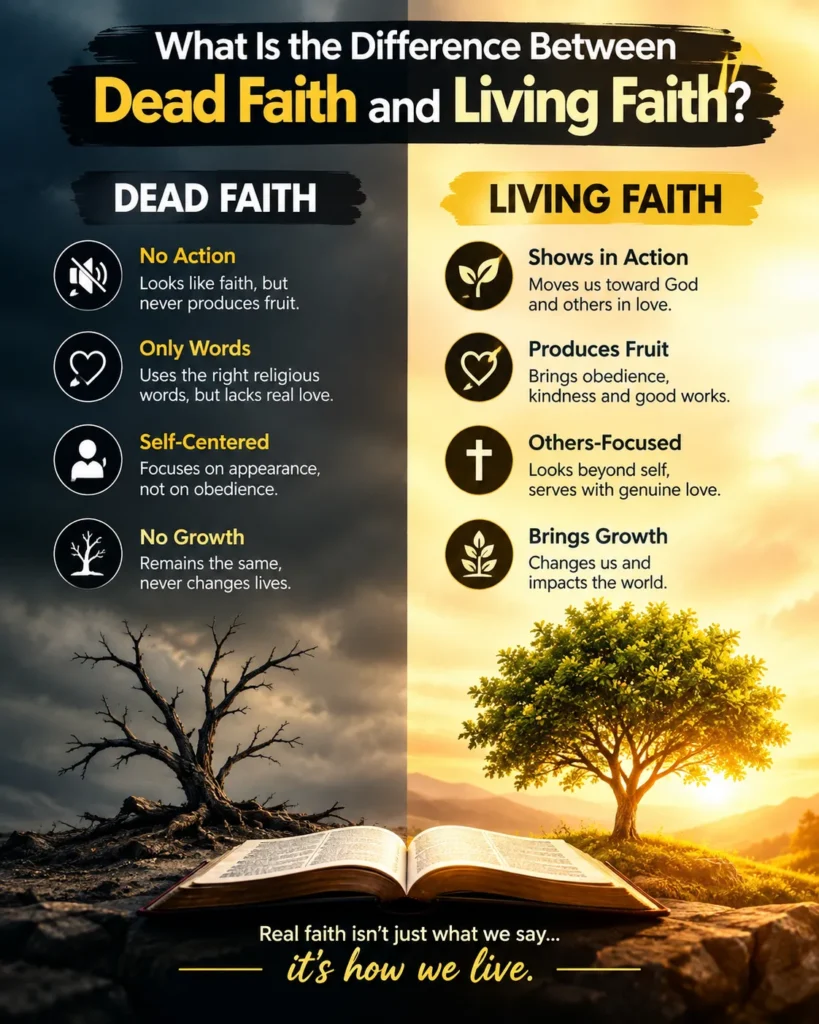
James makes this contrast throughout the passage. Dead faith sees someone in need and offers only words. Living faith responds with practical help when help is possible. Dead faith says, “I believe,” and stops there. Living faith allows that belief to guide decisions, including difficult ones.
This does not mean Christians are expected to obey perfectly or never stumble. Believers still fail, grow gradually, and depend on God’s grace every day. James is not demanding flawless behavior. He is drawing a line between faith that is merely spoken and faith that is genuinely alive and active.
What Does Faith Without Works Look Like Today?
This isn’t just an ancient problem. It can appear in ordinary situations today. Someone may say they follow Christ but consistently refuse to forgive a person who hurt them. Someone may talk about caring for others while ignoring a friend or family member who is clearly struggling. Someone may know what Scripture teaches but choose not to obey when doing so becomes inconvenient.
James’s original example the believer without food or clothing still has modern equivalents. Living faith might look like helping a coworker through a difficult season, keeping a promise when it becomes inconvenient, choosing honesty when a lie would be easier, or quietly serving someone who may never know who helped them.
None of these actions earn salvation. But they can show that faith is affecting the way a person lives. For a newer believer, this is not a call to instant perfection. Christian growth takes time, and faith is worked out through countless ordinary choices to trust God, obey Him, love others, and do what is right.
Why Does James Compare Faith Without Works to a Dead Body?
James saves his most vivid image for the end. Just as a body without the spirit is dead, faith without works is dead. It may look like faith from the outside and use all the right religious words, but without action, something essential is missing.
The message of James 2:14–26 is straightforward. Faith is not meant to remain only in what we say. It moves us toward God in trust, toward obedience even when obedience is costly, and toward other people in genuine love. That is why James calls faith without works dead. He is not teaching that good deeds earn salvation. He is showing that faith which is truly alive does not remain barren; it expresses itself through a changed way of living.

Juganta Kumbhar is a Christian pastor, blogger, and content creator who serves in ministry and a local church. He holds a postgraduate degree and has spent significant time writing and publishing Christian and Bible-related content across multiple websites. He also volunteers in social work, believing a life poured out for others is never wasted. He created ChristianPrayerLife to share the life of Christ honestly and warmly the way one friend talks to another hoping every reader who visits feels a little less alone and a little closer to God.