
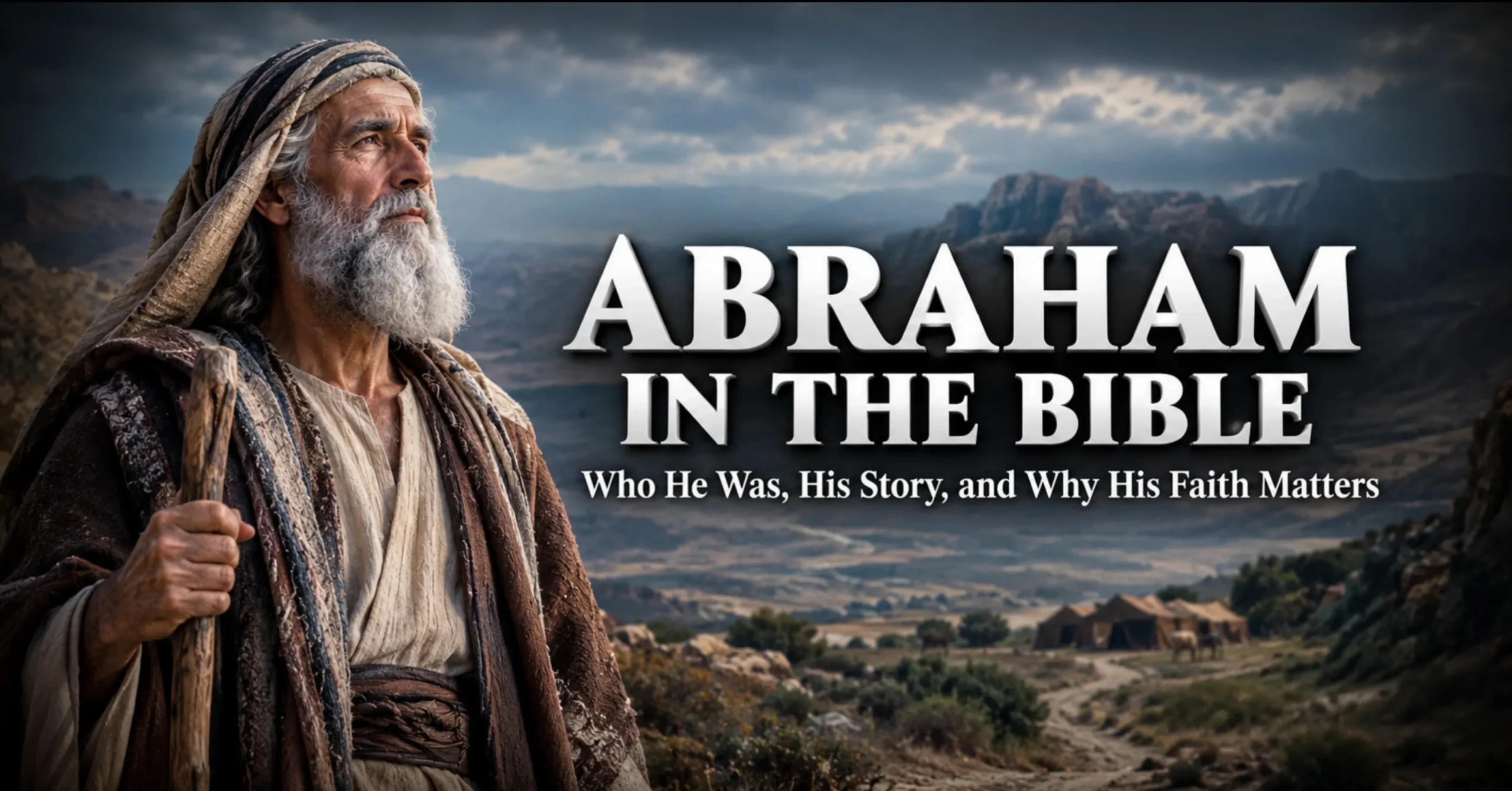
Abraham in the Bible is a man God called to leave his homeland and go to a land God would show him. His main story is recorded in Genesis 11:27–25:11, though he is mentioned elsewhere in both the Old and New Testaments. Along the way, God makes a covenant with him, gives him a son in his old age, and tests his faith by telling him to offer Isaac. Abraham’s story includes faith, failure, waiting, obedience, prayer, and God’s faithfulness to His promises. The New Testament also points to Abraham as an example of faith.
Abraham at a Glance
Here are the key facts about Abraham and his story in Genesis.
| Detail | Answer |
|---|---|
| Original name | Abram |
| Main story in Genesis | Genesis 11:27–25:11 |
| Father | Terah |
| Wife | Sarah |
| Sons | Eight (Ishmael, Isaac, and six sons of Keturah) |
| Promised land | Canaan |
| Promise and covenant passages | Genesis 12–17 |
| Age at death | 175 |
| Key faith passages | Genesis 15:6; Romans 4; Hebrews 11 |
Who Was Abraham in the Bible? From Abram to Abraham
Abraham is one of the central figures of Scripture. God called him to leave his homeland and promised to make him into a great nation and bless others through him (Genesis 12:1–3). Paul later describes Abraham as the father of those who believe (Romans 4:11). His story begins with a man named Abram and his family leaving Ur and traveling toward Canaan.
Abram’s Family and Homeland
Genesis 11:26 says Terah was 70 when he began fathering Abram, Nahor, and Haran, though the verse does not necessarily give their birth order. The family came from Ur of the Chaldeans, where Haran, the father of Lot, died (Genesis 11:27–28). Terah later led Abram, Sarai, and Lot out of Ur toward Canaan, and they settled in the city of Haran, where Terah died (Genesis 11:31–32). Sarai was childless because she could not conceive (Genesis 11:30).
Why God Changed Abram’s Name
When Abram was 99, God renewed His covenant with him and changed his name to Abraham, saying that he would become the father of many nations (Genesis 17:1, 5). Abram is commonly understood to mean “exalted father,” while the name Abraham is associated in Genesis 17 with God’s promise concerning many nations. God also changed Sarai’s name to Sarah (Genesis 17:15). The name change was tied to God’s promise, even though Abraham still had no son with Sarah when God spoke these words. Isaac’s birth was still future.
God Calls Abram: His Journey to Canaan
In Genesis 12, God calls Abram to leave his country, his relatives, and his father’s household and go to a land He would show him. God also promised to make him into a great nation, bless him, make his name great, and bless all the families of the earth through him (Genesis 12:1–3).
Abram obeyed. He took Sarai, his nephew Lot, their possessions, and the people who were with them, and they set out for Canaan (Genesis 12:4–5). Hebrews 11:8 later highlights this act of faith, saying that Abraham obeyed God’s call even though he did not know where he was going.
When Abram reached Shechem, Canaanites were already living in the land (Genesis 12:6). God appeared to him there and promised to give the land to his descendants. Abram built an altar to the LORD. From there, he traveled toward the hills east of Bethel, where he built another altar and called on the name of the LORD (Genesis 12:7–8).
This journey shows Abraham’s faith in action. He trusted God’s call and obeyed before he knew how the promise would unfold.
God’s Covenant With Abraham
In Abraham’s story, a covenant is a solemn agreement and relationship established by God. His covenant with Abraham includes promises about descendants, land, blessing, and God being the God of Abraham and his descendants. Scripture unfolds these promises in stages, and the larger promise is often called the Abrahamic covenant. God repeats, expands, and confirms His words as the story moves forward. Different summaries count these promises in different ways, and Scripture does not give a tidy number.
| Passage | What God said or did |
|---|---|
| Genesis 12:1–3 | Called Abram; promised a great nation and blessing for all families of the earth |
| Genesis 12:7 | Promised the land of Canaan to his offspring |
| Genesis 13:14–17 | Promised the land forever and descendants like the dust |
| Genesis 15 | Promised an heir, countless descendants, and the land; formally made a covenant with Abram |
| Genesis 17 | Confirmed an everlasting covenant; gave the name Abraham; commanded circumcision as the sign |
Taken together, these passages point to promises of descendants, land, blessing, and a continuing covenant relationship. God said He would be God to Abraham and his descendants (Genesis 17:7–8). That blessing also reaches beyond Abraham’s own family, since all peoples on earth would be blessed through him (Genesis 12:3).
Circumcision was the sign of the covenant, and every male in Abraham’s household was to receive it (Genesis 17:10–14). God had already made a covenant with Abram in Genesis 15. In that chapter, Abram fell into a deep sleep, and later a smoking fire pot and a blazing torch passed between the animal pieces (Genesis 15:12, 17–18). The scene highlights God’s role in the covenant ceremony.
For the wider picture, see this article on God’s promises in the Bible.
Abraham’s Family: Sarah, Hagar, Isaac, Ishmael, and Keturah
Sarah, Hagar, and Keturah
Sarah was Abraham’s wife and, as he later explained, his half-sister (Genesis 20:12). In Genesis 16, Sarai gave her Egyptian servant Hagar to Abram as a wife, and Hagar gave birth to Ishmael (Genesis 16:3, 15). Hagar remained Sarah’s servant.
God did not forget Hagar. He heard her when she ran away, and later heard Ishmael’s cry in the desert. He promised to make Ishmael a great nation, while saying that His covenant would be established with Isaac (Genesis 16:11; 17:20–21; 21:17).
Isaac was born to Sarah, just as God had promised (Genesis 21:1–3). Genesis 25 also introduces Keturah and her six sons: Zimran, Jokshan, Medan, Midian, Ishbak, and Shuah (Genesis 25:1–2). With Ishmael and Isaac, that makes eight sons in all.
How Old Was Abraham? Key Ages in His Life
| Moment | Age | Reference |
|---|---|---|
| Leaves Haran | 75 | Genesis 12:4 |
| Ishmael is born | 86 | Genesis 16:16 |
| Covenant and circumcision | 99 | Genesis 17:1, 24 |
| Isaac is born | 100 (Sarah: 90) | Genesis 21:5; 17:17 |
| Sarah dies | Sarah: 127 | Genesis 23:1 |
| Abraham dies | 175 | Genesis 25:7 |
Twenty-five years passed between Abraham leaving Haran and Isaac’s birth.
What Did Abraham Do in the Bible?
Abraham’s life included obedience, travel, worship, prayer, intercession, family struggles, and acts of faith. He left his homeland at God’s call and traveled to Canaan, building altars and worshiping God along the way (Genesis 12). He rescued Lot from the kings who had captured him and was blessed by Melchizedek (Genesis 14). He received God’s covenant and became the father of Ishmael and Isaac. He interceded for Sodom (Genesis 18), prayed for Abimelek’s household (Genesis 20), and, when God tested him, was willing to offer Isaac in the region of Moriah (Genesis 22). Throughout his story, Scripture points back to his belief in God, especially in Genesis 15:6, where his faith was credited to him as righteousness.
Other Important Moments in Abraham’s Life
Abraham and Melchizedek
After Abram returned from defeating Kedorlaomer and the kings allied with him, Melchizedek met him. He was king of Salem and priest of God Most High. He brought bread and wine, blessed Abram, and received a tenth of everything Abram had recovered (Genesis 14:17–20). Abram then refused to take any of the king of Sodom’s possessions, saying he did not want the king to claim that he had made Abram rich (14:21–24).
Did Abraham Pray? Altars and Intercession
Yes. Abram built altars and called on the LORD (Genesis 12:8; 13:4), and he spoke to God about Ishmael’s future (17:18). One of the clearest examples of Abraham’s prayer is found in Genesis 18:22–33.
God told Abraham that the outcry against Sodom and Gomorrah was great and that He was going to investigate the matter (Genesis 18:20–21). Abraham stood before the LORD and asked, “Will not the Judge of all the earth do right?” (18:25, NIV). He then asked whether God would spare the city if fifty righteous people were found there, and continued asking about forty-five, forty, thirty, twenty, and finally ten. Each time, the LORD said He would spare the city for the sake of that number of righteous people. Abraham spoke boldly, yet described himself as “nothing but dust and ashes” (18:27). Sodom was eventually destroyed, but God remembered Abraham and brought Lot out of the city (19:29).
Abraham’s Failures and What They Show
The Bible does not hide Abraham’s failures. During a famine, fearing for his life, Abram told Sarai to say that she was his sister, and Pharaoh took her into his household until God intervened (Genesis 12:10–20). Years later, Abraham did something similar with Abimelek. His statement about Sarah was partly true because she was his half-sister, but he admitted that he feared he would be killed because of her (Genesis 20:11–12).
Earlier, when Sarai suggested having a child through Hagar, Abram agreed, and the decision led to conflict within the household (Genesis 16:1–6).
Even after this, Abraham prayed for Abimelek and his household, and God healed them (Genesis 20:17). Abraham’s story includes genuine faith, but it also includes fear, poor decisions, and the consequences that followed.
The Test of Abraham and Isaac
Years after Isaac was born, God tested Abraham. He told him to take his son, his “only son,” whom he loved, and offer him on a mountain in the region of Moriah (Genesis 22:1–2). Isaac was not Abraham’s only child, because Ishmael was also his son. The description points to Isaac’s unique place in God’s covenant promise, since God had said that the covenant would be established through Isaac (Genesis 17:19–21).
Abraham rose early and went. When Isaac asked where the lamb was, Abraham answered that God would provide it (22:8). At the last moment, an angel stopped him. Abraham saw a ram caught in a thicket and offered it instead, naming the place “The LORD Will Provide” (22:13–14). Hebrews 11:17–19 explains that Abraham believed God was able to raise Isaac from the dead if necessary. God then repeated His promises and confirmed them with an oath (22:15–18).
Second Chronicles 3:1 places Solomon’s temple on Mount Moriah, and many readers connect that location with the region mentioned in Genesis 22. Genesis itself, however, only says that Abraham went to “the region of Moriah.” It does not identify the exact location of the mountain.
Abraham’s Faith: What Scripture Says
One of the clearest statements about Abraham’s faith comes in Genesis 15. Abram was still childless when God took him outside and told him to look at the stars. God promised that his descendants would be that numerous. Genesis 15:6 says that Abram believed the LORD, and the LORD credited it to him as righteousness. Paul later uses this passage to explain that Abraham was counted righteous through faith (Romans 4:3).
The New Testament repeatedly returns to this moment. Paul points out that Abraham believed God before he was circumcised, making him the father of all who believe, whether circumcised or uncircumcised (Romans 4:9–11). Galatians 3:6–9 also connects Abraham’s faith with God’s promise to bless the nations through him. Hebrews 11:8–19 shows what that faith looked like in Abraham’s life: he left his homeland without knowing where he was going, lived as a stranger in the promised land, and trusted God even when tested with Isaac.
James gives another perspective on Abraham’s faith. He points to Abraham offering Isaac and says that his faith was working together with his actions. James then connects this with Abraham being called God’s friend (James 2:21–23).
Paul and James emphasize different aspects of Abraham’s faith. Paul highlights his trust in God’s promise, while James shows that genuine faith is expressed through action. Together, these passages show that Abraham’s faith was not merely something he said he had; it shaped the way he lived.
Abraham’s faith also included moments of uncertainty and struggle. He asked how God’s promise would be fulfilled when he was still childless (Genesis 15:2–3). Later, both Abraham and Sarah laughed when they heard that they would have a son in their old age (Genesis 17:17; 18:12). Yet God fulfilled His promise. Abraham’s story points again and again to God’s faithfulness, even when Abraham’s own faith was tested.
How the New Testament Uses Abraham
The New Testament refers to Abraham often. Matthew 1:1 opens by calling Jesus the son of David, the son of Abraham. John the Baptist also warned that being Abraham’s descendant was not enough, saying that God could raise up children for Abraham from stones (Matthew 3:9).
Jesus said that many would come from east and west to share a feast with Abraham, Isaac, and Jacob (Matthew 8:11). He also reminded the Sadducees that God calls Himself the God of Abraham, Isaac, and Jacob, and said that He is the God of the living, not the dead (Matthew 22:32).
In John 8, Jesus said that Abraham rejoiced at the thought of seeing His day. He then declared, “Before Abraham was born, I am” (John 8:56–58). This article on where the Bible says Jesus is God looks more closely at that passage. Paul also writes that those who belong to Christ are Abraham’s offspring and heirs according to the promise (Galatians 3:29).
Abraham’s Death and Legacy
Abraham died at 175 and was “gathered to his people” (Genesis 25:7–8). Isaac and Ishmael buried him in the cave of Machpelah, where Sarah had already been buried (23:17–20; 25:9–10). God then blessed Isaac (25:11), and Genesis immediately records the descendants of Ishmael (25:12–16). This reflects God’s earlier promise that Ishmael would also become the father of a great number of descendants (Genesis 17:20).
Abraham did not live to see the full development of the great nation God had promised. Hebrews 11:13 says that these people of faith died without receiving the things promised, though they saw them from a distance and welcomed them. Abraham’s story continued through his descendants, the nation of Israel, and ultimately the coming of Christ.
What Christians Can Learn From Abraham
God told Abraham to go, but He did not show him the whole road at once (Hebrews 11:8). Most of us are asked to trust God in the same way.
Waiting can be part of faith, as this article on the difference between faith and hope explores. Isaac was born many years after God’s call, and Genesis says that the LORD did for Sarah what He had promised (Genesis 21:1). Obedience matters too, but it grows out of trust, as James 2:22 shows. At the same time, faith does not mean a person never struggles. Abraham questioned, laughed, and stumbled, yet God remained faithful to His word.
Prayer can also be honest and bold. Abraham brought his concern for Sodom directly to God (Genesis 18). Sodom still fell, so prayer is not a way to make God do what we want. Abraham could bring his questions and concerns to God while trusting His judgment. God’s purpose was also bigger than Abraham’s own lifetime, extending to the nations through the promise God made to him (Genesis 12:3).
Abraham in the Bible was not a flawless man, and Scripture never presents him that way. He kept turning back to God, and God remained faithful to His promise. Through Christ, the blessing promised to Abraham extends to people of every nation, as Paul explains in Galatians 3:14.
Frequently Asked Questions
How many wives did Abraham have?
Genesis connects three women with Abraham: Sarah, Hagar, and Keturah. It calls Sarah his wife, says that Sarah gave Hagar to Abraham as a wife (Genesis 16:3), and calls Keturah another wife (Genesis 25:1). First Chronicles 1:32 calls Keturah his concubine, so the Bible uses different terms when describing her relationship with Abraham.
Was Abraham Jewish?
The Bible calls Abraham “the Hebrew” (Genesis 14:13). The term “Jew” is connected to Judah and his later descendants, so Genesis does not use that term for Abraham. He is the forefather of Israel through Isaac and Jacob, but the Bible does not call him the first Jew.
Where was Abraham born?
Genesis places Abraham’s family in Ur of the Chaldeans before they moved toward Canaan (Genesis 11:31; 15:7). This is the place of origin given in the biblical account. Stephen also says that God appeared to Abraham in Mesopotamia before he lived in Haran (Acts 7:2–4).
How old was Abraham when he died?
Abraham was 175 years old when he died (Genesis 25:7–8). Genesis says he was buried in the cave of Machpelah near Mamre, beside Sarah (Genesis 23:19; 25:9–10).
Why is Abraham called the father of faith?
Scripture does not use “father of faith” as a formal title. Paul calls Abraham the father of all who believe (Romans 4:11, 16) because he trusted God before he was circumcised. James adds that Abraham’s faith was expressed through his actions (James 2:22).

Juganta Kumbhar is a Christian pastor, blogger, and content creator who serves in ministry and a local church. He holds a postgraduate degree and has spent significant time writing and publishing Christian and Bible-related content across multiple websites. He also volunteers in social work, believing a life poured out for others is never wasted. He created ChristianPrayerLife to share the life of Christ honestly and warmly the way one friend talks to another hoping every reader who visits feels a little less alone and a little closer to God.