
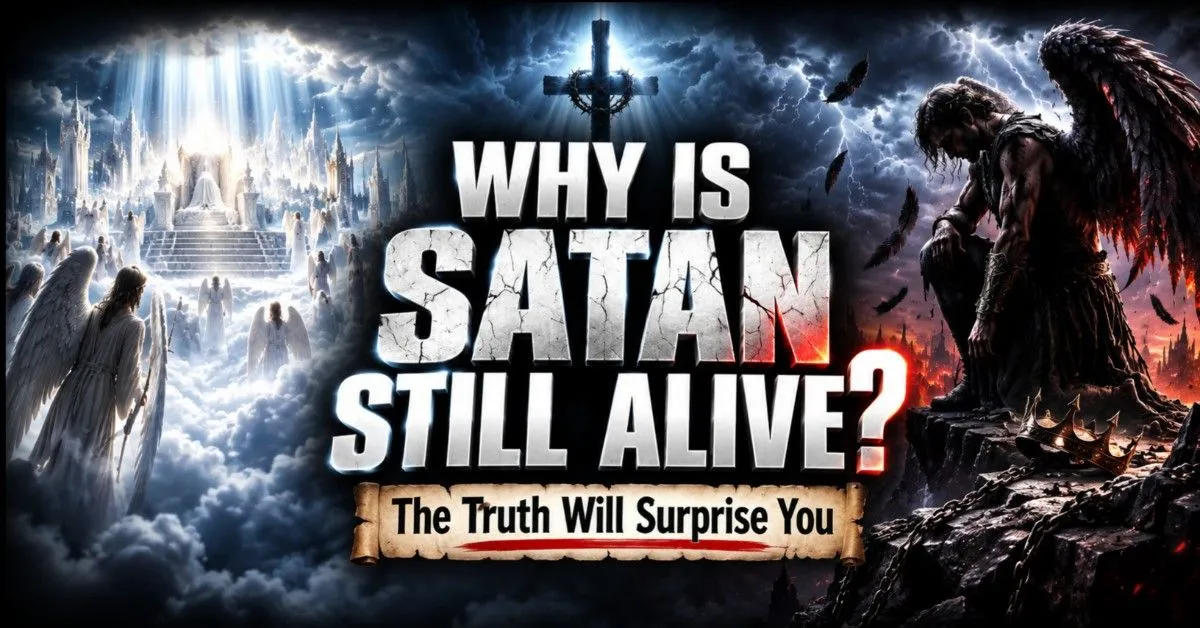
If you have ever asked, “Why did God not kill Satan?”, you are not alone and you are not wrong for asking it.
Maybe you have watched someone you love suffer and wondered why God does not just destroy the one behind so much pain. Maybe someone challenged your faith with it: “If God is all-powerful, why is Satan still here?” Or maybe the question lives quietly in the back of your mind, never quite resolved.
The answer is more complete than most people realize. God has defeated Satan at the cross. What we are waiting for is not God’s victory. We are waiting for the final execution of a sentence that has already been decided. Understanding this changes everything.
Quick Answer: God did not kill Satan immediately because His perfect plan required evil to be fully exposed, answered, and judged before all creation. Satan was already decisively defeated through Christ’s death and resurrection (Colossians 2:15), but his final punishment in the lake of fire (Revelation 20:10) awaits God’s appointed time. Until then, every day of God’s patience is an opportunity for people to receive salvation (2 Peter 3:9).
Who Was Satan Before He Became Satan?
To understand why God did not kill Satan, we first need to understand who Satan was before he became the enemy we read about in Scripture.
“God did not create Satan as an evil being. He created Lucifer as a perfect angel, who later chose rebellion and became Satan.”
The prophet Ezekiel describes this being in striking terms: “You were the seal of perfection, full of wisdom and perfect in beauty. You were in Eden, the garden of God” (Ezekiel 28:12-13). He was called the “anointed cherub” an angel of the highest rank who walked in the very presence of God. He was blameless from the day he was created. Then something changed.
That something was pride.
Isaiah 14:12-15 records the five-fold declaration that drove Lucifer’s fall. Five times he said “I will” I will ascend to heaven, I will raise my throne above the stars, I will make myself like the Most High. It was not a temptation from outside. No one deceived Lucifer. He looked at his own beauty and wisdom and decided he deserved more than his place beside God.
God did not create Satan. He created a perfect, free being and that being freely chose to become Satan. Lucifer used his freedom to rebel, and a third of the angels followed him (Revelation 12:4). But what happened next is where most people get confused.
Why didn’t God simply destroy him right then?
Why Did God Not Kill Satan Immediately After He Rebelled?
This is the heart of the question, and the Bible offers several interconnected answers.
Because Destroying Him Would Have Created Fear, Not Love
When Lucifer fell, he did not rebel quietly. He made accusations. He told the angels that God’s government was unjust, that God could not be fully trusted, that something better existed outside of His rule. These were lies, but the angels had never heard a lie before. Many were confused.
If God had destroyed Satan the moment he sinned, those unanswered accusations would have hung in the air forever. Every remaining angel would have quietly wondered: Was Lucifer right? Is God only keeping us in line through fear of punishment?
God is not building a kingdom of afraid servants. He is building a family of willing lovers. The apostle John says it plainly: “God is love” (1 John 4:8). Love cannot be coerced. Destroying Satan immediately would have placed a shadow of fear over every act of worship for eternity. God chose a different path one that would answer every accusation and leave no doubt about His character.
Because Satan’s Accusations Had to Be Answered, Not Just Silenced
The book of Job shows us this principle with remarkable clarity. Job 1 opens with a scene that is striking if you have never slowed down to notice it: Satan appears before God in what looks like a heavenly court and accuses Job directly. Job only loves God, Satan claims, because God has protected and blessed him. Remove the blessings, and Job will curse God to His face.
God’s response is not to silence Satan. He allows Satan to test Job inside strict limits. “Very well, he is in your hand; but spare his life” (Job 2:6). Satan cannot move an inch beyond what God explicitly permits. He is not acting independently. He operates entirely within boundaries God has set.
This is not God being passive. This is God being completely sovereign. By the end of Job, Job’s faith stands firm. Satan’s accusations are exposed as false. God is vindicated not through force, but through truth.
The same principle runs through all of human history. Time itself has become the answer to Lucifer’s accusations. Every generation sees where Satan’s way leads to suffering, division, and death. And every generation sees what God’s way produces: redemption, restoration, and life.
Because God’s Control Over Satan Has Always Been Total
Here is an assumption hidden inside the question “Why did God not kill Satan?” the idea that Satan is somehow acting freely, outside of God’s reach.
He is not.
In Job 1 and 2, Satan cannot touch Job without permission. He cannot cross the limits God sets. The same God who governs the galaxies governs the enemy. Satan is not a rival to God. He is a defeated adversary operating inside boundaries God has established. The delay in his final punishment is not evidence of lost control it is evidence of perfect timing.
Did God Already Defeat Satan? The Answer Most People Miss
When people ask why God has not killed Satan, they often assume the outcome is still uncertain. Scripture tells a very different story.
The decisive victory is already in the past.
The night before He died, Jesus said: “Now the prince of this world will be driven out” (John 12:31). The apostle Paul describes what happened at the cross: “Having disarmed the powers and authorities, he made a public spectacle of them, triumphing over them by the cross” (Colossians 2:15). Hebrews adds that through His death, Jesus destroyed “him who holds the power of death that is, the devil” (Hebrews 2:14).
Satan is not waiting to be defeated. He has already been defeated.
Think of it like a courtroom. When a judge delivers a guilty verdict, the criminal’s fate is sealed even before the sentence is carried out. Satan received his verdict at Calvary. His authority was stripped. His accusations against God’s people were answered permanently in the blood of Christ. We are living in the time between the verdict and the final sentencing.
That means when you face spiritual attack, you are not in a war whose outcome is still uncertain. You are standing in the aftermath of a war that Jesus already won.
Why Does God Still Allow Satan to Operate?
If Satan has been defeated, why does he still cause so much destruction?
Peter gives us the clearest answer: “The Lord is not slow in keeping his promise, as some understand slowness. Instead he is patient with you, not wanting anyone to perish, but everyone to come to repentance” (2 Peter 3:9).
The delay is not for Satan’s benefit. It is for ours.
Every day God withholds Satan’s final destruction is another day someone, somewhere, has the chance to turn to Him and be saved. That person still asking questions. That family member still far from God. God’s patience is not weakness it is mercy on an open offer.
There is also a deeper point worth understanding. Even if God removed Satan entirely, sin would not disappear from the world. James 1:14 says each person “is tempted when they are dragged away by their own evil desire and enticed.” We do not need Satan to make destructive choices. The root of sin lives inside the human heart, not only in an external adversary. This is why God’s plan through Jesus goes so much deeper than simply eliminating the devil it transforms us from the inside out.
Why Was Satan Not Forgiven by God?
This is a question that comes up often, and it deserves a careful, honest answer.
First, Jesus did not die for angels. Hebrews 2:16 is direct: “For surely it is not angels he helps, but Abraham’s descendants.” The entire design of redemption the incarnation, the cross, the resurrection was shaped for fallen humanity, not for fallen spirit beings.
Second, Satan has never wanted forgiveness. His ambition is not reconciliation it is conquest. Even after a thousand years bound during the Millennium, the first thing he does when released is raise an army to war against God (Revelation 20:7-8). No repentance. No change of heart. The rebellion is permanent.
Third, Satan sinned with full knowledge. He stood in the immediate presence of God. He had no weakness of the flesh, no outside deceiver to blame, no ignorance to appeal to. The condemnation he faces is not God withholding mercy. It is God responding justly to an enemy who has made his choice with perfect clarity and has no interest in reversing it.
What Will God Do to Satan in the End?
God will judge Satan completely, publicly, and finally.
Revelation 20 describes the sequence in detail. Satan is bound for a thousand years, released briefly for one final rebellion, then permanently defeated. The sentence follows: “And the devil, who deceived them, was thrown into the lake of burning sulfur… They will be tormented day and night for ever and ever” (Revelation 20:10). Matthew 25:41 adds that this place was specifically “prepared for the devil and his angels.”
Christians hold different views on what “tormented forever” means eternal conscious punishment or ultimate destruction. Both views have serious scholars and Scripture behind them. But every branch of Christianity agrees on this: Satan’s reign ends. His power is broken permanently. His judgment is fully just. Every created being will witness it and recognize the righteousness of God.
The sentence is coming. God has not forgotten.
What This Means for Your Faith Today
You may have come to this article with a theological question. But perhaps what you really needed to hear is this:
God is not late. He is not passive. He is not outmatched.
Satan still causes real pain in this world. But he cannot claim your soul if you belong to Christ. Paul writes with breathtaking certainty: “Neither death nor life, neither angels nor demons, neither the present nor the future, nor any powers… will be able to separate us from the love of God that is in Christ Jesus our Lord” (Romans 8:38-39).
James gives us a practical response: “Resist the devil, and he will flee from you” (James 4:7). Not “he might.” He will because the One who lives in you is greater than the one who is in the world (1 John 4:4).
The story of Job is deeply reassuring here. God did not prevent Job’s suffering, but He bounded every bit of it and redeemed all of it. Job came through knowing God in a way he never had before working through limits and loss toward something greater than we could see from where we stood.
Trust the timing. Trust the sovereignty. Trust the God who did not silence Satan’s accusations but answered them once and for all through the cross of Jesus Christ.
Conclusion
So why did God not kill Satan?
Because God’s plan is not simply to remove an enemy. It is to fully expose evil, fully answer every accusation, and fully redeem a people who choose Him freely not out of fear, but out of love. A love that had to be proven, not commanded.
Satan was defeated at Calvary. His final judgment is scheduled and certain. Every moment between now and then, God’s patience is an open door to you and to everyone who has not yet walked through it.
He is not surprised. He has simply chosen the better way the way that answers every question, saves every willing soul, and leaves no doubt about who He truly is.
He is good. He is just. And He is never, ever late.
Frequently Asked Questions
Can God kill Satan?
Yes. God is all-powerful and fully capable of judging Satan. This has never been about ability only His perfect timing and sovereign plan.
Why was Satan not forgiven by God? Satan
Satan has never sought forgiveness, and Jesus’s redemptive work was designed for humanity, not angels (Hebrews 2:16). His rejection of God is total, self-chosen, and permanent.
Will God destroy Satan in the end?
Yes. Revelation 20:10 describes Satan being thrown into the lake of burning sulfur, where he is tormented forever. Matthew 25:41 confirms this place was prepared specifically for the devil and his angels. His final judgment is certain.
Why didn’t God kill Satan instead of sending Jesus to die?
The problem was never only Satan it was the sin living inside every human heart. Removing Satan would not have restored our broken relationship with God. Only the atoning death of Christ could accomplish that (Romans 6:23; John 3:16).
Why doesn’t God just get rid of sin?
Sin originates from within us, not only from an external enemy (James 1:14). God’s solution is inner transformation through Christ and the Holy Spirit not simply removing the devil.
What Bible verse says God will destroy Satan?
Revelation 20:10 is the clearest statement of Satan’s final fate. Matthew 25:41 also confirms the lake of fire was “prepared for the devil and his angels.”

Juganta Kumbhar is a Christian pastor, blogger, and content creator who serves in ministry and a local church. He holds a postgraduate degree and has spent significant time writing and publishing Christian and Bible-related content across multiple websites. He also volunteers in social work, believing a life poured out for others is never wasted. He created ChristianPrayerLife to share the life of Christ honestly and warmly the way one friend talks to another hoping every reader who visits feels a little less alone and a little closer to God.