
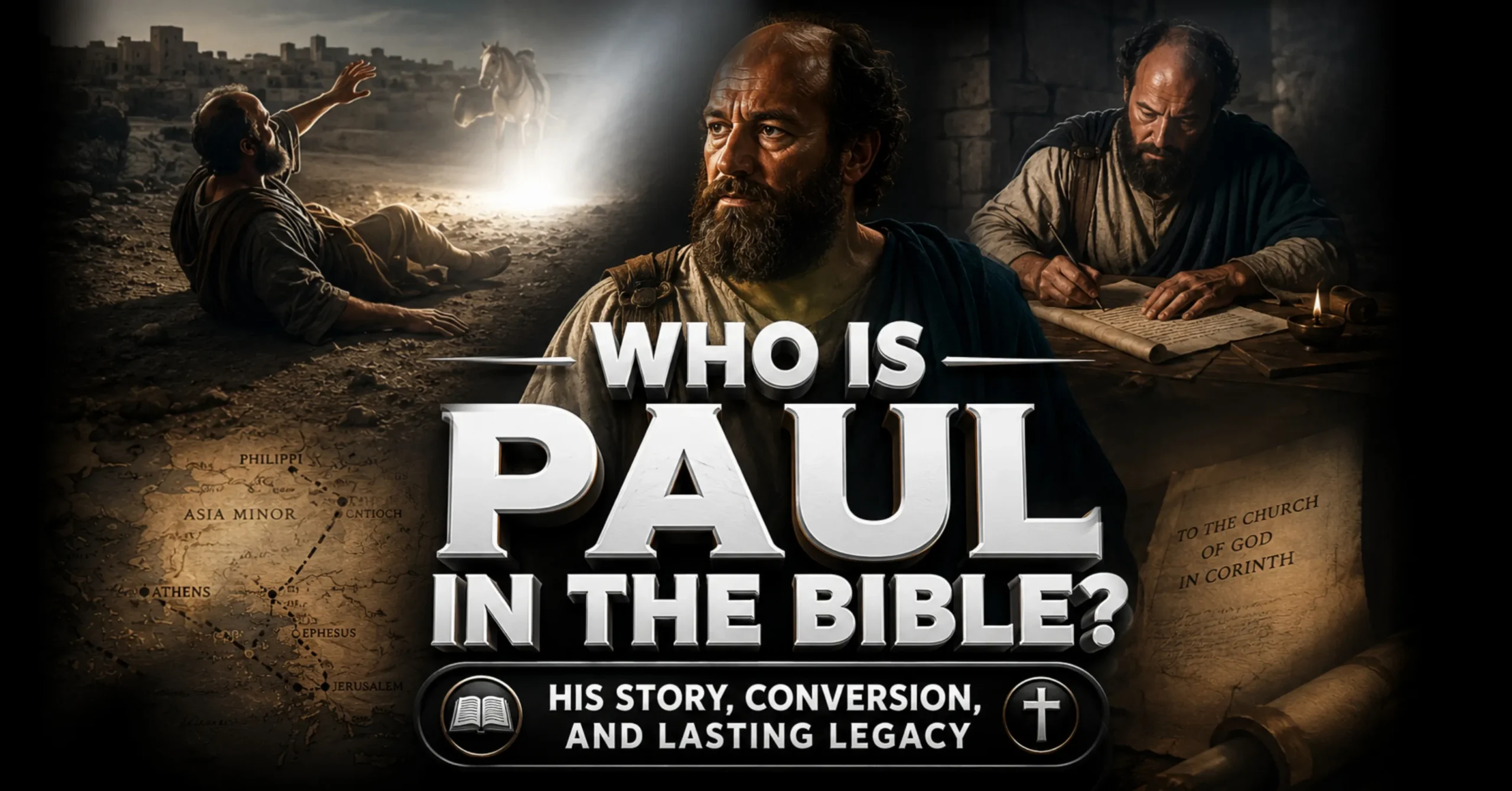
Who is Paul in the Bible? He is one of the most important figures in the New Testament, though he didn’t start out that way. Before he was Paul, he was Saul of Tarsus, a Jewish Pharisee who hunted down followers of Jesus. Then something happened on a road to Damascus that changed the direction of his entire life. He went from persecutor to apostle, from a man who arrested Christians to a man who wrote letters that make up a large part of the New Testament. Paul is traditionally credited with 13 of those letters. His story is one of the clearest pictures in Scripture of what it looks like for God to completely redirect a person’s life.
Who Was Paul Before He Followed Jesus?
Paul was born in Tarsus, a city in what is now southern Turkey. He was Jewish by birth and raised with a serious commitment to his faith. In Acts 22:3, Paul describes his own upbringing, saying he was trained under Gamaliel, one of the most respected Jewish teachers of that time, and taught carefully in the law of his ancestors.
He identified himself as a Pharisee, a group known for strict devotion to Jewish law and tradition. In Philippians 3:5-6, Paul later described himself as a Hebrew of Hebrews, a Pharisee, and, as far as the law was concerned, blameless. He wasn’t exaggerating his credentials. He genuinely believed he was doing what was right.
That conviction is what led him to persecute the early church. Galatians 1:13-14 says he violently persecuted the church of God and tried to destroy it, going beyond many of his peers in his zeal for Jewish tradition. In 1 Timothy 1:13, Paul later called himself a blasphemer, a persecutor, and a violent man. This wasn’t a minor disagreement he had with early Christians. He believed they were dangerous, and he acted on that belief.
Saul and Stephen’s Death
Acts 7:58-8:3 describes Saul’s presence at the stoning of Stephen, one of the first Christian martyrs. The witnesses laid their coats at Saul’s feet while they stoned Stephen, and Scripture says Saul approved of his death. Right after this, Acts 8:3 tells us Saul went from house to house, dragging off men and women and putting them in prison.
Scripture doesn’t tell us that Stephen’s death directly caused what happened to Saul next. But it’s worth noticing that Luke, the author of Acts, places this event right before Saul’s own encounter with Christ. Saul was there. He watched it happen. And he continued on a path of persecution for some time afterward.
What Happened to Saul on the Road to Damascus?
Acts 9 opens with Saul still breathing out threats against the Lord’s disciples. He asked the high priest for letters giving him authority to find followers of “the Way” in Damascus and bring them back to Jerusalem as prisoners. He wasn’t traveling to Damascus out of curiosity. He was going there to make arrests.
As he neared the city, a light from heaven suddenly flashed around him. He fell to the ground and heard a voice say, “Saul, Saul, why do you persecute me?” Saul asked who was speaking, and the voice answered, “I am Jesus, whom you are persecuting.” The men traveling with him heard the sound but saw no one. When Saul got up from the ground, he could not see. His companions had to lead him by the hand into Damascus.
For three days, Saul was blind. He did not eat or drink. We aren’t told exactly what he thought during those three days, only that he waited in that condition until God sent someone to him.
Ananias Was Afraid of Saul
That someone was a disciple named Ananias. In a vision, the Lord told Ananias to go to Saul, lay hands on him, and restore his sight. Ananias’s response, recorded in Acts 9:13-14, was honest: “Lord, I have heard from many about this man, how much evil he has done to your saints in Jerusalem. And here he has authority from the chief priests to bind all who call on your name.”
Ananias knew exactly who Saul was and what he had done. His fear was reasonable. But the Lord told him to go anyway, explaining that Saul was a chosen instrument to carry His name before Gentiles, kings, and the people of Israel. Ananias obeyed. He found Saul, called him “brother,” and placed his hands on him. Something like scales fell from Saul’s eyes, and he could see again. He got up and was baptized.
Saul Begins Preaching Christ
What happened next is easy to miss if you read too quickly. Acts 9:20-22 says that immediately, Saul began proclaiming Jesus in the synagogues, saying he is the Son of God. Everyone who heard him was amazed, because this was the same man who had come to Damascus to arrest people just like the ones he was now teaching. His preaching only grew stronger, and it confused and troubled the Jews living in Damascus, because they couldn’t reconcile who he had been with who he had suddenly become.
When Did Saul Become Paul? Understanding His Two Names
A lot of people assume Saul changed his name to Paul when he became a Christian, as if it were a kind of spiritual rebranding. But that’s not quite what Scripture says.
In Acts 13:9, we read, “Saul, who was also called Paul…” Notice the wording. It doesn’t say Saul’s name was changed. It says he was also known as Paul. Saul was his Hebrew name, likely used among Jewish communities. Paul was a Greco-Roman name, and it appears more often in Acts once his ministry expands into the wider Gentile world.
Both names belonged to the same man throughout his life. Scripture doesn’t describe a formal name change tied to his conversion. It simply shifts to using “Paul” more consistently as his ministry moves further into Gentile territory.
Was Paul a Disciple or an Apostle?
A disciple is a follower and learner, someone who follows the teaching and example of Jesus. An apostle is someone specifically commissioned and sent out with the authority of a messenger of the gospel.
Paul was not one of the original twelve apostles chosen by Jesus during His earthly ministry. He came to faith after Jesus had already died, risen, and ascended. Yet Paul consistently identifies himself as an apostle throughout his letters. In 1 Corinthians 15:8-9, he describes himself as one who was “untimely born,” the last to see the risen Christ, and calls himself the least of the apostles because he had persecuted the church of God.
In Galatians 1:1, Paul is even more direct, saying his apostleship did not come from men or through any human being, but through Jesus Christ and God the Father. Paul’s calling was unusual. It came later, and it came directly, according to his own account, from an encounter with the risen Christ himself.
Why Was Paul Called to Preach to the Gentiles?
Scripture is clear about the direction of Paul’s calling, even if it doesn’t spell out every reason behind it. In Acts 9:15, God tells Ananias that Saul is a chosen instrument to carry His name before Gentiles, kings, and the people of Israel.
Paul echoes this in Galatians 1:15-16, writing that God, who set him apart from birth and called him by His grace, was pleased to reveal His Son in him so that he might preach Christ among the Gentiles. In Romans 11:13, Paul refers to himself directly as an apostle to the Gentiles.
It’s reasonable to think that Paul’s Jewish upbringing, his education under Gamaliel, and his familiarity with the wider Greek and Roman world later proved useful for this kind of ministry. He could speak to Jewish audiences from within their own tradition and also engage with a broader Gentile world beyond it. But Scripture doesn’t spell out these things as God’s stated reasons for choosing him. What it does state plainly is the direction of the calling itself: Gentiles, kings, and Israel.
Paul’s Missionary Journeys
Paul’s ministry took him across a large stretch of the Roman world, and Acts records this through what are usually called his missionary journeys.
On his first journey, Paul traveled with Barnabas to Cyprus and through parts of Asia Minor, including Pisidian Antioch and Lystra. In Lystra, after healing a man who had been lame from birth, the crowd tried to worship Paul and Barnabas as gods, then later turned on Paul and stoned him, leaving him for dead outside the city. He got up and continued on.
The second journey took Paul into new territory, including Philippi, Thessalonica, Athens, and Corinth. In Philippi, Paul and Silas were beaten and imprisoned after Paul cast a spirit out of a slave girl, and Acts 16 records the earthquake that shook open the prison doors that night. In Athens, Paul addressed a crowd at the Areopagus, reasoning with them about the “unknown god” they had been worshiping without realizing who He was.
The third journey centered heavily on Ephesus, where Paul taught for an extended period before moving on through Macedonia and Greece and eventually heading back toward Jerusalem, aware that hardship was likely waiting for him there.
Paul and Barnabas
Barnabas was the one who first vouched for Saul to the apostles in Jerusalem, who were understandably still wary of him given his history (Acts 9:27). Barnabas later brought Saul into ministry at Antioch and partnered with him on the first missionary journey.
Paul and Timothy
Timothy became one of Paul’s closest companions in ministry, described in terms that suggest a father-son kind of relationship. Paul refers to him warmly throughout his letters, including Philippians 2:19-22, where he says no one else shares his concern for the churches the way Timothy does.
What Books of the Bible Did Paul Write?
Paul is traditionally credited with writing 13 letters found in the New Testament. These letters were written to specific churches or individuals, usually to teach, correct, or encourage them in some way.
| Letter | Main Audience | Main Focus |
|---|---|---|
| Romans | Church in Rome | Salvation by faith, God’s grace |
| 1 & 2 Corinthians | Church in Corinth | Unity, correction, love, resurrection |
| Galatians | Gentile churches in Galatia | Freedom from the law, grace |
| Ephesians | Church in Ephesus | Unity in Christ, the church as one body |
| Philippians | Church in Philippi | Joy in the midst of hardship |
| Colossians | Church in Colossae | The supremacy of Christ |
| 1 & 2 Thessalonians | Church in Thessalonica | Christ’s return, encouragement |
| 1 & 2 Timothy | Timothy, his co-worker | Pastoral guidance, church leadership |
| Titus | Titus, his co-worker | Church order, sound teaching |
| Philemon | Philemon, a believer | Forgiveness and reconciliation |
Hebrews is sometimes associated with Paul, but its authorship isn’t stated in the text itself, and it’s not counted among the 13 letters traditionally attributed to him.
Paul’s Suffering, Imprisonment, and Shipwreck
Paul’s ministry cost him a great deal. In 2 Corinthians 11:23-28, he gives his own account of what he endured: beaten with rods, stoned, shipwrecked, in danger from rivers, robbers, his own countrymen, Gentiles, false believers, sleepless nights, hunger, and exposure to the elements. He wasn’t exaggerating for effect. He was listing what had actually happened to him.
Acts 21-28 records the events surrounding his arrest in Jerusalem, a series of trials before Roman officials, and his eventual appeal to Caesar as a Roman citizen. On the voyage toward Rome, the ship he was on was caught in a violent storm and wrecked near the island of Malta. Paul and everyone aboard survived, and he spent time on the island before finally continuing on to Rome, where Acts ends with him under guard but still teaching and preaching openly.
Paul’s calling never promised him an easier life. If anything, it guaranteed the opposite.
How Did Paul Die?
Scripture doesn’t tell us exactly how Paul died. What it does give us is 2 Timothy 4:6-8, likely written near the end of his life, where Paul says he is being poured out like a drink offering and that the time of his departure has come. He writes that he has fought the good fight, finished the race, and kept the faith.
Acts itself ends with Paul in Rome, under house arrest but still preaching. It doesn’t record his death.
Christian tradition holds that Paul was executed in Rome during the persecution under the emperor Nero, and beheading is the traditional account of how he died, since as a Roman citizen he would not have been crucified. This is a longstanding belief in church history, but it comes from tradition outside of Scripture, not from the biblical text itself.
Timeline of Paul’s Life
| Life Event | Reference / Approximate Period |
|---|---|
| Birth in Tarsus | Early 1st century AD |
| Trained under Gamaliel | Acts 22:3 |
| Persecution of the early church | Acts 8:1-3 |
| Present at Stephen’s death | Acts 7:58-8:1 |
| Encounter on the road to Damascus | Acts 9:1-9 |
| Begins preaching Christ in Damascus | Acts 9:20-22 |
| Missionary journeys | Acts 13-21 |
| Jerusalem Council | Acts 15 |
| Arrest in Jerusalem | Acts 21 |
| Shipwreck on the way to Rome | Acts 27 |
| Ministry and imprisonment in Rome | Acts 28 |
| Traditional death under Nero | Church tradition, not recorded in Acts |
What Can Christians Learn From Paul’s Life?
Paul’s story offers more than an interesting biography. It shows several specific things worth sitting with.
In 1 Timothy 1:13-16, Paul describes himself as someone who received mercy, so that in him, as the worst of sinners, Christ might display His patience as an example to those who would believe. He didn’t minimize what he had done. He used it as evidence of what grace can reach.
Acts 9 shows that God didn’t just soften Saul’s opinions over time. He redirected the entire trajectory of his life in a single encounter. Saul woke up that morning intending to arrest Christians in Damascus. By the end of the story, he was one of them.
His calling didn’t spare him from hardship. The list in 2 Corinthians 11:23-28 makes it clear that following God’s direction for his life led to real suffering, not comfort.
Paul also didn’t do this alone. Ananias overcame his fear to reach him. Barnabas vouched for him when others were suspicious. Timothy stayed close to him in ministry. Each of these relationships mattered at different points in his story.
In 2 Corinthians 12:7-10, Paul describes a “thorn in the flesh” that he asked God three times to remove. God’s answer was that His grace was sufficient, and that His power is made perfect in weakness. Paul’s limitations didn’t disqualify him from the work God had given him.
And near the end, in 2 Timothy 4:6-8, Paul wasn’t writing about impressive achievements. He was writing about finishing well, about staying faithful to the calling he had received all the way to the end of it.
Key Takeaways About Paul
- Paul was originally known as Saul, a Jewish Pharisee who persecuted early Christians.
- He encountered the risen Christ on the road to Damascus, recorded in Acts 9.
- Saul and Paul are the same person; Scripture doesn’t describe a formal name change at conversion (Acts 13:9).
- Paul was not one of the original twelve apostles, but he identifies himself as an apostle called directly by Christ.
- He carried the gospel across the Roman world through several missionary journeys.
- Paul is traditionally credited with writing 13 letters in the New Testament.
- He suffered greatly for his faith, and according to Christian tradition, was martyred in Rome.
Frequently Asked Questions About Paul
Who is Paul in the Bible?
Paul was a Jewish Pharisee originally named Saul who persecuted early Christians before encountering the risen Christ and becoming an apostle who spread the gospel to the Gentile world.
Was Paul one of the 12 apostles?
No. Paul came to faith after Jesus’s death and resurrection. He identifies himself as an apostle in 1 Corinthians 15:8-9, though not one of the original Twelve.
What was Paul’s real name?
Saul. Acts 13:9 shows he was also called Paul; both names belonged to the same person.
Did Paul meet Jesus?
Paul encountered the risen Christ on the road to Damascus, described in Acts 9. Scripture doesn’t describe him meeting Jesus during His earthly ministry.
Was Paul married?
Scripture doesn’t state this clearly. Some point to 1 Corinthians 7:7-8 in this discussion, but there isn’t enough information to say for certain either way.
What was Paul’s thorn in the flesh?
The Bible doesn’t say. In 2 Corinthians 12:7-10, Paul only describes it as a source of ongoing weakness that kept him dependent on God’s grace.
How did Paul die?
The Bible doesn’t record his death. Christian tradition holds that he was executed in Rome under Nero, commonly described as beheading.
How many books of the Bible did Paul write?
Paul is traditionally credited with writing 13 letters in the New Testament.

Juganta Kumbhar is a Christian pastor, blogger, and content creator who serves in ministry and a local church. He holds a postgraduate degree and has spent significant time writing and publishing Christian and Bible-related content across multiple websites. He also volunteers in social work, believing a life poured out for others is never wasted. He created ChristianPrayerLife to share the life of Christ honestly and warmly the way one friend talks to another hoping every reader who visits feels a little less alone and a little closer to God.