
Coming Before God With an Honest Heart
There is a particular kind of quiet that settles over you in the moments before confession. Maybe you are sitting in a pew, watching the line move slowly ahead of you. Maybe you are in the car outside the church, gathering the courage to walk in. Maybe it has been years long enough that you are not even sure you remember the words anymore and you are simply hoping God still wants to hear from you.
He does.
A prayer before confession is not a formality you rush through on the way to something else. It is the moment your heart turns, gently and honestly, toward God before you speak your sins aloud to a priest. It is where courage is born. It is where shame starts to loosen its grip. It is where you remind yourself, before you say a single word of your confession, that you are not walking into judgment you are walking into mercy.
Whether you are preparing for your first confession, returning after a long absence, or simply making this a regular part of your spiritual life, this prayer matters. It softens the heart. It quiets the fear. It helps you see, even for a moment, what the priest sees and what God has always known: that you are loved, that your sins do not define you, and that grace is already waiting on the other side of your honesty.
It’s worth naming what this prayer is not. It is not a performance meant to impress God with how sorry you sound. It is not a way of talking yourself out of feeling the weight of what you’ve done. And it is not something you need to get exactly right in order for it to work. God is not grading your wording. He is looking at your willingness the simple, trembling decision to stop hiding and start speaking honestly.
If you’re feeling nervous right now, that’s not a sign something is wrong with you. It’s often a sign that something real is about to happen in your heart. Nerves and sincerity tend to travel together. So does relief, once the honesty is finally spoken. Many people say the hardest part of confession isn’t the confessional itself it’s the ten minutes beforehand, sitting with your own thoughts, working up the courage to walk in. This prayer is for those ten minutes.
Take a breath. You are not alone in this. Let’s pray together before you go in.
A Short Prayer Before Confession
Sometimes you don’t need many words. You need something simple enough to hold onto while your heart is racing.
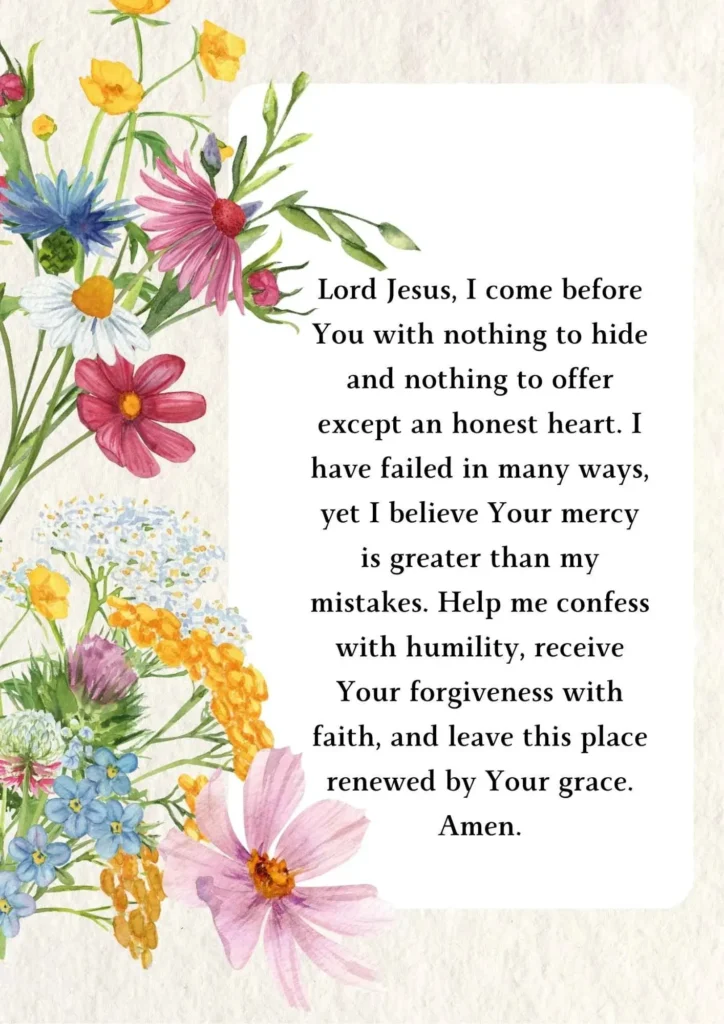
Lord Jesus, I come to You just as I am tired, unsure, and carrying more than I want to carry any longer. Help me to see myself honestly. Take away my fear of being known. Give me the courage to confess my sins with a sincere heart, and let me trust, even now, in Your mercy. Amen.
Say it slowly. Say it again if you need to. There is no wrong way to pray this only an honest one.
A Longer Prayer to Prepare Your Heart
If you have a little more time sitting in the pew, waiting your turn let this prayer walk with you a bit further into stillness.
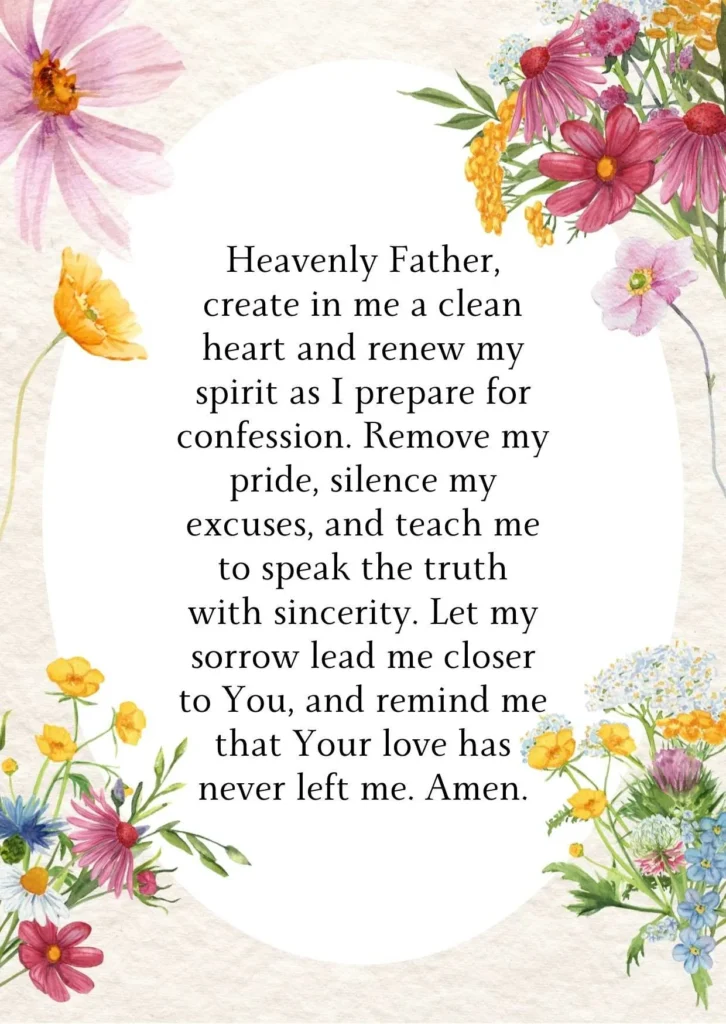
Merciful God, I come before You not to hide, but to be known. You already see everything I carry: the sins I remember clearly, the ones I have tried to forget, and the ones I am only now beginning to understand. I don’t want to make excuses for them. I don’t want to minimize what I’ve done or left undone. I simply want to bring them to You honestly, the way a child brings a broken thing to a parent, trusting that You will not turn me away.
Search my heart, Lord, and show me what I have been avoiding. Give me true sorrow – not the kind that comes from fear of being caught, but the kind that comes from knowing I have wounded a love as great as Yours. Help me to forgive myself as You forgive me, and to release the guilt I have been carrying alone for far too long.
As I prepare to confess, take away my pride. Take away my need to appear better than I am. Let me speak plainly and without excuse. And when I have said what I came to say, let me leave this place lighter than I arrived- forgiven, renewed, and free.
Through Christ our Lord, Amen.
There is something the Church has always understood about moments like this: before we can speak our sins to a priest, we first need to be still enough to hear our own hearts. This is what that stillness sounds like when it becomes prayer.
Preparing Your Heart: A Simple Examination of Conscience
Before you walk into the confessional, it helps to spend a few quiet minutes reviewing your life not to punish yourself, but to see clearly. This is called an examination of conscience, and it doesn’t need to be complicated.
Ask yourself gently, without rushing:
- Where have I turned away from God’s love in my thoughts, my words, or my actions?
- Have I been honest, or have I hidden behind small dishonesties I told myself didn’t matter?
- Have I treated the people in my life – my family, my friends, strangers – with the patience and kindness God has shown me?
- Is there a sin I have been avoiding naming, even to myself?
- Is there someone I need to forgive, or someone I owe an apology to?
- Have I made room for God in my days, or have I let distraction crowd Him out?
Write these down if it helps. Many people find it easier to speak honestly in the confessional when they’ve already faced these questions quietly, on their own, in prayer. A small notebook or even the notes app on your phone is enough this isn’t about producing something polished, only something honest enough to work from when your mind goes blank in the moment.
Try not to examine your conscience the way you’d review a checklist. It helps instead to walk slowly through your recent days your relationships, your work, your private thoughts, the moments you’re proudest of and the ones you’d rather forget and simply notice where love was missing. Sin, at its root, is usually a failure to love: love of God, love of others, or even a right love of yourself. Seeing it that way, rather than as a list of rule-breaking, often makes the truth easier to name.
And if you find yourself overwhelmed by what surfaces take heart. Naming a sin honestly, even the ones that feel heaviest, is not the moment you become unworthy of God’s love. It’s the moment His mercy begins working in you. The examination of conscience was never meant to leave you crushed under guilt; it was meant to lead you somewhere into the confessional, into honesty, into the forgiveness that’s already waiting for you there.
What to Say When You Enter the Confessional
For many people, this is the part that causes the most anxiety not the sins themselves, but simply not knowing what to say first. So let’s walk through it gently.
When you sit or kneel before the priest, you begin with the Sign of the Cross, and then a simple opening:
“Bless me, Father, for I have sinned. It has been [however long] since my last confession.”
If it’s your first confession, you can simply say so. There is no shame in that every priest has heard it many times, and every priest understands.
From there, you confess your sins as plainly and honestly as you can. You don’t need polished language. You don’t need to explain every circumstance in detail. You simply need to be truthful. If you’re unsure whether something is worth mentioning, mention it the priest is there to guide you, not to judge you.
After you’ve shared what’s on your heart, the priest will usually offer some brief guidance or encouragement, and give you a penance a small act of prayer or kindness meant to help you grow. Then you’ll be invited to pray an act of contrition, expressing your sorrow to God and your desire to change.
The priest will then speak the words of absolution, and your sins are truly forgiven. You’ll likely hear him say something like, “Go in peace,” and you’ll be free to answer, “Thanks be to God.” Because that’s exactly what it is.
Scripture to Hold Onto Before Confession
Scripture has always understood what it costs to be honest before God and what waits for us on the other side of that honesty.
1 John 1:9 promises that if we confess our sins, He is faithful and just to forgive us, and to cleanse us from all unrighteousness. Not faithful if we are good enough. Faithful because He is good enough. This verse is worth carrying with you into the confessional itself a reminder that forgiveness isn’t something you have to earn before you ask for it.
Psalm 51 is perhaps the most honest prayer of repentance in all of Scripture. It’s traditionally attributed to David after he was confronted with his own sin, and it doesn’t hide from the weight of what he’d done. He asks God to create in him a clean heart, and to renew a right spirit within him. If your own heart feels far from clean right now, you are in good company this is exactly the prayer for you.
Proverbs 28:13 reminds us that whoever conceals their sins does not prosper, but whoever confesses and forsakes them finds mercy. There is a kind of relief that only comes from naming the truth out loud, rather than carrying it silently.
Psalm 32:5 tells the story simply: I acknowledged my sin to You… and You forgave the guilt of my sin. Not eventually. Not after a long process of proving yourself worthy. The moment the truth was spoken, forgiveness met it.
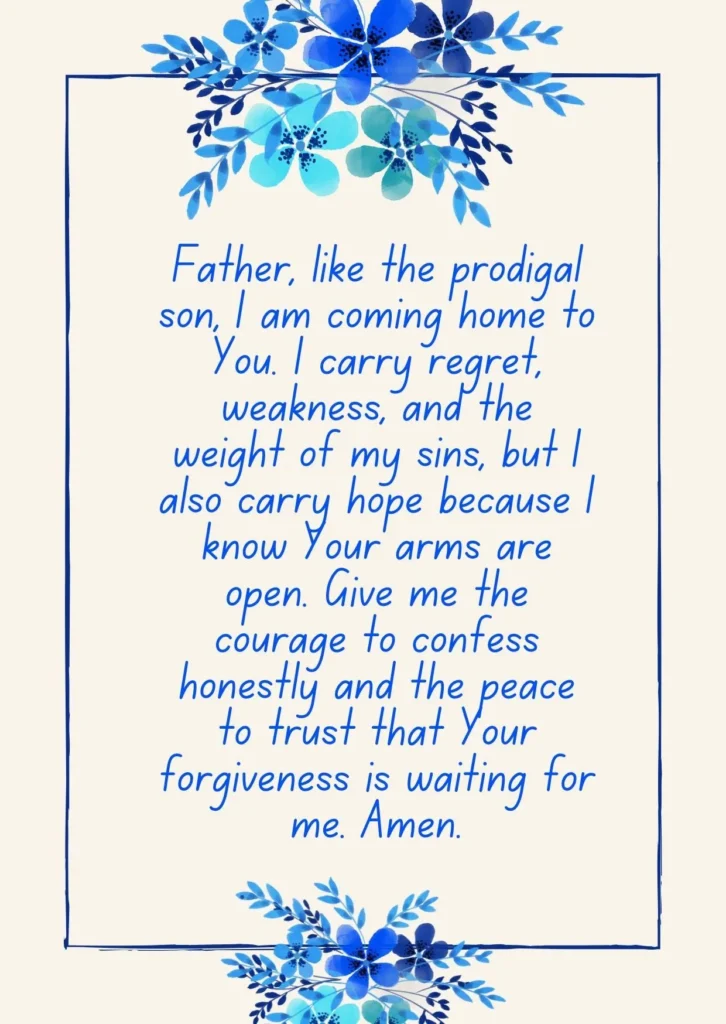
And then there is the story Jesus told in Luke 15, of a son who left his father, wasted everything, and came home rehearsing an apology he never even got to finish because his father was already running to meet him. If you are afraid that too much time has passed, that you’ve strayed too far, that you won’t be welcomed back the way you once were this story exists precisely for you. God is not waiting at a distance, arms crossed. He is already running toward you.
What Comes After: The Act of Contrition
After you’ve confessed and received your penance, you’ll be asked to pray an act of contrition a short prayer expressing genuine sorrow for your sins and a resolve, with God’s grace, not to repeat them. It’s the natural next step after the prayer before confession, and it deserves its own space to be prayed slowly and meant fully.
If you’d like the full traditional text of the Act of Contrition, along with its meaning and different versions used across parishes, you can find that here: Act of Contrition Prayer.
If You Are Not Catholic: Bringing Your Confession Directly to God
If you come from a Christian tradition that doesn’t include confession to a priest, please don’t feel this article has nothing for you. The heart behind it honesty before God, sorrow for sin, and trust in His mercy belongs to every believer, in every tradition.
Scripture is clear that we can bring our sins directly to God and be met with forgiveness. 1 John 1:9 doesn’t specify a confessional; it simply promises that confession, offered honestly, is met with faithfulness and cleansing. James 5:16 encourages believers to confess to one another and pray for one another, so that they may be healed a picture of confession as something meant to be shared in community, even outside a formal sacrament.
If that’s your tradition, you can still use the prayers on this page. Find a quiet place. Speak honestly to God about what weighs on you. Ask for a clean heart, the way David did in Psalm 51. And trust that the same mercy waiting in every confessional is waiting for you right where you are.
Frequently Asked Questions
What do you say before going into confession?
There’s no single required prayer – many people simply ask God for honesty and courage. A short prayer like the one above, asking Him to help you confess sincerely and trust His mercy, is enough.
Is there a specific prayer before confession?
There are several traditional prayers used before confession, but none is strictly required. What matters most is that the prayer is sincere whether you use a written prayer or speak to God in your own words.
What if I haven’t been to confession in years?
You are not the first, and the priest will not be surprised. Simply say so when you begin: “It has been [however long] since my last confession.” Many priests find these confessions especially meaningful, because they know what courage it takes to return.
What do you say at the start of confession?
Begin with the Sign of the Cross, then: “Bless me, Father, for I have sinned. It has been [amount of time] since my last confession.” From there, the priest will guide you.
Do you have to confess every sin by name?
You’re asked to confess mortal sins specifically and honestly, including roughly how often they occurred. If you’re unsure how to categorize something, simply describe it the priest will help you understand it, not judge you for asking.
What happens if I forget a sin?
Forgotten sins are not held against you. If you remember something afterward, you can simply mention it the next time you go to confession. God already knows your heart’s intention was to be honest.

Juganta Kumbhar is a Christian pastor, blogger, and content creator who serves in ministry and a local church. He holds a postgraduate degree and has spent significant time writing and publishing Christian and Bible-related content across multiple websites. He also volunteers in social work, believing a life poured out for others is never wasted. He created ChristianPrayerLife to share the life of Christ honestly and warmly the way one friend talks to another hoping every reader who visits feels a little less alone and a little closer to God.