
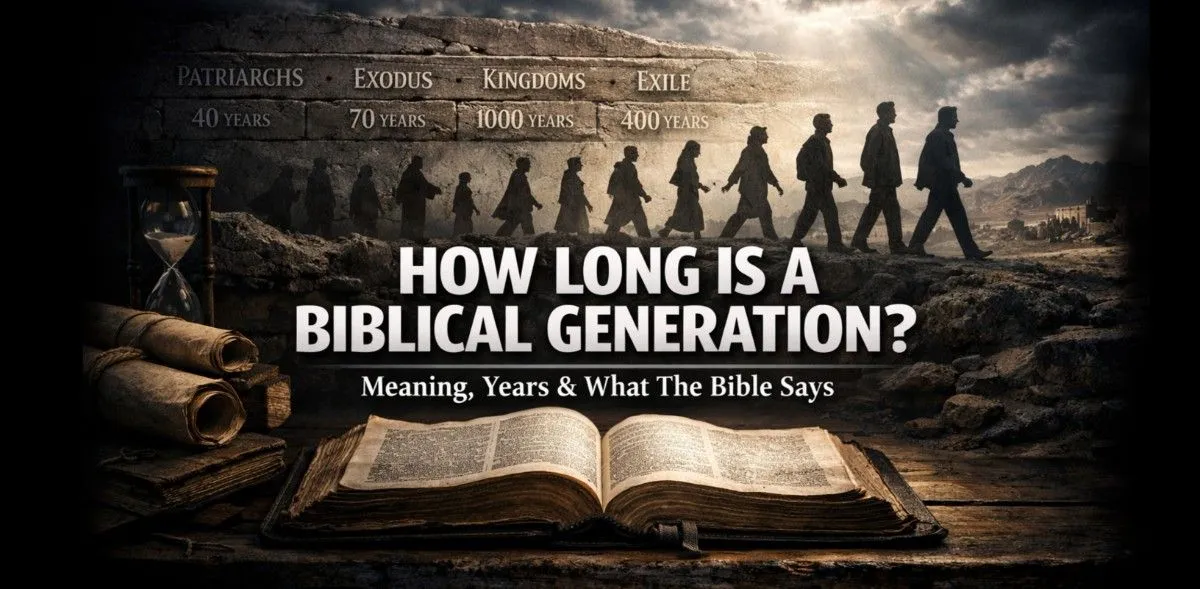
Many readers of the Bible ask an important question: how long is a biblical generation? The answer is not always as simple as a single number. In Scripture, the word generation can describe a group of people living at the same time, a family lineage, or a specific historical period in God’s plan.
Because of this, different passages suggest different lengths for a generation. Some biblical references point to 40 years, while others connect generations with the 70–80 year human lifespan mentioned in the Psalms. Understanding these differences requires looking carefully at biblical context, historical culture, and the way Scripture uses the term.
In this guide, we will explore what the Bible actually says, examine key verses, and explain how long a generation is in biblical terms.
What Does the Bible Mean by “Generation”?
Understanding how long is a biblical generation begins with knowing what the Bible actually means by the word generation. In Scripture, this term does not always refer to a fixed number of years. Instead, it often describes a group of people connected by time, family lineage, or shared historical experience.
Because of this broader meaning, the length of a biblical generation can vary depending on the context of the passage.
Definition of Generation in Biblical Language
In the Bible, the word generation commonly refers to a group of people born and living during the same period. It can also describe the descendants of a particular family line.
In the Old Testament, the Hebrew word “dor” is often translated as generation. This word can mean:
- A period of time when a group of people live
- A family lineage or descendants
- A historical era marked by certain events
For example, when Scripture speaks about the “generation of the righteous” or “this generation,” it often describes the people living at that time rather than a specific number of years.
Hebrew and Greek Words for Generation
Both the Old and New Testaments use specific words that shape how we understand the concept of generations.
In the Hebrew Old Testament, the word “dor” describes a cycle of life from parents to children. It focuses more on a group of people living together in the same era rather than a strict time measurement.
In the Greek New Testament, the word “genea” is used. This term can refer to:
- People living at the same time
- A family descent or lineage
- A historical generation witnessing certain events
For example, when Jesus said, “This generation will certainly not pass away until all these things have happened” (Matthew 24:34), He was referring to the people living during that period.
How Generations Were Viewed in Biblical Culture
In biblical times, generations were closely tied to family life and ancestry. Genealogies recorded in books like Genesis often list fathers, sons, and descendants to show how God’s promises moved from one generation to another.
Because people married younger and family structures were different, generational transitions could happen more quickly than today. At the same time, Scripture sometimes uses the word generation more symbolically to describe an era or group of people defined by their faith or lack of it.
For this reason, the Bible’s idea of a generation is not always a fixed number of years. Instead, it is often connected to people, lineage, and historical context.
How Long Is a Biblical Generation in Years?
After understanding the meaning of the word generation, the next question becomes practical: how long is a biblical generation in years? While the Bible does not define one exact number, several passages provide strong clues. By examining key Scriptures, many Bible scholars identify common timeframes such as 40 years or a lifespan of 70–80 years.
The specific length often depends on the context in which the Bible uses the word.
The 40-Year Generation in the Wilderness
One of the clearest examples of a biblical generation appears during Israel’s journey through the wilderness. After leaving Egypt, the Israelites wandered in the desert for 40 years before entering the Promised Land.
This period is often understood as the time it took for the original generation those who left Egypt in unbelief to pass away.
Numbers 32:13 describes this period clearly:
- God allowed Israel to wander in the wilderness for forty years
- The entire generation that had sinned against Him eventually died
- A new generation then entered the land God had promised
Because of this historical event, many Bible teachers consider 40 years a typical biblical generation, especially when Scripture describes a group of people living through a major period of testing or judgment.
Psalm 90:10 and the 70–80 Year Lifespan
Another important passage appears in Psalm 90:10, which speaks about the length of human life. The verse explains that the normal human lifespan is about 70 years, or 80 years for those with strength.
This verse provides a different perspective on generations. Instead of focusing on a historical period like the wilderness journey, it connects the idea of a generation with the average length of a person’s life.
Because of this, some scholars believe a biblical generation could represent:
- The lifespan of one group of people
- The time between the birth of parents and their children becoming adults
This interpretation places a generation closer to 70 years in some biblical contexts.
Why Some Scholars Use 70 Years for a Generation
Biblical scholars sometimes calculate generations using the average human lifespan described in the Psalms. Their reasoning is based on how societies move from one generation to the next through families.
For example:
- Parents raise children who eventually become adults
- Those children start their own families
- A new generation begins as leadership and influence shift
Because these transitions usually happen across a lifetime, some theologians view 70 years as a generational cycle in certain biblical interpretations.
However, it is important to remember that the Bible uses the word generation in different ways. In some passages it refers to a specific historical group, while in others it reflects a broader span of human life.
How Long Is a Generation Biblically?
When people ask how long is a generation biblically, they are often looking for one exact number. However, the Bible uses the term generation in several different ways. Sometimes it refers to a specific group of people living during the same time, while in other cases it points to a family lineage or a historical period.
Because of this, the biblical length of a generation is best understood by examining how the word is used in different passages.
Biblical Examples of Generational Cycles
The Bible frequently records generations through genealogies and historical accounts. These generational lists show how God’s promises and events unfold across time.
For example:
- The book of Genesis traces generations from Adam through many family lines.
- The genealogy of Abraham’s descendants shows how God’s covenant passed from one generation to another.
- The Gospel of Matthew records generations from Abraham to Jesus to demonstrate the fulfillment of prophecy.
These examples highlight that a generation can represent a sequence of family transitions, where children grow up and eventually become the parents of the next generation.
Differences Between Modern and Biblical Generations
Today, the word generation often describes groups such as Millennials or Generation Z. These categories usually represent a span of about 20 to 30 years.
Biblical usage, however, is broader. In Scripture, a generation may describe:
- People living during the same historical moment
- The descendants of a family line
- A time period marked by a specific spiritual condition
For instance, the Bible sometimes speaks about a faithful generation or a rebellious generation, focusing on the character of the people rather than the exact number of years.
Context Determines the Length of a Generation
One of the most important principles when studying biblical generations is context. The meaning of a generation changes depending on the passage.
In some situations, a generation may represent:
- A 40-year period, such as Israel’s wilderness generation
- A lifetime span, around 70–80 years
- A family transition, when children grow into adulthood and start new families
This flexibility shows that the Bible uses the word generation more as a descriptive concept than as a fixed timeline. Understanding the surrounding context helps readers interpret what the passage intends to communicate.
How Long Was a Generation in Biblical Times?
To understand how long is a generation in biblical times, it helps to look at the social and historical setting of the ancient world. Family life, lifespan, and cultural practices were very different from modern society. These factors influenced how generations formed and how quickly one generation replaced another.
By examining historical patterns in Scripture, we can better understand how generational timelines worked during biblical history.
Family Structure and Generational Gaps
In ancient biblical culture, families often formed earlier than they do today. People commonly married at a younger age and began raising children soon after. Because of this, generational transitions could occur more quickly.
For example:
- Parents might have children in their late teens or early twenties
- Those children would grow up and start families relatively early
- Leadership and responsibility within the family passed down sooner
In this type of social structure, a generation could sometimes be measured by the time between the birth of parents and the adulthood of their children.
Lifespans in Ancient Biblical History
The Bible records a wide range of lifespans, especially in the Old Testament. Early patriarchs in Genesis lived extraordinarily long lives, but later generations experienced more typical human lifespans.
Over time, lifespans became closer to what Psalm 90 describes around 70 to 80 years. As life expectancy stabilized, generational cycles also became more predictable.
Because of this, historians studying biblical timelines often consider both factors:
- Average lifespan
- Age at which people had children
Together, these elements shape how long a generation might last in historical terms.
Historical Context of Generations in Scripture
Biblical historians and scholars often estimate generational spans by analyzing genealogies recorded in Scripture. These genealogies show the sequence of fathers and sons across many centuries.
By studying these records, researchers can observe patterns in how generations progressed. In many cases, a generational transition occurred somewhere between 25 and 40 years, depending on the cultural and historical setting.
This historical perspective helps explain why the Bible sometimes associates generations with family lineage, while in other passages it connects them to major historical periods.
Key Bible Verses That Mention Generations
To fully understand how long is a biblical generation in the Bible, it is important to examine the passages where Scripture directly mentions generations. These verses help reveal how the Bible uses the term in historical, spiritual, and prophetic contexts.
Several key verses provide insight into how generations were understood in biblical times.
Psalm 90:10
Psalm 90:10 is one of the most frequently cited verses when discussing the length of human life. The passage explains that the average lifespan is seventy years, or eighty years for those who are strong.
This verse helps readers understand the general lifespan of people during later biblical history. Because of this, some interpreters connect the idea of a generation with the span of a person’s life.
The verse highlights two important ideas:
- Human life has a natural limit
- Each generation eventually gives way to the next
This perspective connects generations with the cycle of human life and time.
Numbers 32:13
Numbers 32:13 describes the period when Israel wandered in the wilderness after leaving Egypt. The passage explains that God allowed the people to wander for forty years until the entire generation that had sinned against Him had passed away.
This event is one of the clearest biblical examples of a forty-year generation. The people who left Egypt experienced the consequences of their unbelief, while their children became the new generation that eventually entered the Promised Land.
Because of this historical example, many Bible teachers refer to 40 years as a typical biblical generation in certain contexts.
Matthew 24:34
In the New Testament, Jesus used the term generation when speaking about future events. In Matthew 24:34, He stated that “this generation will certainly not pass away until all these things have happened.”
This statement has been widely discussed by theologians because it connects the idea of a generation with prophetic fulfillment.
In this context, the word generation likely refers to the group of people living at that time, rather than a fixed number of years. This shows again that biblical generations are often defined by people and historical moments, not only by exact timelines.
Genesis Genealogies
The book of Genesis records several genealogies that trace family lines across many generations. These lists show how descendants followed one another from fathers to sons.
Genealogies served several purposes in the Bible:
- They preserved family history
- They demonstrated the fulfillment of God’s promises
- They connected major biblical figures through lineage
By studying these genealogies, readers can observe how generations progressed over time and how God’s plan unfolded from one generation to the next.
To understand biblical timelines and God’s plan across generations, it helps to explore what heaven is really like according to the Bible and God’s promise for believers.
Why the Length of a Biblical Generation Matters
Understanding how long is a biblical generation is not only a historical question. It also helps readers interpret important parts of Scripture more clearly. When we understand how generations function in the Bible, many passages about history, prophecy, and spiritual legacy become easier to understand.
The concept of generations often reveals how God works through people over time.
Understanding Biblical Prophecy
In several prophetic passages, the Bible refers to a generation when describing future events. Because of this, the length of a generation can influence how readers interpret certain prophecies.
For example:
- Some prophecies speak about events happening within a particular generation
- Others describe how one generation will witness significant spiritual changes
When readers understand the biblical meaning of generations, they can approach these passages with greater clarity and avoid misinterpreting the timeline of events.
Interpreting Historical Biblical Events
Generations also help explain the timeline of major events recorded in Scripture. Many historical moments in the Bible unfold across several generations.
Examples include:
- The generations between Abraham and the nation of Israel
- The family lines that lead to King David
- The genealogies that connect the Old Testament to the birth of Jesus
By following these generational transitions, readers can see how God’s plan moved forward through history.
Lessons About Faith Across Generations
The Bible frequently emphasizes the importance of passing faith from one generation to the next. Parents were encouraged to teach their children about God’s laws, promises, and faithfulness.
Throughout Scripture, we see a repeating pattern:
- One generation experiences God’s works
- They teach the next generation about those experiences
- The knowledge of God continues through families and communities
This pattern shows that the idea of a biblical generation is not only about years. It is also about spiritual legacy, where faith and truth are shared with future generations.
FAQ Section
How long is a biblical generation in years?
A biblical generation is often understood as about 40 years, though some interpretations connect it to a 70–80 year lifespan mentioned in Psalm 90:10.
Is a biblical generation 40 years?
Many Bible teachers consider 40 years a generation because Israel’s wilderness generation lasted forty years.
What does the Bible mean by a generation?
In the Bible, a generation usually refers to a group of people living during the same period or a family lineage.
How long was a generation in biblical times?
In biblical times, a generation could range from about 25–40 years, depending on family and historical context.
Which Bible verse mentions a generation lasting 40 years?
Numbers 32:13 describes the wilderness generation that lasted forty years before Israel entered the Promised Land.
Conclusion
The question “how long is a biblical generation” does not have a single fixed answer because the Bible uses the term in several ways. In some passages, a generation refers to a group of people living at the same time, while in others it reflects family lineage or a historical period.
Biblical examples show that a generation is often connected with 40 years, especially in the story of Israel’s wilderness journey. At the same time, passages like Psalm 90:10 link generations with the 70–80 year human lifespan.
By understanding these contexts, readers can better interpret biblical history, prophecy, and the way God’s work continues from one generation to the next. The Bible ultimately emphasizes that every generation has the responsibility to know God, follow His truth, and pass faith on to those who come after them.

Juganta Kumbhar is a Christian pastor, blogger, and content creator who serves in ministry and a local church. He holds a postgraduate degree and has spent significant time writing and publishing Christian and Bible-related content across multiple websites. He also volunteers in social work, believing a life poured out for others is never wasted. He created ChristianPrayerLife to share the life of Christ honestly and warmly the way one friend talks to another hoping every reader who visits feels a little less alone and a little closer to God.