
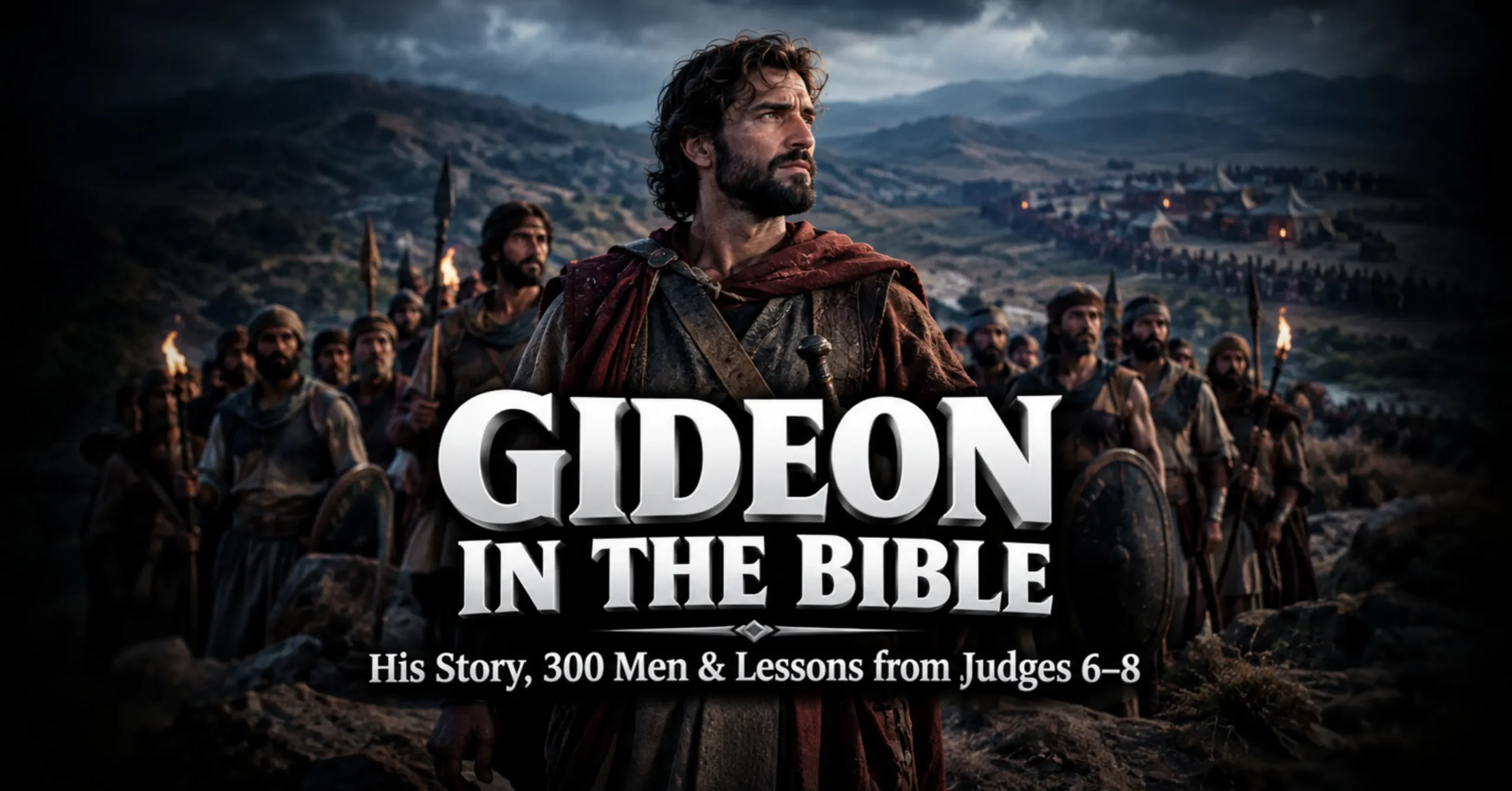
Gideon in the Bible was an Israelite judge whom God called to deliver Israel from Midianite oppression. His story is recorded mainly in Judges 6–8. God reduced Gideon’s army from 32,000 men to just 300 before giving Israel victory over Midian. Gideon is also named among the people of faith in Hebrews 11:32.
But Gideon’s story is about more than the famous battle with 300 men. He was afraid when God called him, questioned why Israel was suffering, asked God for signs, obeyed difficult commands, and later made choices that became a snare to him and his household.
Gideon was not a flawless hero. Judges 6–8 shows both his faith and his failures. At the same time, the story repeatedly points to God as the one who delivered Israel.
Who Was Gideon in the Bible?
Gideon was the son of Joash, an Abiezrite who lived in Ophrah. He belonged to the tribe of Manasseh. His story begins during a difficult period in Israel’s history, when the Midianites oppressed the Israelites for seven years (Judges 6:1–6).
The oppression was severe. Whenever the Israelites planted crops, Midianites, Amalekites, and other peoples from the east came into the land and destroyed the harvest. Israel became greatly impoverished, and the people cried out to the LORD for help (Judges 6:6).
Gideon was one of Israel’s judges, whom God raised up to deliver His people from oppression. Yet when we first meet him, he is not standing on a battlefield. He is threshing wheat in a winepress to keep it from the Midianites (Judges 6:11).
That gives us an important picture of Gideon from the beginning. He was not introduced as a fearless warrior. He was a man living under oppression and trying to protect the wheat from his enemies.
Where Is Gideon’s Story Found in the Bible?
The main account of Gideon’s life is found in Judges 6–8.
- Judges 6 describes Israel’s oppression, Gideon’s calling, the destruction of Baal’s altar, and the fleece.
- Judges 7 describes the reduction of Gideon’s army to 300 men and the defeat of Midian.
- Judges 8 describes Gideon’s pursuit of the Midianite kings, his conflict with Succoth and Penuel, the ephod, his family, and his death.
- Judges 9 tells what happened with Abimelech, one of Gideon’s sons, after Gideon’s death.
- Hebrews 11:32 names Gideon among several people remembered for faith.
Why Did God Call Gideon?
Before Gideon went to fight Midian, the LORD confronted Israel’s disobedience. After the people cried out, the LORD sent a prophet who reminded them that He had delivered them from Egypt and given them the land. The prophet then confronted Israel for not obeying the LORD’s commands (Judges 6:7–10).
After that, the angel of the LORD came to Gideon while he was threshing wheat in the winepress.
The angel said:
“The LORD is with you, mighty warrior.”
– Judges 6:12 (NIV)
Gideon’s response reveals his concerns. He questioned why Israel was suffering and asked where the miracles of previous generations had gone (Judges 6:13).
He also pointed to his family’s weakness and his own low position within his father’s household:
“My clan is the weakest in Manasseh, and I am the least in my family.”
– Judges 6:15 (NIV)
God’s answer was not a long explanation of why Gideon should feel powerful. Instead, God promised His presence:
“I will be with you.”
– Judges 6:16 (NIV)
That promise becomes central to Gideon’s calling. The victory would not depend on Gideon’s natural strength.
“The LORD Is With You, Mighty Warrior”
The phrase “mighty warrior” should not be read as though Gideon had already become a fearless military leader.
The story has just introduced a man hiding his wheat from Midian. Gideon is questioning Israel’s suffering and wondering why God seems absent.
Yet God calls him to go in the strength he has and promises to be with him (Judges 6:14–16).
Gideon’s story therefore begins with a tension that continues throughout Judges 6–8: he is afraid and uncertain, yet God calls him to obey.
What Does the Name Gideon Mean?
The name Gideon is commonly associated with the idea of cutting down or hewing. That meaning should not be confused with the phrase “mighty warrior” in Judges 6:12.
“Mighty warrior” is part of God’s greeting to Gideon. It is not simply a definition of his name.
Gideon Tears Down Baal’s Altar
Before Gideon would fight Midian, God dealt with idolatry in Gideon’s own community.
God told Gideon to tear down his father’s altar to Baal and cut down the Asherah pole beside it. He was then told to build an altar to the LORD and offer a sacrifice there (Judges 6:25–26).
Gideon obeyed, but he did it at night because he was afraid of his family and the people of the town (Judges 6:27).
When the townspeople discovered what had happened, they wanted Gideon killed. His father, Joash, answered by challenging Baal himself: if Baal was truly a god, he could defend his own altar (Judges 6:28–31).
Gideon was then called Jerub-Baal, a name connected with the challenge to Baal (Judges 6:32).
The scene gives us another honest picture of Gideon. Fear was present, but it did not stop him from obeying God’s command.
Why Did Gideon Use a Fleece?
One of the best-known parts of Gideon’s story is the fleece.
Before the battle, Gideon asked God for a sign to confirm His promise. He placed a fleece on the threshing floor and asked that dew be found on the fleece while the ground around it remained dry. God did so.
Gideon then asked for the opposite sign: that the fleece remain dry while the ground became covered with dew. God did that as well (Judges 6:36–40).
The passage is clear about what happened. Gideon asked for signs, and God answered him.
The more difficult question is how Christians should understand the event.
What Did Gideon Ask God to Do?
Gideon was preparing to move against the Midianites, and he asked God to confirm His promise.
First, he asked for a wet fleece and dry ground. Then he asked for a dry fleece and wet ground.
The Bible records both requests and God’s response (Judges 6:36–40). It does not, however, say that Gideon used the fleece because his faith was weak.
Some readers understand the fleece as evidence of Gideon’s uncertainty or fear. Others emphasize God’s patience in responding to him. These are interpretations of the passage rather than statements the text makes directly.
A careful reading recognizes what Scripture records without turning Gideon’s experience into a formula for guidance.
Does Gideon’s Fleece Mean Christians Should Test God?
Gideon’s fleece is a biblical event, but Judges 6 does not command Christians to use fleeces as a normal way of discovering God’s will.
The passage tells us what Gideon did. It does not give believers a general instruction to place conditions before God and wait for a supernatural sign before making decisions.
Christians can learn from Gideon’s honesty without turning his experience into a formula.
When facing difficult decisions, Scripture points believers toward prayer, wisdom, obedience to God’s revealed Word, and faithful dependence on Him rather than a demand for signs.
How Gideon’s 300 Men Defeated the Midianites
Gideon’s force numbered 32,000 men before God began reducing it.
God told Gideon that the army was too large. If Israel won with such a large force, the people might boast that their own strength had saved them (Judges 7:2).
So the army was reduced:
32,000 → 22,000 leave → 10,000 remain → 300 remain
First, Gideon announced that anyone who was afraid could leave. Twenty-two thousand men went home, leaving 10,000 (Judges 7:3).
God then reduced the number again through a test at the water. The passage records how the men drank, and God selected 300 men. Gideon sent the rest home (Judges 7:4–8).
The text does not say that the 300 were chosen because they were better soldiers, more alert, or more courageous. Those explanations should not be presented as though Judges 7 directly teaches them.
The reason God gives for reducing the army is much clearer: Israel’s victory needed to show that the LORD, not Israel’s strength, had delivered them.
Gideon Was Still Afraid
Before the attack, God told Gideon that if he was afraid, he should go down to the Midianite camp with his servant Purah and listen to what the soldiers were saying (Judges 7:9–11).
Gideon went.
There he heard a Midianite soldier telling another man about a dream involving a loaf of barley bread tumbling into the camp and overturning a tent. The other soldier interpreted the dream as a sign that God had given Midian into Gideon’s hands (Judges 7:13–14).
When Gideon heard the dream and its interpretation, he worshiped God.
Then he returned to the Israelite camp and said that the LORD had given the Midianite army into their hands (Judges 7:15).
That moment is easy to overlook, but it shows something important about Gideon. His fear was still present, yet he responded to God’s reassurance with worship and obedience.
The Battle With Trumpets, Jars, and Torches
Gideon divided the 300 men into three groups. Each man carried a trumpet, an empty jar, and a torch inside the jar (Judges 7:16).
At Gideon’s command, the men blew their trumpets, broke the jars, revealed the torches, and shouted. The Midianite camp was thrown into confusion.
Judges 7 says that the LORD caused the men in the camp to turn against one another with their swords. The Midianites fled, and the Israelites pursued them.
The battle was not presented as a triumph of superior military strength. The account points to God’s promise to deliver Israel.
Why Did God Use Only 300 Men?
Judges 7 gives the main reason.
God did not want Israel to say, “My own strength has saved me” (Judges 7:2).
The small force made it clear that Israel’s victory did not come from military numbers.
The famous 300 men are memorable, but the deeper point is God’s deliverance. The story directs attention away from Gideon’s strength and toward the LORD’s power to save.
What Happened to Gideon After the Victory?
The victory over Midian did not end Gideon’s story.
Gideon and his 300 men continued pursuing Zebah and Zalmunna, the kings of Midian. The men were exhausted, but they kept pursuing them (Judges 8:4).
Gideon and the Ephraimites
The men of Ephraim were angry because Gideon had not called them to fight earlier.
Gideon pointed to what Ephraim had already accomplished, especially the capture of the Midianite leaders Oreb and Zeeb (Judges 8:1–3).
His response eased their anger.
This brief exchange shows Gideon dealing with conflict within Israel while the pursuit of the Midianite kings continued.
Succoth and Penuel Refuse to Help
Gideon and his men came to Succoth while pursuing the Midianite kings. Gideon asked the people there for bread because his men were exhausted.
The officials of Succoth refused, pointing out that Zebah and Zalmunna had not yet been captured (Judges 8:4–6).
Gideon then went to Penuel and made the same request. The people there also refused.
Gideon warned them about what would happen when he returned (Judges 8:7–9).
After capturing Zebah and Zalmunna, Gideon returned. Judges 8 records that he punished the men of Succoth and tore down the tower at Penuel, killing the men of the town (Judges 8:13–17).
This is a difficult part of the story, and Scripture does not hide what Gideon did.
Gideon Captures Zebah and Zalmunna
Gideon eventually caught the Midianite kings Zebah and Zalmunna.
Judges 8:10 says that about 15,000 men remained with them at that point, while 120,000 swordsmen had already fallen.
These numbers should be reported carefully. Scripture gives these figures at this stage of the pursuit, so we should not simply describe the original Midianite army as exactly 135,000 men.
Gideon questioned Zebah and Zalmunna about the men they had killed at Tabor. They answered that those men had been like Gideon himself.
Gideon then explained that if those men had lived, he would not have killed the two kings (Judges 8:18–21).
This gives Gideon’s stated reason in the passage without adding a motive that Scripture does not explicitly give.
Did Gideon Become King?
After the victory, the Israelites asked Gideon to rule over them. They wanted Gideon, his son, and his grandson to rule because they believed Gideon had saved them from Midian (Judges 8:22).
Gideon refused:
“I will not rule over you… The LORD will rule over you.”
– Judges 8:23 (NIV)
His refusal to become king is clear. But Judges 8 gives a more complicated picture of his later life.
Gideon collected gold, made an ephod, had many wives, and had 70 sons. His life after the victory was therefore not simply a continuation of the moment when he refused the throne.
What Was Gideon’s Ephod, and Why Did It Become a Snare?
After refusing kingship, Gideon asked the Israelites to give him gold earrings taken from the spoil of battle.
The gold weighed 1,700 shekels. Gideon used it to make an ephod and placed it in Ophrah (Judges 8:24–27).
The Bible does not give enough detail to confidently reconstruct exactly what this ephod looked like or how it functioned.
What Scripture does tell us is clear: Judges 8:27 says that Israel went astray after it and that the ephod became a snare to Gideon and his household.
The ephod therefore became a spiritual danger.
Two later statements also need to be kept separate.
Judges 8:27 says the ephod became a snare.
Judges 8:33 says that after Gideon’s death, the Israelites again turned to the Baals and made Baal-Berith their god.
The text does not directly say that the ephod caused this later Baal worship.
Gideon’s story therefore carries a serious warning. A person can experience a remarkable work of God and still make choices later that bring spiritual trouble.
Gideon’s Family, 70 Sons, and Abimelech
Gideon’s family was large.
Judges 8:30 says Gideon had many wives and 70 sons. He also had a concubine in Shechem whose son was named Abimelech (Judges 8:31).
Abimelech becomes the central figure of Judges 9.
After Gideon’s death, Abimelech sought power in Shechem. He killed his brothers, with one exception, and the people of Shechem made him their ruler. Judges 9 records the violent story of Abimelech’s rise and eventual downfall.
It would be too simple to say that Gideon’s many wives caused Abimelech’s rebellion. Scripture does not make that claim.
What the text does show is that Gideon’s family became deeply troubled after his death.
What Happened to Gideon?
Gideon eventually died at a good old age and was buried in the tomb of his father Joash at Ophrah (Judges 8:32).
Judges 8:28 says that the land had peace for 40 years in Gideon’s days.
But after Gideon died, the Israelites turned away from the LORD again. They worshiped the Baals and failed to remember the LORD who had delivered them from their enemies (Judges 8:33–35).
The ending keeps Gideon’s story from becoming a simple success story. His victory was real, but Israel’s deeper spiritual problem had not disappeared.
What Does Gideon’s Story Teach Us?
Gideon’s story gives Christians several lessons, but those lessons are most useful when they stay connected to what actually happened in Judges 6–8.
God Can Work Through Someone Who Feels Weak
When God called Gideon, Gideon did not see himself as an important or powerful man. He pointed to his family’s weakness and his own low position (Judges 6:15).
God’s response focused on His presence: “I will be with you” (Judges 6:16).
Gideon did not succeed because he suddenly discovered natural strength. God called him, stayed with him, and used him to deliver Israel.
If you are struggling with weakness or self-doubt, these Bible verses about confidence can remind you to place your confidence in God.
Fear Does Not Always Prevent Obedience
Gideon was afraid when he tore down Baal’s altar. He was also afraid before the battle, and God gave him permission to go down to the Midianite camp if he needed reassurance (Judges 7:10–11).
Gideon went.
He listened to the dream, worshiped God, and returned to lead the 300 men.
The account gives us a more honest picture of courage. Courage does not always mean feeling no fear. Sometimes obedience happens while fear is still present.
If you are facing fear or uncertainty yourself, these Bible verses about trusting God through fear can offer encouragement from Scripture.
A Great Victory Does Not Remove the Need for Faithfulness
Gideon saw God give Israel a remarkable victory.
Yet later, the ephod he made became a snare to him and his household (Judges 8:27).
His earlier obedience was real, and so was the later trouble.
His story reminds us that a season of spiritual victory does not make someone incapable of making poor choices later. Faithfulness still matters after the battle is over.
Was Gideon a Man of Faith?
Yes. Gideon is explicitly named among the people of faith in Hebrews 11:32.
But Hebrews 11 does not present him as a flawless example.
Judges 6–8 gives the fuller picture. Gideon trusted God enough to obey difficult commands, lead Israel into battle, and continue the pursuit of Midian. He also asked for signs, struggled with fear, and later made choices that became a snare to his household.
Hebrews 11 remembers Gideon for his faith without erasing the difficult parts of his story.
That is one of the helpful things about reading the whole biblical account. The Bible can recognize genuine faith without pretending that God’s servants never failed.
Gideon’s story ultimately points beyond his own strength. Judges 6–8 repeatedly emphasizes God’s role in delivering Israel. Gideon was an instrument in that story, not the ultimate source of the victory.
Frequently Asked Questions About Gideon
Who was Gideon in the Bible?
Gideon was an Israelite from the tribe of Manasseh whom God raised up to deliver Israel from Midianite oppression. His main story is found in Judges 6–8, and Hebrews 11:32 names him among the people remembered for faith.
How many men did Gideon have?
Gideon began with 32,000 men. After 22,000 left because they were afraid, 10,000 remained. God then reduced the force to 300 through the test involving the water (Judges 7:2–7).
Why did Gideon use a fleece?
Gideon asked God for signs involving a fleece. First, he asked for the fleece to be wet while the ground remained dry. Then he asked for the fleece to be dry while the ground was wet. God granted both requests (Judges 6:36–40).
The passage records Gideon’s experience but does not command Christians to use fleeces as a normal way of discovering God’s will.
What happened to Gideon after the battle?
Gideon continued pursuing the Midianite kings Zebah and Zalmunna. Israel later asked him to rule over them, but he refused and said that the LORD would rule over them. Later, the ephod he made became a snare to him and his household (Judges 8:22–27).
Did Gideon become king?
No. Israel asked Gideon to rule over them, but he refused, saying, “The LORD will rule over you” (Judges 8:23).
What happened to Gideon’s ephod?
Gideon made an ephod from gold taken from the battle spoils and placed it in Ophrah. Judges 8:27 says that Israel went astray after it and that it became a snare to Gideon and his household.
The Bible does not give enough detail to confidently describe exactly what the ephod looked like.
Conclusion
Gideon’s story is much bigger than the 300 men who defeated Midian.
Judges 6–8 shows a man who was afraid, questioned God, obeyed difficult commands, experienced an extraordinary victory, and later made choices that brought trouble to his household. Scripture neither hides his failures nor ignores his faith.
The focus is not Gideon’s natural strength. God reduced the army so Israel would know that the victory came from Him.
For Christians, Gideon’s story offers a grounded picture of faith: fear may still be present, but obedience is possible. Even after a great victory, we still need to walk faithfully with God.

Juganta Kumbhar is a Christian pastor, blogger, and content creator who serves in ministry and a local church. He holds a postgraduate degree and has spent significant time writing and publishing Christian and Bible-related content across multiple websites. He also volunteers in social work, believing a life poured out for others is never wasted. He created ChristianPrayerLife to share the life of Christ honestly and warmly the way one friend talks to another hoping every reader who visits feels a little less alone and a little closer to God.