
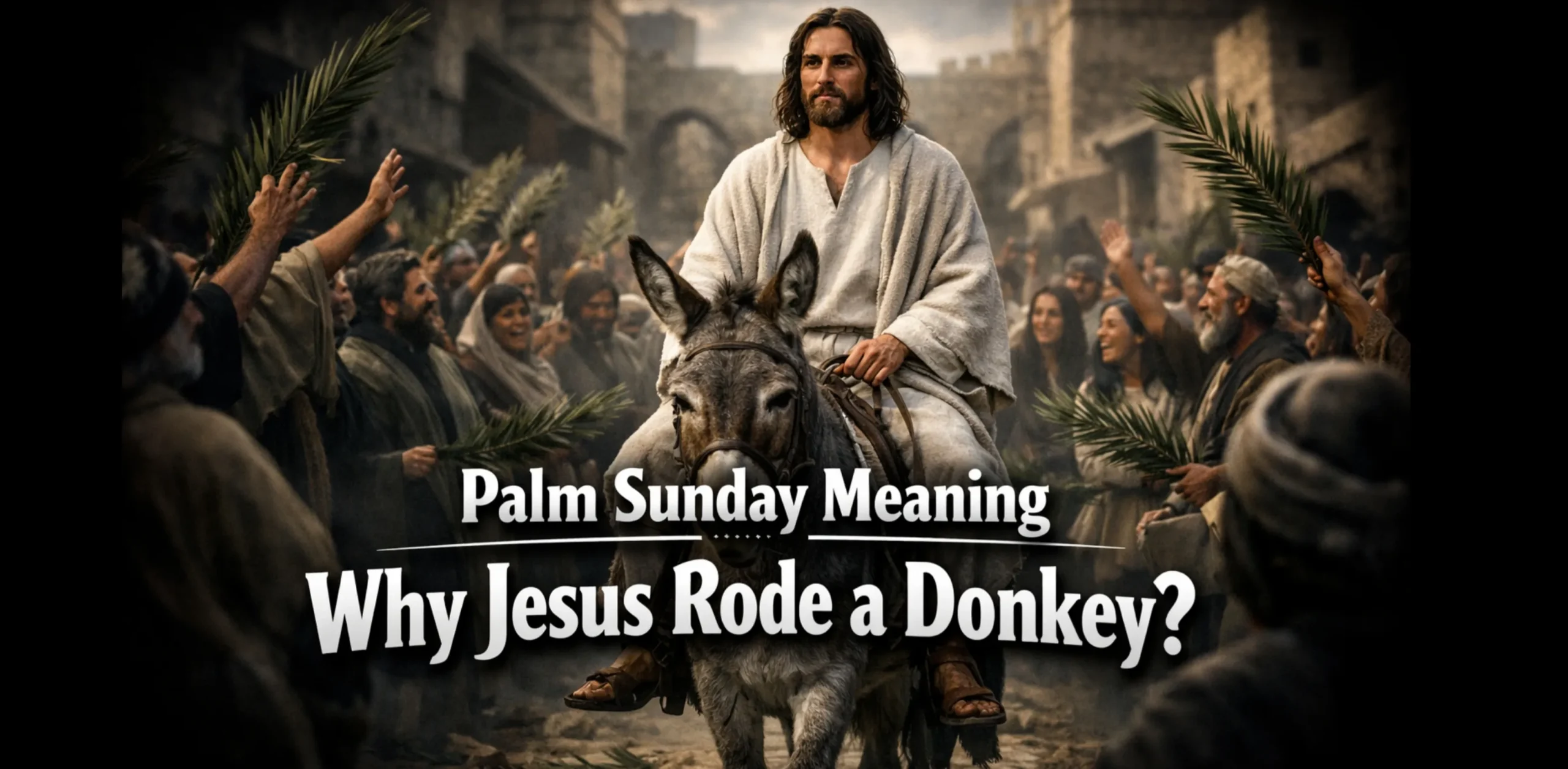
Palm Sunday meaning is one of the most searched questions during Holy Week, yet many people still feel confused about its true significance. What actually happened on this day, and why does it matter for Christians today?
In simple terms, Palm Sunday marks the moment Jesus entered Jerusalem and was welcomed as a king but in a way no one expected. This event is not just historical; it carries deep spiritual meaning connected to humility, peace, and faith. In this guide, you’ll discover the true meaning of Palm Sunday, its biblical foundation, and the powerful symbolism behind the palms and the donkey explained clearly without confusion.
What Does Palm Sunday Mean?
Simple Definition of Palm Sunday
Palm Sunday is the day Christians remember Jesus’ entry into Jerusalem, where people welcomed Him by laying palm branches and praising Him as King.
In simple words, the Palm Sunday meaning is about recognizing Jesus as the promised Savior but also understanding that His kingdom is not worldly. Instead of power and dominance, it represents peace, humility, and salvation.
Many people search “what does Palm Sunday mean” because they want a clear answer without complex theology. At its core, it is a moment of celebration mixed with deeper spiritual truth Jesus is honored publicly, yet His mission is far greater than what the crowd expected.
Why It Marks the Beginning of Holy Week
Palm Sunday is not just an isolated event it begins Holy Week, the most important period in Christianity leading up to Easter.
This day sets the stage for everything that follows:
- Jesus is welcomed as King
- The same crowd later turns against Him
- It leads to His crucifixion and resurrection
This contrast is key to understanding the meaning of Palm Sunday. It shows how quickly human expectations can change and highlights the deeper purpose of Jesus’ mission.
For believers today, Palm Sunday is both a celebration and a reminder to truly understand who Jesus is, not just follow Him in moments of excitement.
Palm Sunday Meaning in the Bible
The Story of Jesus Entering Jerusalem
The Palm Sunday meaning in the Bible comes directly from the Gospel accounts especially Gospel of Matthew (chapter 21) and Gospel of John (chapter 12).
As Jesus approached Jerusalem, He rode into the city on a donkey. People gathered around Him, spreading their cloaks and palm branches on the road. They shouted “Hosanna,” which means save us now, recognizing Him as the long-awaited Messiah.
This moment is powerful because:
- Jesus openly allowed Himself to be called King
- The crowd responded with joy and expectation
- It fulfilled what had been prophesied centuries earlier
But there’s a deeper layer most people expected a political savior, not a spiritual one.
Biblical Meaning of Palm Sunday
The biblical meaning of Palm Sunday goes beyond celebration. It reveals who Jesus truly is and what kind of King He came to be.
Instead of arriving with power and armies, Jesus chose humility. Instead of overthrowing rulers, He came to transform hearts. This shows that His kingdom is not based on force, but on peace and truth.
Palm Sunday also fulfills the prophecy from Book of Zechariah (9:9), which describes a king coming gently, riding on a donkey. This confirms that Jesus’ actions were intentional and deeply symbolic.
In essence, the Palm Sunday meaning in the Bible teaches that:
- Jesus is the promised King
- His mission is spiritual, not political
- True salvation comes through humility and sacrifice
Why Did Jesus Ride a Donkey?
Symbol of Humility and Peace
One of the most important parts of the Palm Sunday story is that Jesus chose to ride a donkey not a horse. This was not random; it carried a clear message.
In ancient times:
- Kings rode horses when going to war
- Kings rode donkeys when coming in peace
By choosing a donkey, Jesus showed that He was a King of peace, not conflict. This directly shapes the deeper understanding of Palm Sunday it’s not about power or control, but about humility and love.
For modern readers, this answers a common question: why did Jesus ride a donkey?
Because His kingdom is built on serving others, not ruling over them.
Fulfillment of Prophecy
Jesus’ decision also fulfilled a well-known prophecy from Book of Zechariah (9:9), which described a king arriving “gentle and riding on a donkey.”
This detail proves that:
- Jesus’ actions were intentional, not accidental
- He was fulfilling Scripture step by step
- His identity as the Messiah was being revealed publicly
This moment connects the Old Testament promises with their fulfillment in Jesus, strengthening the biblical meaning of Palm Sunday.
It also shows that what looked simple on the surface actually carried deep spiritual significance.
Meaning of Palms on Palm Sunday
What Do Palm Branches Represent?
The palm branches used on Palm Sunday were not just decoration they carried strong cultural and spiritual meaning.
In biblical times, palms were symbols of:
- Victory – used to celebrate triumph
- Honor – given to kings and heroes
- Joy and celebration – marking important events
So when people laid palm branches before Jesus, they were honoring Him as a victorious King. This helps explain the meaning of palms on Palm Sunday it was an act of recognition and praise.
However, many people misunderstood the type of victory Jesus came to bring. They expected political freedom, while Jesus came to offer spiritual salvation.
Spiritual Meaning for Christians Today
Today, the palm branches still carry deep meaning for believers.
They represent:
- Welcoming Jesus into one’s life
- Surrendering to His authority
- Celebrating His presence with faith
This answers the common question: what do the palms mean on Palm Sunday?
They are a symbol of both honor and personal commitment.
Palm Sunday is not just about remembering history it’s about reflecting on how we respond to Jesus today. Do we follow Him only in celebration, or also in faith and obedience?
The Real Meaning Behind Palm Sunday
Lesson of Humility
Palm Sunday teaches us that true greatness is found in humility. Jesus entered Jerusalem as a King, yet He chose a donkey instead of a horse. This act reminds believers that spiritual leadership is about serving others, not seeking power.
Humility is at the heart of the Palm Sunday meaning Jesus showed that even a King bows to God’s will and puts others first.
Lesson of True Kingship
The crowds hailed Jesus as King, but His kingdom was unlike any earthly kingdom. This day shows that true kingship is measured by love, sacrifice, and peace, not political influence or military strength.
Believers are encouraged to understand that Jesus’ authority is spiritual, guiding hearts rather than governments.
Lesson of Faith
Palm Sunday also reminds us to trust Jesus fully. The people celebrated Him publicly, but faith means following Him even when it’s not easy or popular.
For Christians today, the real meaning behind Palm Sunday is:
- Recognizing Jesus’ humble yet powerful authority
- Learning to live with faith and integrity
- Reflecting on the spiritual victory He brings
This section ties together the symbolism, biblical fulfillment, and practical lessons, giving readers a clear, actionable understanding of Palm Sunday.
FAQs
What does Palm Sunday mean?
Palm Sunday meaning is Jesus’ entry into Jerusalem, marking humility, peace, and the start of Holy Week
What is the biblical meaning of Palm Sunday?
Palm Sunday meaning in the Bible shows Jesus fulfilling prophecy as the spiritual King.
Why did Jesus ride a donkey?
Jesus rode a donkey to symbolize humility and peace, fulfilling Zechariah’s prophecy.
What do palm branches symbolize?
Palms represent victory, honor, and welcoming Jesus into one’s life.
Why is Palm Sunday important?
Palm Sunday meaning emphasizes faith, spiritual kingship, and preparation for Easter.
Conclusion
In summary, the Palm Sunday meaning is deeply rooted in Jesus’ entry into Jerusalem, highlighting His humility, spiritual kingship, and fulfillment of biblical prophecy. By understanding the biblical meaning of Palm Sunday and the symbolism of palms, believers can reflect on lessons of faith, humility, and peace. Today,
Palm Sunday reminds Christians to welcome Jesus into their lives, honor His spiritual authority, and celebrate the profound truth behind this significant day.