
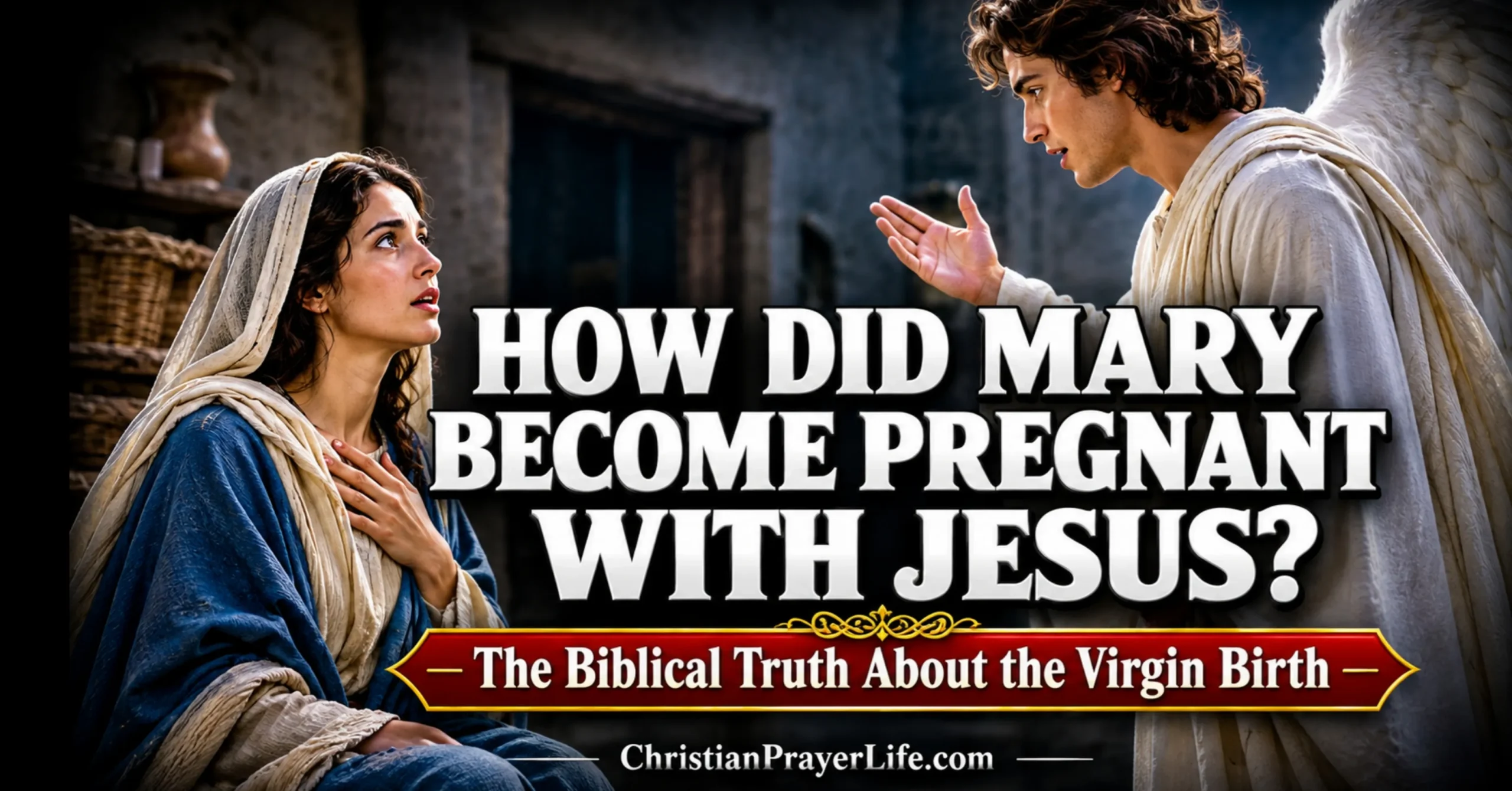
How Did Mary Get Pregnant With Jesus? The Bible gives a clear answer: Mary conceived through the power of the Holy Spirit while she was still a virgin. Both Luke and Matthew describe this miracle from different perspectives. Luke records the angel Gabriel’s announcement to Mary, while Matthew explains what God revealed to Joseph about her pregnancy.
Neither Gospel explains the physical process of Jesus’ conception. Both identify the Holy Spirit as the one at work.
What Luke Says About How Mary Conceived Jesus (Luke 1:26–38)
Luke begins his account in Nazareth, a town in Galilee. God sends the angel Gabriel to Mary, a virgin who was betrothed to Joseph, a descendant of David.
Luke describes her this way:
“To a virgin espoused to a man whose name was Joseph, of the house of David; and the virgin’s name was Mary.” (Luke 1:27, KJV)
The word espoused means betrothed or formally pledged to be married. In Jewish society, betrothal was a binding commitment, not simply an informal promise to marry. This helps explain why Matthew later describes Joseph considering putting Mary away (Matthew 1:19).
Gabriel Announces the Birth of Jesus (Luke 1:28–33)
Gabriel greets Mary and tells her that she has found favour with God. Mary is troubled by his words, but the angel tells her not to be afraid. He then announces that she will have a son:
“And, behold, thou shalt conceive in thy womb, and bring forth a son, and shalt call his name JESUS.” (Luke 1:31, KJV)
Gabriel also tells Mary that her son will be called “the Son of the Highest.” God will give Him the throne of His father David, and His kingdom will have no end (Luke 1:32–33). These words connect Jesus with God’s promise to David and describe His everlasting kingdom. You can learn more about David and his place in the Bible.
After hearing the angel’s announcement, Mary asks how this can happen since she is a virgin.
Mary Asks, “How Shall This Be?” (Luke 1:34)
Mary responds with a question:
“Then said Mary unto the angel, How shall this be, seeing I know not a man?” (Luke 1:34, KJV)
In this passage, the expression “know not a man” refers to sexual relations. Mary is explaining that she has not had sexual relations with a man. Her question is how she can conceive under these circumstances.
The Holy Ghost Shall Come Upon Thee (Luke 1:35)
Luke 1:35 gives the central biblical answer to how Mary conceived Jesus:
“And the angel answered and said unto her, The Holy Ghost shall come upon thee, and the power of the Highest shall overshadow thee: therefore also that holy thing which shall be born of thee shall be called the Son of God.” (Luke 1:35, KJV)
Gabriel explains that the Holy Ghost, or Holy Spirit, will come upon Mary and the power of the Highest will overshadow her. This describes God’s divine action in bringing about Jesus’ conception.
The word overshadow does not describe a sexual act or explain a biological process. Luke tells us that Mary conceived through God’s power, but he does not explain the physical details.
The word therefore connects the angel’s explanation with the child’s identity: the one born to Mary would be called the Son of God. Luke presents Jesus’ conception as the work of the Holy Spirit and identifies Him as God’s Son.
Some people ask how the Holy Spirit impregnated Mary. The Bible does not describe this as human reproduction or present the Holy Spirit as a human father. It simply tells us that Mary conceived through God’s miraculous power without explaining the physical mechanism.
Mary Responds to God’s Message (Luke 1:36–38)
Gabriel then tells Mary about her relative Elisabeth. Although Elisabeth had been unable to have children, she had conceived a son in her old age and was already in her sixth month of pregnancy (Luke 1:36).
Gabriel gives Mary this assurance:
“For with God nothing shall be impossible.” (Luke 1:37, KJV)
Mary replies:
“And Mary said, Behold the handmaid of the Lord; be it unto me according to thy word. And the angel departed from her.” (Luke 1:38, KJV)
A handmaid is a female servant. By calling herself the Lord’s handmaid, Mary expresses her willingness to serve God’s purpose. Her words also show her trust in the message Gabriel has delivered.
Mary’s response is sometimes discussed in connection with her willingness to have Jesus. Luke records her answer directly: “Be it unto me according to thy word.” The passage presents her response as an expression of faith and submission to God’s message.
Luke then describes Mary’s visit to Elisabeth and records her song of praise (Luke 1:39–56).
What Matthew Says About Mary’s Pregnancy (Matthew 1:18–25)
Luke records the announcement made to Mary. Matthew adds Joseph’s perspective, describing how he responded when he learned that Mary was pregnant.
Mary Was Found With Child Before They Came Together (Matthew 1:18)
Matthew introduces the birth of Jesus with these words:
“Now the birth of Jesus Christ was on this wise: When as his mother Mary was espoused to Joseph, before they came together, she was found with child of the Holy Ghost.” (Matthew 1:18, KJV)
Mary was betrothed to Joseph when she was found to be pregnant. The phrase “before they came together” indicates that they had not yet had marital relations. Matthew later states that Joseph did not know Mary before she gave birth (Matthew 1:25).
Matthew does not explain how Joseph first learned about the pregnancy or describe a conversation between them. Instead, he focuses on the fact that Mary was with child of the Holy Ghost.
Why Joseph Planned to Put Mary Away Privately (Matthew 1:19)
Matthew next describes Joseph’s response:
“Then Joseph her husband, being a just man, and not willing to make her a publick example, was minded to put her away privily.” (Matthew 1:19, KJV)
Matthew calls Joseph a just man. He did not want to make Mary a public example, so he considered ending their betrothal quietly.
In Jewish society, betrothal was a binding commitment. Ending it required a formal separation, rather than simply calling off a modern engagement. Matthew’s words “put her away” refer to ending that commitment.
The Gospel does not tell us how Joseph first learned about Mary’s pregnancy or what she may have said to him. Matthew focuses instead on Joseph’s decision and the message he receives from the angel.
The Angel Explains the Holy Spirit’s Role (Matthew 1:20–21)
While Joseph was thinking about what to do, the angel of the Lord appeared to him in a dream:
“But while he thought on these things, behold, the angel of the Lord appeared unto him in a dream, saying, Joseph, thou son of David, fear not to take unto thee Mary thy wife: for that which is conceived in her is of the Holy Ghost.” (Matthew 1:20, KJV)
The angel tells Joseph not to be afraid to take Mary as his wife because the child conceived in her is of the Holy Ghost. This message explains why Joseph should not end their betrothal.
The angel then tells Joseph what to name the child and explains His mission:
“And she shall bring forth a son, and thou shalt call his name JESUS: for he shall save his people from their sins.” (Matthew 1:21, KJV)
Joseph is instructed to name the child Jesus because He will save His people from their sins. Matthew connects Jesus’ name with the purpose of His coming.
Matthew calls the messenger “the angel of the Lord” but does not give his name. Gabriel appears in Luke’s account, but Matthew does not identify the angel who appeared to Joseph as Gabriel.
Joseph Obeys the Angel’s Message (Matthew 1:24–25)
After waking from the dream, Joseph follows the angel’s instruction:
“Then Joseph being raised from sleep did as the angel of the Lord had bidden him, and took unto him his wife: And knew her not till she had brought forth her firstborn son: and he called his name JESUS.” (Matthew 1:24–25, KJV)
Joseph takes Mary as his wife and names the child Jesus, just as the angel instructed him. Matthew also makes clear that Joseph had no sexual relations with Mary before Jesus was born. The passage does not go on to describe their married life afterward.
Joseph accepts the angel’s message and carries out what he was told to do.
Why Matthew Connects Jesus’ Birth With Isaiah 7:14
Matthew connects Jesus’ birth with a prophecy from the book of Isaiah:
“Now all this was done, that it might be fulfilled which was spoken of the Lord by the prophet, saying, Behold, a virgin shall be with child, and shall bring forth a son, And they shall call his name Emmanuel, which being interpreted is, God with us.” (Matthew 1:22–23, KJV)
This prophecy comes from Isaiah 7:14. To understand Matthew’s use of it, we need to look at the historical setting in which Isaiah first spoke these words.
Isaiah delivered this message during the reign of King Ahaz of Judah. Rezin, king of Aram (Syria), and Pekah, king of Israel, had joined forces against Judah and threatened Jerusalem. Ahaz was afraid, but Isaiah told him not to fear because their plans against Judah would not succeed (Isaiah 7:1–9).
Isaiah 7:14 gives a sign to the house of David during this crisis. The verses that follow explain that the child’s early years would be connected with the downfall of the two kings threatening Judah (Isaiah 7:15–16). Matthew later connects this prophecy with the birth of Jesus.
The Hebrew word used in Isaiah 7:14 is almah, which generally refers to a young woman of marriageable age. The word does not, by itself, establish whether she is a virgin. In the Septuagint, an ancient Greek translation of the Old Testament, almah is translated as parthenos, a Greek word commonly translated “virgin.”
Matthew uses this Greek wording when quoting Isaiah’s prophecy. He presents Jesus’ birth as its fulfillment and explains the name Emmanuel as “God with us” (Matthew 1:23).
This connection is important because Matthew presents Jesus as the promised Son of David and Emmanuel, God with us.
What the Bible Does Not Explain About Mary’s Conception
Luke and Matthew explain that Mary conceived through the Holy Spirit, but they do not provide every detail about her pregnancy.
For example, the Gospels do not tell us:
- Mary’s exact age: Luke describes Mary as a virgin espoused to Joseph but does not give her age.
- The exact date of conception: Neither Gospel provides a calendar date for when Mary conceived.
- The length of her pregnancy: The Gospels do not state the exact number of days or months Mary carried Jesus.
These details are not recorded in Scripture. Estimates and later traditions should therefore be distinguished from what the biblical accounts actually say.
Is the Virgin Birth the Same as the Immaculate Conception?
No. The Virgin Birth and the Immaculate Conception are two different Christian teachings.
The Virgin Birth refers to the belief that Jesus was conceived by the Holy Spirit and born of the virgin Mary. Luke 1:26–35 and Matthew 1:18–25 describe this event.
The Immaculate Conception is a specific teaching of the Catholic Church about Mary. It teaches that she was preserved from original sin from the first moment of her own conception, by God’s grace and in view of the merits of Jesus Christ. It does not refer to the conception of Jesus.
Other Christian traditions do not accept this Catholic teaching and understand Mary’s spiritual condition differently. The key distinction is that the Virgin Birth concerns Jesus, while the Immaculate Conception concerns Mary.
Frequently Asked Questions About Mary’s Pregnancy
Who Got Mary Pregnant With Jesus?
According to Luke 1:35 and Matthew 1:18–20, Mary conceived through the Holy Spirit. Joseph was not responsible for the conception. He later took Mary as his wife and named the child Jesus, as the angel instructed him.
How Long Was Mary Pregnant With Jesus?
The Bible does not give the exact length of Mary’s pregnancy. Luke 2:6 says, “the days were accomplished that she should be delivered,” but it does not specify how many days or months had passed.
How Old Was Mary When She Became Pregnant?
The Bible does not state Mary’s exact age when she conceived Jesus. Luke 1:27 describes her as a virgin espoused to Joseph but gives no age. Historical estimates should not be presented as facts from Scripture.
Does the Bible Describe How Mary Gave Birth to Jesus?
Luke 2:7 says that Mary brought forth her firstborn son and wrapped Him in swaddling clothes. However, the Gospels do not describe the physical details of her childbirth.
Were Mary and Joseph Married When Jesus Was Born?
Matthew 1:24 says that Joseph took Mary as his wife after receiving the angel’s message. This happened before Jesus was born. However, Matthew does not give the date or details of their wedding.
Conclusion: Mary’s Conception Was the Work of the Holy Spirit
So, how did Mary get pregnant with Jesus? Luke and Matthew give the same answer: Mary conceived through the power of the Holy Spirit while she was still a virgin.
Luke records Gabriel’s announcement to Mary, while Matthew describes how God revealed the truth to Joseph. Both accounts identify the Holy Spirit as the one at work in Jesus’ conception.
The Bible does not explain the physical process. It tells us that Jesus was conceived through God’s power and that the child born to Mary was the Son of God. As Gabriel told Mary, “For with God nothing shall be impossible” (Luke 1:37, KJV).

Juganta Kumbhar is a Christian pastor, blogger, and content creator who serves in ministry and a local church. He holds a postgraduate degree and has spent significant time writing and publishing Christian and Bible-related content across multiple websites. He also volunteers in social work, believing a life poured out for others is never wasted. He created ChristianPrayerLife to share the life of Christ honestly and warmly the way one friend talks to another hoping every reader who visits feels a little less alone and a little closer to God.