
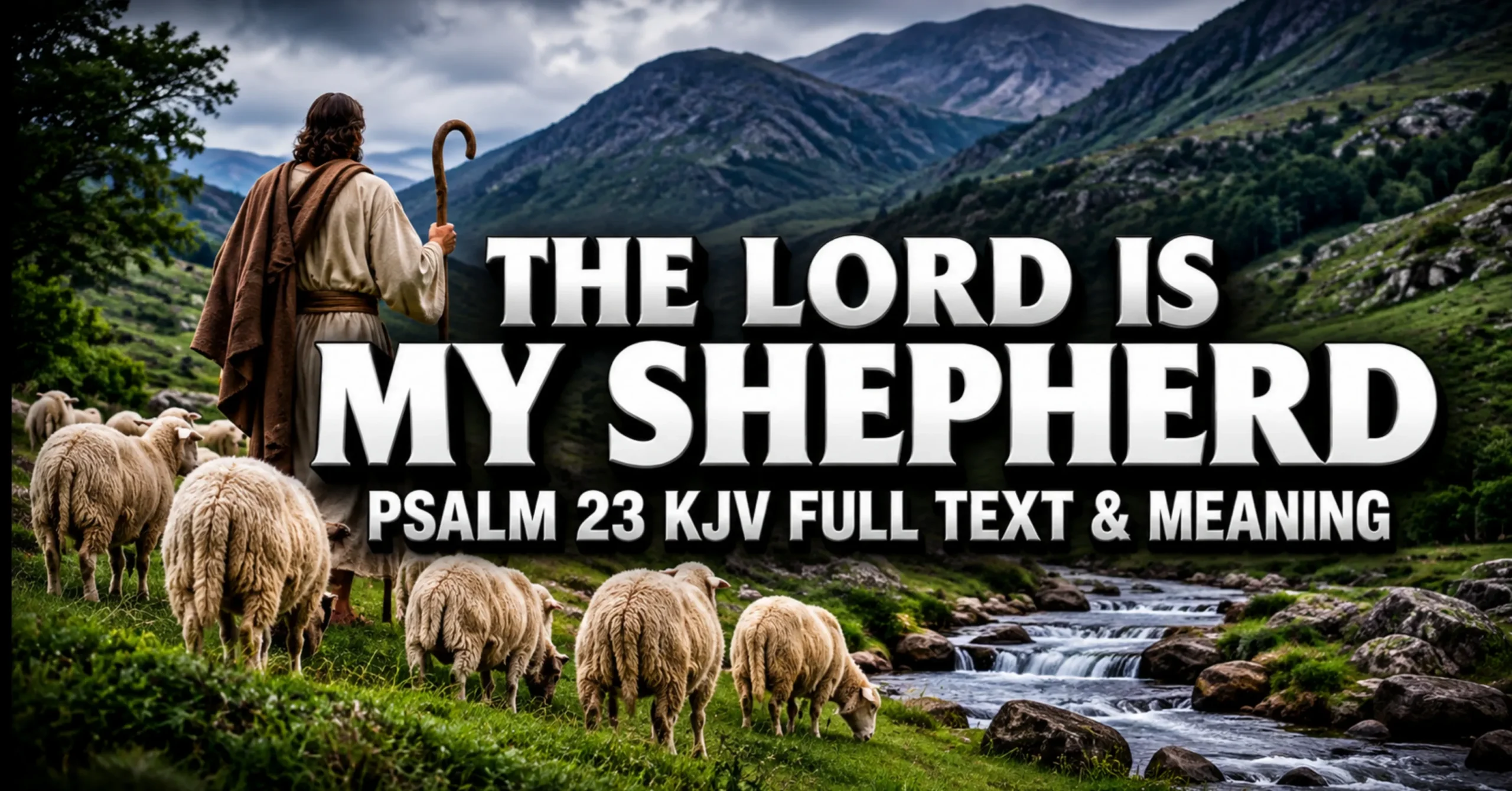
“The LORD is my shepherd; I shall not want” are the opening words of Psalm 23. In this psalm, David describes the LORD as a shepherd who cares for His sheep and a host who welcomes a guest. These pictures show God’s provision, guidance, protection, and faithful love. Read the complete Psalm 23 in the King James Version (KJV), then explore what each verse means, how the psalm connects to Jesus, and how its message can guide your prayers.
Psalm 23 KJV: Full Text
King James Version (KJV)
A Psalm of David
Psalm 23:1–6
1 The LORD is my shepherd; I shall not want.
2 He maketh me to lie down in green pastures: he leadeth me beside the still waters.
3 He restoreth my soul: he leadeth me in the paths of righteousness for his name’s sake.
4 Yea, though I walk through the valley of the shadow of death, I will fear no evil: for thou art with me; thy rod and thy staff they comfort me.
5 Thou preparest a table before me in the presence of mine enemies: thou anointest my head with oil; my cup runneth over.
6 Surely goodness and mercy shall follow me all the days of my life: and I will dwell in the house of the LORD for ever.
Read the full Psalm 23 in the King James Version.
A note about KJV language: The King James Version uses some older English words and verb forms. “Thou” and “thy” mean “you” and “your.” The verb endings “-eth” express present-tense actions. For example, “maketh” means “makes,” and “leadeth” means “leads.”
Understanding Psalm 23 in Its Biblical Context
Shepherding was a familiar part of life in the Old Testament. A shepherd had to find food and water for the flock, guide the sheep along safe paths, and protect them from danger. Caring for sheep required patience, attention, and responsibility.
The Bible also uses shepherd language to describe leadership. In 2 Samuel 5:2, David is told that he will shepherd Israel and become its ruler. This shows how the shepherd’s responsibility for a flock could also describe a leader’s responsibility toward his people.
The Old Testament uses this image to describe God’s care as well. Isaiah 40:11 portrays Him as a shepherd who feeds His flock, gathers lambs in His arms, and gently leads those that need care.
Ezekiel 34 develops this picture further. In verses 11–16, God promises to search for His scattered sheep, gather them, feed them, and care for them because the shepherds responsible for them have failed. In verses 23–24, God promises to place one shepherd over His people, calling him “my servant David.” This points to the hope of a future Davidic shepherd-king who will lead God’s people.
These passages help explain the significance of the shepherd image in Psalm 23. The LORD is portrayed as one who knows His people, takes responsibility for their care, and faithfully leads them.
What Does Psalm 23 Mean? A Verse-by-Verse Explanation
Each verse of Psalm 23 reveals a different aspect of the LORD’s care. Let’s look at what each verse means and how its message speaks to our lives today.
Psalm 23:1: The LORD Is My Shepherd; I Shall Not Want
“The LORD is my shepherd; I shall not want.” David begins this psalm with a declaration of personal trust in the LORD. By calling God his Shepherd, he describes a relationship in which he depends on God for care, guidance, and provision.
The words “The LORD is my shepherd” show that David does not view God as distant or unconcerned. Just as a shepherd watches over his sheep, leads them, and cares for their needs, the LORD faithfully cares for His people.
The next words, “I shall not want,” express David’s confidence that God will provide what he truly needs. This does not mean that believers will never experience hardship, financial difficulties, or suffering. Rather, David is expressing trust in the LORD’s sufficient care and provision.
If you are learning to trust God through difficult and uncertain seasons, read our guide to Verses About Trusting God Through Fear, Hope, and Trials for more biblical encouragement.
This opening verse establishes the central message of Psalm 23. The Shepherd who provides for His sheep also restores them, guides them through difficult paths, protects them in danger, and remains faithful throughout their lives.
Psalm 23:2: Green Pastures and Still Waters
“He maketh me to lie down in green pastures” describes a shepherd who brings his sheep to places where they can find food and rest. The sheep depend on him for guidance and care rather than searching for every need on their own.
The next phrase, “he leadeth me beside the still waters,” continues this picture. The KJV’s “still waters” is traditionally understood as quiet or refreshing water. The Hebrew expression has also been translated as “waters of resting places.” Translators differ over its precise nuance, so the image should not be limited to motionless pools alone.
Together, the green pastures and waters picture the Shepherd leading His sheep to what sustains and refreshes them.
For readers today, these images remind us that we need more than constant activity and self-reliance. We also need to depend on God, seek His direction, and receive the provision He gives.
Psalm 23:3: He Restoreth My Soul
“He restoreth my soul” describes the LORD renewing the psalmist and restoring his strength. In Hebrew, the word translated as “soul” can refer to a person’s life or the person themselves, depending on the context. Within the shepherd image, the emphasis is on the Shepherd refreshing and restoring the one in His care.
David continues, “he leadeth me in the paths of righteousness.” In the shepherding picture, these are right paths along which the sheep are led. The phrase can also describe God’s guidance in the right way of life. Both ideas fit the psalm’s picture of a Shepherd who leads His people faithfully.
The final words, “for his name’s sake,” explain why the LORD leads in this way. His guidance reflects His own character. He remains faithful to who He is, and His actions display His goodness and righteousness.
Restoration and guidance belong together in this verse. God renews the weary and leads His people in the right direction.
For a closer look at the translation questions in this verse, see the NET Bible’s notes on Psalm 23.
Psalm 23:4: The Valley of the Shadow of Death
The scene changes in verse 4. David moves from green pastures and still waters to walking through “the valley of the shadow of death.” The image suggests a place of darkness, danger, and uncertainty.
The Hebrew expression traditionally translated as “the shadow of death” has also been understood more broadly as “deep darkness.” Both readings communicate the seriousness of the valley. David is not describing a life without danger. He is expressing confidence while passing through it.
Notice the change in how David speaks. In the first three verses, he talks about God, saying, “he leadeth me.” In verse 4, he speaks directly to Him: “for thou art with me.” The language moves from speaking about the Shepherd to speaking to Him. In the darkest part of the journey, God’s presence becomes the focus.
David also mentions the LORD’s rod and staff. These were familiar shepherd’s tools associated with guiding and protecting the flock. Together, they picture the Shepherd’s authority, care, and reassuring presence.
The verse does not promise that faithful people will never experience grief, danger, or suffering. It offers a different kind of comfort: the Shepherd who leads beside refreshing waters is also present in the valley. David can keep walking because he is not alone.
Psalm 23:5: A Table Before My Enemies
In verse 5, the picture changes from a shepherd and his sheep to a host welcoming a guest.
David says, “Thou preparest a table before me in the presence of mine enemies.” A prepared table suggests welcome, provision, and honor. The striking detail is that the enemies are still present. The psalmist does not say that every conflict has disappeared. Instead, he describes God’s provision in the middle of opposition.
Some interpreters understand this scene as resembling a royal banquet, where a host publicly welcomes and honors a guest. Although the exact setting is not specified, the image clearly conveys generous hospitality.
The verse continues, “thou anointest my head with oil.” In the setting of hospitality, oil can be understood as a sign of welcome, refreshment, and care. It adds to the picture of a guest being received generously.
Then David says, “my cup runneth over.” The KJV uses this expression to communicate abundance. Some modern translations describe the cup as completely full. Either way, the image is of a host who provides more than enough.
The table, oil, and overflowing cup show that opposition does not prevent the psalmist from receiving the LORD’s care. His provision remains present even when life is far from peaceful.
Psalm 23:6: Goodness, Mercy, and the House of the LORD
The final verse brings the psalm to a confident conclusion:
“Surely goodness and mercy shall follow me all the days of my life.”
David expresses confidence that God’s goodness and mercy will remain with him throughout his life. The Hebrew word translated as “mercy” is hesed, a rich term associated with steadfast love, kindness, loyalty, and faithful commitment.
The word translated as “follow” can also carry the stronger sense of pursuing. This gives the verse a striking picture: God’s goodness and faithful love do not simply accompany the psalmist; they pursue him throughout his life.
David then says, “and I will dwell in the house of the LORD for ever.” This expresses his desire for lasting fellowship with God. The phrase may evoke the place of worship and the privilege of living in the LORD’s presence. It also brings the psalm’s picture of the welcoming host to a fitting conclusion.
There is a translation difference worth noting. The KJV says “for ever,” while the Christian Standard Bible (CSB) translates the phrase as “as long as I live.” The Hebrew expression refers to the length of days, and translations differ in how they convey its meaning. “For ever” is the traditional rendering found in the KJV.
Christians may also read this final hope in light of the wider biblical promise of life with God. Psalm 23 ends with confidence in the LORD’s faithful care throughout life and the hope of remaining in His presence.
Who Wrote Psalm 23?
Psalm 23 is traditionally attributed to David. Its superscription reads, “A Psalm of David.” Other biblical passages also describe David’s experience as a shepherd before he became king.
In 1 Samuel 16:11, David is keeping his father’s sheep when Samuel asks Jesse whether all his sons are present. Psalm 78:70–72 also describes God choosing David from the sheepfolds and making him the shepherd of Israel.
These passages provide helpful background for the psalm’s shepherd imagery. David knew the responsibility of caring for a flock, and the Bible later uses shepherd language to describe his leadership of Israel.
The traditional understanding is that David wrote Psalm 23. The Hebrew expression in the superscription is commonly translated as “A Psalm of David.” Although scholars discuss the precise meaning of this expression, the biblical heading is the basis for the traditional attribution.
The Bible does not give a definite date or identify a particular event when David composed this psalm. It does not say that he wrote it during a specific battle, during Absalom’s rebellion, or at any other named point in his life. It is better not to assign the psalm to an event Scripture does not identify.
What we can say is that the psalm reflects a deep trust in the LORD as Shepherd, a theme that continues to encourage readers today.
Is Psalm 23 About Jesus?
Psalm 23 does not mention Jesus by name. In its original Old Testament setting, it is a psalm of trust in the LORD, who is described as the Shepherd of His people.
The shepherd image becomes especially important when we read the wider Bible. In Ezekiel 34:23–24, God promises to set one shepherd over His people, calling him “my servant David.” This points to the hope of a future Davidic shepherd-king who will care for God’s people. Christians understand this promise in the light of Jesus, the Son of David and the Good Shepherd.
In John 10:11, Jesus says, “I am the good shepherd: the good shepherd giveth his life for the sheep.” He explains that the Good Shepherd willingly gives His life for His sheep. This adds an important dimension to the shepherd image: Jesus does not simply guide and care for His people; He also gives Himself for them.
The New Testament uses this shepherd language in other passages, too. Hebrews 13:20 calls Jesus “that great shepherd of the sheep,” and 1 Peter 2:25 describes Him as “the Shepherd and Bishop” of believers’ souls.
For Christians, these passages connect the shepherd imagery of Psalm 23 with Jesus’ care, leadership, and sacrifice. The original psalm speaks of the LORD as Shepherd, while the New Testament presents Jesus as the Good Shepherd who knows His sheep and gives His life for them.
How to Pray Psalm 23
Psalm 23 can guide us in prayer through different seasons of life. Its words help us thank God for His provision, ask for His direction, seek His presence in difficult times, and remember His faithful love.
The following is an original devotional prayer based on Psalm 23, not a quotation from Scripture.
A Prayer Based on Psalm 23
Heavenly Father,
Thank You for being my Shepherd and caring for me each day. Help me trust You for what I need and find rest in Your presence.
Restore my strength when I feel weary. Lead me in the right paths and help me live in a way that honors You.
When I walk through difficult times, remind me that You are with me. Give me courage when I feel afraid, and help me trust Your guidance even when I cannot see what lies ahead.
Thank You for welcoming and caring for me, even when I face opposition. Teach me to receive Your provision with a grateful heart and recognize Your goodness and faithful love throughout my life.
Keep my heart close to You, guide me in Your truth, and help me walk with You each day.
In Jesus’ name, Amen.
Frequently Asked Questions About Psalm 23
What verse says, “The LORD is my shepherd”?
“The LORD is my shepherd” is found in Psalm 23:1. These are the opening words of the psalm in the King James Version.
What psalm is “The Lord Is My Shepherd”?
“The Lord Is My Shepherd” refers to Psalm 23. Its opening verse describes the LORD as a shepherd who cares for His people.
Conclusion
Psalm 23 reminds us that God’s presence does not disappear when life becomes difficult. The Shepherd who leads us through green pastures also walks with us through the darkest valleys. Even in the presence of opposition, His care remains faithful.
The psalm does not promise a life without hardship. Instead, it invites us to trust the LORD through every season, depend on His guidance, and find confidence in His goodness and mercy.

Juganta Kumbhar is a Christian pastor, blogger, and content creator who serves in ministry and a local church. He holds a postgraduate degree and has spent significant time writing and publishing Christian and Bible-related content across multiple websites. He also volunteers in social work, believing a life poured out for others is never wasted. He created ChristianPrayerLife to share the life of Christ honestly and warmly the way one friend talks to another hoping every reader who visits feels a little less alone and a little closer to God.