
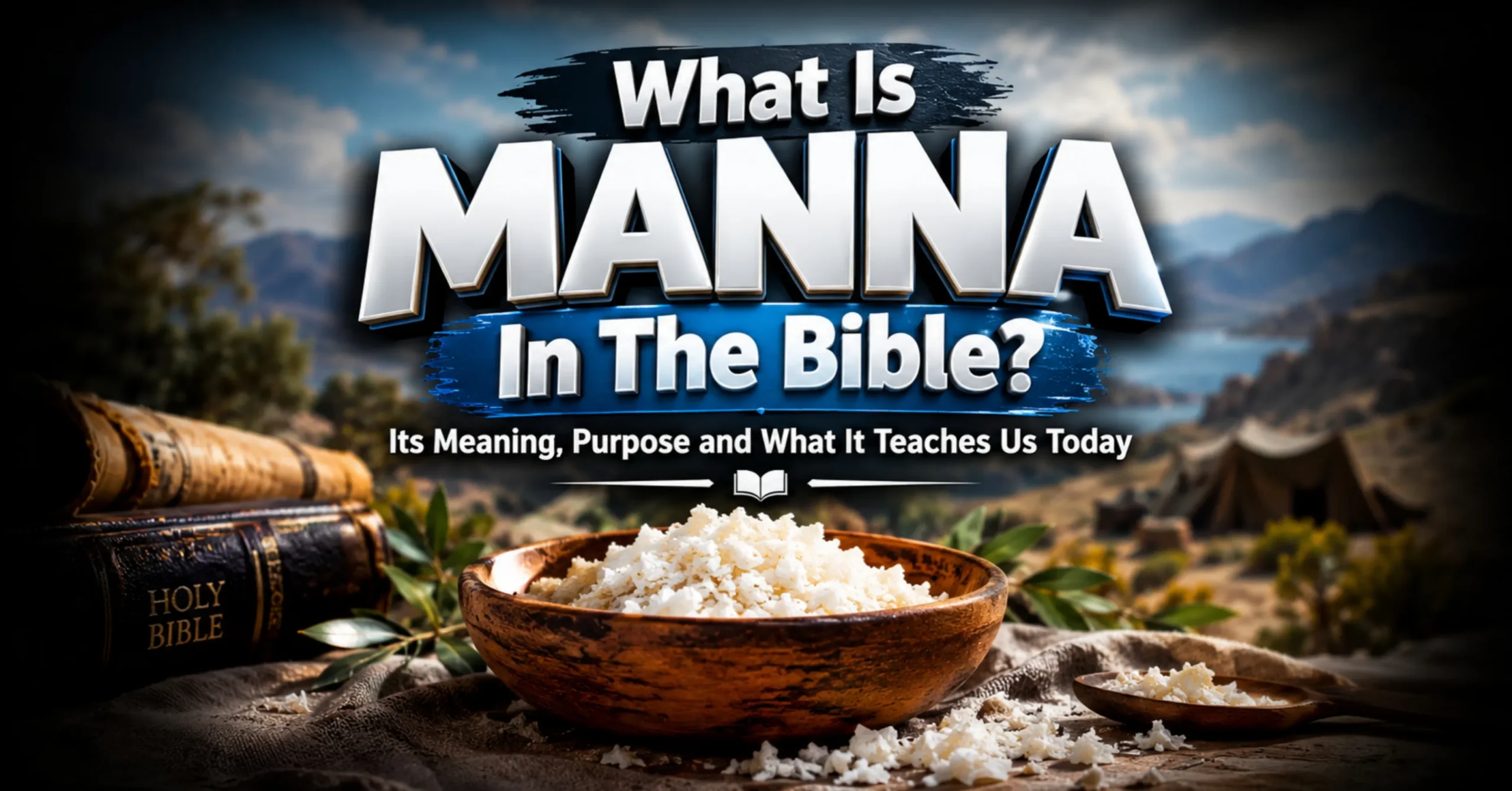
Manna was the food God provided for the Israelites after He brought them out of Egypt. During their journey through the wilderness, the people faced a serious problem: they needed food, but they could not depend on the land around them for everything they needed. In Exodus 16, God provided manna and gave the Israelites instructions for gathering it each day.
The story of manna shows how God cared for the Israelites during their journey. It also became an important part of their history, reminding them to trust His provision and follow His instructions. Centuries later, Jesus referred to manna when He described Himself as the bread of life (John 6:35).
What Was Manna in the Bible?
After leaving Egypt, the Israelites traveled through the wilderness toward the land God had promised them. Their journey was not easy. They had left behind the place where they had been slaves, but freedom did not mean they would never face hardship. They still needed food, water, and guidance as they traveled.
Exodus 16 tells how God provided food when the Israelites became hungry. The food was called manna, and the people gathered it from the ground each morning. God also gave them specific instructions about how much to collect and when to gather it.
Why Did Manna Appear in the Wilderness?
Exodus 16:1–3 places the Israelites in the wilderness of Sin, between Elim and Sinai. By this point, they had been traveling for about a month since leaving Egypt. As their food supply became a concern, the people began complaining to Moses and Aaron.
They remembered the food they had eaten in Egypt and spoke as though they would have been better off there. Although they had lived as slaves, their hunger made them focus on the food they remembered rather than the hardship they had endured.
Moses and Aaron were the people’s leaders, but the complaint was ultimately directed against the Lord. God heard them and told Moses that He would provide bread from heaven. He also instructed the people to gather enough for each day, giving them an opportunity to learn whether they would follow His commands (Exodus 16:4).
That evening, quail came and covered the camp, providing meat for the Israelites. The next morning, after the dew lifted, a small substance appeared on the ground. The people had never seen anything like it, so they asked one another what it was.
Moses explained that it was the bread the Lord had given them to eat (Exodus 16:13–15). This food became known as manna.
The quail and manna served different purposes in the account. The quail provided meat, while the manna was gathered from the ground in the morning. Through this provision, the Israelites had food to eat as they continued their journey through the wilderness.
How Did the Israelites Gather Manna?
Each morning, the Israelites had to go out and gather manna for their families. God had given them clear instructions about how much to collect and when to gather it. They were not supposed to store up extra food for the following days or ignore the instructions He had given them.
According to Exodus 16:16, each person was to gather an omer of manna for every member of the household. An omer was an ancient measure of dry volume. When the Israelites brought their manna together and measured it, something important became clear: those who had gathered more did not have too much, and those who had gathered less did not have too little (Exodus 16:17–18).
Moses then told the people not to leave any manna until the next morning. Some did not listen and kept part of their food overnight. By morning, it had spoiled, developed worms, and smelled bad (Exodus 16:19–20). The people had to learn to follow God’s instructions instead of trying to keep extra manna for another day.
The sixth day of the week was different. God instructed the Israelites to gather twice the usual amount because they were not to collect manna on the seventh day, the Sabbath. They could prepare what they needed and keep the extra portion overnight without it spoiling (Exodus 16:22–26).
However, not everyone followed the instructions. When some people went out on the Sabbath to look for manna, they found none. God had already told them to gather enough on the sixth day and rest on the seventh (Exodus 16:27–30).
Gathering manna became part of the Israelites’ daily lives. They went out in the morning, collected the food they needed, and learned to follow God’s instructions about the Sabbath. The account shows that manna was not simply food they found on the ground; it was part of the way God provided for them during their wilderness journey.
When Did the Israelites Stop Receiving Manna?
The Israelites did not receive manna forever. Exodus 16:35 says they ate it for forty years, until they came to the border of the land of Canaan.
The story reaches its next stage in Joshua 5:10–12. After crossing into the promised land, the Israelites camped at Gilgal and celebrated the Passover. They then began eating food produced in the land. The Bible says that the manna ceased after they ate the produce of Canaan.
This marked a change in how the Israelites received their food. During their wilderness journey, manna had sustained them from day to day. In Canaan, they could eat the produce of the land God had brought them into.
The manna had served its purpose during that particular period of Israel’s history. Once the people began eating food from the promised land, they no longer received manna.
What Did Manna Look and Taste Like?
The Bible gives readers a few details about the appearance and taste of manna. These descriptions appear mainly in Exodus 16 and Numbers 11. Although they do not explain every physical detail, they help us understand what the Israelites saw and how they prepared the food.
What Did Manna Look Like?
When the Israelites first saw manna on the ground, they did not recognize it. Exodus 16:14 describes it as a small, round substance that appeared after the dew lifted. The King James Version compares it to fine frost on the ground.
Later in the same chapter, Exodus 16:31 gives a more specific description. Manna was white and looked like coriander seed. Numbers 11:7 also compares its appearance to coriander seed and says it resembled bdellium.
These comparisons help readers picture the food, but they do not provide an exact description of its size, texture, or physical composition. The Bible tells us what manna looked like to the people who gathered it without giving enough information to recreate its precise appearance today.
Exodus 16:21 adds another detail. The Israelites gathered manna in the morning because it melted when the sun grew hot. This explains why they needed to collect it early rather than wait until later in the day.
Taken together, these passages describe manna as a small substance found on the ground in the morning, white in appearance and comparable to coriander seed. Beyond these details, the Bible does not give a complete physical description.
What Did Manna Taste Like?
The Bible also describes the taste of manna. Exodus 16:31 says it tasted like wafers made with honey. This gives readers an idea of how the Israelites experienced the food, although the passage does not provide a recipe or explain its exact ingredients.
Numbers 11:8 adds that the people gathered manna, ground it or crushed it in a mortar, and prepared it in different ways. The passage compares its taste to fresh oil.
These descriptions show that manna could be prepared before eating and that the biblical writers used familiar foods to help readers understand its taste. Exodus compares it to honey wafers, while Numbers provides another comparison involving fresh oil.
The two accounts do not give a complete explanation of manna’s flavor or ingredients. It is best to stay with what Scripture says rather than claim that manna tasted exactly like a particular modern food.
What Was Manna Made Of? Does It Exist Today?
The Bible tells us where the Israelites found manna, what it looked like, and how they used it for food. However, it does not identify its exact biological source or chemical composition. This leaves an important question for modern readers: can we identify the substance today?
Does the Bible Explain What Manna Was Made Of?
No. The Bible does not explain the exact physical or chemical makeup of manna. Exodus describes how it appeared and how the Israelites gathered it, but it does not name the plants, insects, or ingredients from which it came.
Some people have proposed that biblical manna may have resembled natural substances found in desert environments. These suggestions include sweet secretions associated with certain insects and plants. Such substances can provide possible comparisons, but they have not been established as the exact manna described in Exodus.
A substance that looks or tastes similar to manna is not necessarily the same food the Israelites received. The biblical account presents manna as God’s provision during the wilderness journey, but it does not offer enough scientific detail to identify its precise natural source.
For that reason, it is important to distinguish between what Scripture actually records and what people have proposed as an explanation. We can describe the biblical account with confidence without claiming to know something the text does not tell us.
Does Manna Exist Today?
Some natural substances found today are called manna or are compared with the manna described in the Bible. However, the use of the same name does not prove that these substances are identical to the food the Israelites ate.
The Bible does not identify a modern substance as the exact manna that appeared during the wilderness journey. Although researchers and writers may suggest possible explanations, the biblical descriptions alone do not provide enough information to confirm any of them.
What Scripture does make clear is manna’s role in Israel’s history. It was the food God provided for the people during their journey through the wilderness, and they continued eating it until they began eating the produce of Canaan.
So, while natural substances may offer interesting comparisons, it would be inaccurate to say that a particular substance found today has been definitively identified as biblical manna.
What Does Manna Mean in the Bible?
When the Israelites first saw manna lying on the ground, they did not know what it was. Exodus 16:15 records their question: “It is manna” is not what they first said; instead, they asked one another what they were seeing. Moses then explained that it was the bread the Lord had given them to eat.
The name manna is traditionally connected with this question, often expressed as “What is it?” This explanation comes from the biblical account of the Israelites encountering unfamiliar food in the wilderness. However, the passage does not settle every question about the word’s linguistic origin.
For the Israelites, manna was more than something new to eat. It was the food God provided when they needed help sustaining themselves during their journey. Each morning, they gathered what they needed and continued traveling through the wilderness.
The story reminds readers that manna was part of a specific event in Israel’s history. The people did not understand what they were seeing at first, but Moses explained its purpose: God had provided food for them.
Why Did God Give the Israelites Manna?
The Israelites needed food after leaving Egypt, and Exodus 16 describes how God provided for them. But the Bible also explains that their experience in the wilderness taught them an important lesson about depending on Him.
In Exodus 16:4, God told Moses that He would provide bread from heaven and instructed the people to gather a daily portion. They were not simply given food without any instructions. They had to follow what God told them about gathering it, keeping it overnight, and preparing for the Sabbath.
Later, Moses explained the deeper lesson behind this experience. In Deuteronomy 8:2–3, he reminded the Israelites how God had led them through the wilderness, humbled them, and tested them. They had experienced hunger, but God had also fed them with manna—a food they and their ancestors had not known before.
Moses then reminded them that people do not live by bread alone, but by every word that proceeds from the mouth of the Lord. His point was that human life depends on God, not only on the food people can see or obtain through their own efforts.
This lesson mattered as the Israelites prepared to live in the promised land. Once they had homes, crops, and other sources of food, they could be tempted to forget the One who had sustained them in the wilderness. Moses urged them to remember God and remain faithful to Him.
Psalm 78:23–25 also looks back on this part of Israel’s history. The psalm describes God opening the heavens and providing food for the people. In the King James Version, Psalm 78:24 calls it the “corn of heaven,” while verse 25 describes it as “angels’ food.”
These passages show why manna holds an important place in the biblical account. It met the Israelites’ physical needs, but it also became a reminder of God’s provision and their responsibility to listen to Him.
For Christians today, the story can encourage gratitude for daily needs and trust in God. However, it does not promise that every believer will receive a particular material blessing, healing, or outcome. The original account describes God’s care for Israel during a specific period, and its lessons should be understood in that context.
What Did Jesus Say About Manna?
Many years after the Israelites’ wilderness journey, Jesus spoke about manna while teaching a crowd in John 6. The people referred to the food their ancestors had eaten in the wilderness and recalled the account of bread coming down from heaven.
Jesus used their reference to explain something greater than the food itself. He told them that Moses was not the ultimate giver of the bread from heaven. His Father was the One who gives the true bread from heaven (John 6:32).
Jesus then turned the conversation toward His own identity and the life He offers.
How Is Jesus the Bread of Life?
In John 6:35, Jesus says, “I am the bread of life” (KJV). He made this statement after feeding a large crowd, an event that had drawn people’s attention to Him. Some continued looking for physical food, but Jesus directed them toward a deeper need: the need for the life that comes through Him.
The Israelites had eaten manna in the wilderness, but that food sustained them physically for a time. Jesus explained that the people who ate manna eventually died. He then described Himself as the living bread that came down from heaven (John 6:48–51).
His teaching draws a distinction between the manna their ancestors received and the life He offers. Manna helped keep the Israelites alive during their journey, but it was not a way for them to escape physical death forever. Jesus presented Himself as the source of life for the world.
This does not mean that Jesus and the physical food called manna are literally the same thing. Rather, Jesus used the earlier event in Israel’s history to help explain who He is and why people need Him.
For Christians, this connection makes the manna account especially meaningful. The story begins with God providing food for hungry people in the wilderness. In John 6, Jesus uses the memory of that provision to teach about Himself as the bread of life. Reading John 6:31–51 in context helps readers understand how He develops this comparison.
Bible Verses About Manna
Several Bible passages explain where manna came from, how the Israelites gathered it, and why it became an important part of their history. These verses are useful for studying the account in its biblical context.
- Exodus 16:4: God promises bread from heaven and instructs the Israelites to gather a daily portion.
- Exodus 16:14–15: Manna appears on the ground, and Moses explains that it is the food the Lord has given them.
- Exodus 16:16–26: These verses describe the amount the people were to gather, the instructions about keeping it overnight, and the double portion before the Sabbath.
- Exodus 16:31: The Bible describes manna as white, like coriander seed, and tasting like wafers made with honey.
- Numbers 11:7–9: This passage adds details about manna’s appearance, taste, and preparation.
- Deuteronomy 8:2–3: Moses explains how the wilderness experience taught Israel to depend on God.
- Psalm 78:23–25: The psalm recalls God’s provision of food from heaven during Israel’s wilderness journey.
- Joshua 5:10–12: These verses describe the Israelites celebrating Passover in Canaan and the manna ceasing after they began eating the land’s produce.
- John 6:31–35: Jesus responds to the reference to manna and identifies Himself as the bread of life.
Reading these passages together gives a fuller picture of manna. Exodus describes the food and the instructions for gathering it, Deuteronomy explains the lesson Moses drew from the experience, and John records how Jesus used the story to teach about Himself. If you want to learn more about how to read and understand the Bible, studying each passage in its surrounding context can help you understand how these events fit into the wider message of Scripture.
FAQ About what is manna in the bible
How Do You Pronounce Manna?
In common English usage, manna is pronounced MAN-uh, with the emphasis on the first syllable. Pronunciation may vary slightly depending on the speaker’s accent.
What Is Manna Compared to Today?
Some natural substances found in desert environments have been compared with biblical manna. However, the Bible does not identify any modern substance as the exact food the Israelites ate. These comparisons remain possible explanations rather than confirmed identifications.
The biblical account identifies manna by its role in Israel’s wilderness journey: it was the food God provided for the people, as described in Exodus 16.
Conclusion
Manna was the food God provided for the Israelites during their journey through the wilderness after leaving Egypt. Its story explains how God met their need for food and taught them to follow His instructions and depend on His provision.
The account also has an important connection with Jesus’ teaching in John 6. When Jesus called Himself the bread of life, He used the memory of manna to point beyond physical food to the life He offers. Reading Exodus 16, Deuteronomy 8:2–3, and John 6:31–51 together helps readers understand both the historical role of manna and its place in Jesus’ teaching.

Juganta Kumbhar is a Christian pastor, blogger, and content creator who serves in ministry and a local church. He holds a postgraduate degree and has spent significant time writing and publishing Christian and Bible-related content across multiple websites. He also volunteers in social work, believing a life poured out for others is never wasted. He created ChristianPrayerLife to share the life of Christ honestly and warmly the way one friend talks to another hoping every reader who visits feels a little less alone and a little closer to God.