

Relationships can bring joy, love, friendship, and support, but they can also bring conflict, hurt, loneliness, and disappointment. The Bible gives us guidance for how to love others, communicate, forgive, handle conflict, choose friends, honor family, and build faithful relationships.
These 45 Bible verses about relationships cover love, friendship, family, communication, conflict, forgiveness, dating, marriage, and difficult relationships. Some speak directly about relationships, while others give biblical principles for how we treat people.
As you read, consider each verse in its biblical context and ask: What is God teaching me about the way I should love and treat the people in my life?
The Scripture passages below are summarized rather than quoted from a specific Bible translation.
What Does the Bible Say About Relationships?
Jesus summarized the heart of God’s commands as love for God and love for our neighbor (Matthew 22:37–40). He also taught His followers to treat others as they would want to be treated (Matthew 7:12).
Throughout Scripture, relationships are connected with sincere love, humility, patience, truth, forgiveness, kindness, faithfulness, and peace. These principles apply to friendships, family, marriage, dating, and relationships within the Christian community.
The Bible does not promise that every relationship will be easy. Instead, it teaches us how to respond wisely and faithfully when relationships are joyful, strained, or difficult.
Bible Verses About Love and Relationships

1. 1 Corinthians 13:4–7 Love Is Patient and Kind
Paul describes love by its character and actions. Love is patient and kind, does not envy or boast, and does not insist on its own way. It rejoices with truth and endures.
The passage appears within Paul’s teaching about spiritual gifts and life in the church, not originally as a marriage ceremony passage. Its description of Christian love, however, applies to every relationship.
2. John 13:34–35 – Love One Another
Jesus gave His disciples a new command to love one another as He had loved them. He connected this love with the way people would recognize His followers.
Christian love is more than a feeling. It becomes visible through how we treat people, especially when love requires patience, sacrifice, or forgiveness.
3. Romans 12:9–10 – Let Love Be Genuine
Paul tells Christians to let their love be sincere, hold on to what is good, and honor one another.
Healthy relationships need genuine care rather than manipulation or pretense. Biblical love treats another person as valuable instead of using the relationship for personal gain.
4. Colossians 3:12–14 – Put On Love
Paul calls believers to put on compassion, kindness, humility, gentleness, patience, and forgiveness. Above all these qualities, he places love.
Together, these qualities give a practical picture of Christian relationships. Love does not stand alone; it shapes how we respond to other people.
5. 1 Peter 4:8 – Love Covers a Multitude of Sins
Peter urges believers to love one another deeply because love covers a multitude of sins.
This points to gracious relationships that do not magnify every minor offense. It does not mean hiding abuse, serious wrongdoing, or danger. Wisdom, accountability, and appropriate boundaries still matter.
6. 1 John 3:18 – Love in Action
John teaches that Christian love should not remain only in words. It should be expressed through actions and truth.
Care becomes meaningful when it is practiced. A person may say they love others, but faithful love becomes visible through service, honesty, generosity, and consistent actions.
7. 1 John 4:7–8 – Love Comes From God
John teaches that love comes from God and connects loving others with knowing God.
For Christians, love is not simply a changing emotion. Our relationships should increasingly reflect the character of the God who calls His people to love one another.
Bible Verses About Treating Others With Kindness and Respect
8. Matthew 7:12 – Treat Others as You Want to Be Treated
Jesus teaches His followers to treat others in the way they would want to be treated.
This principle applies to everyday relationships. Before acting toward someone, it is worth considering how you would want to be treated in the same situation.
9. Philippians 2:3–4 – Look to the Interests of Others
Paul warns against selfish ambition and pride and calls believers to consider the interests of others.
This does not mean ignoring every personal need. It means refusing to make every relationship revolve around yourself and learning to consider another person’s needs with humility.
10. Ephesians 4:2–3 – Be Humble and Patient
Paul calls Christians to humility, gentleness, patience, and bearing with one another in love. He also urges believers to maintain unity and peace.
Relationships often require patience because people have different personalities, weaknesses, opinions, and expectations.
11. Galatians 6:2 – Carry One Another’s Burdens
Paul tells believers to bear one another’s burdens and so fulfill the law of Christ.
Healthy relationships leave room for people who are struggling. Sometimes love means listening, helping, praying, or simply remaining present when someone is going through a difficult season.
12. Ephesians 4:32 – Be Kind and Forgiving
Paul calls Christians to kindness, compassion, and forgiveness, following God’s forgiveness toward them.
Forgiveness is an important part of Christian relationships, but it does not require ignoring wisdom or pretending that trust has been restored. A forgiving heart can still recognize the need for healthy boundaries.
13. 1 Peter 3:8 – Have Compassion and Humility
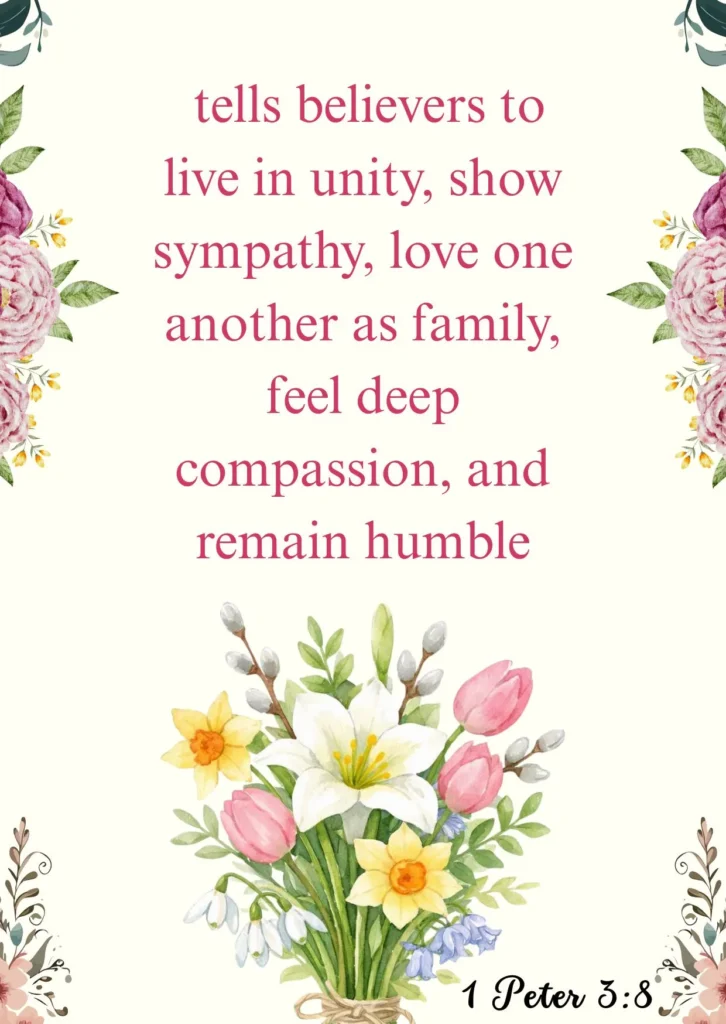
Peter calls believers to unity, sympathy, brotherly love, compassion, and humility.
These qualities can change the way disagreements are handled. Listening to another person’s pain and responding with humility may help keep a difficult conversation from becoming a deeper conflict.
Bible Verses About Communication and Listening
14. James 1:19–20 – Be Quick to Listen
James calls believers to be quick to listen, slow to speak, and slow to become angry. Human anger does not produce the righteousness God desires.
When emotions rise, listening before responding can keep angry words from causing deeper hurt.
15. Proverbs 15:1 – A Gentle Answer
Proverbs contrasts a gentle answer with harsh words that stir up anger.
The way something is said can affect the direction of a conversation. Gentleness does not require avoiding truth; it means speaking honestly without unnecessary harshness.
16. Proverbs 18:13 – Listen Before Answering
Proverbs warns against answering a matter before hearing it.
Assumptions can damage relationships quickly. Listening to the whole situation before responding shows respect and helps us understand what another person actually means.
17. Ephesians 4:15 – Speak the Truth in Love
Paul describes Christian maturity as speaking the truth in love.
Truth without love can become unnecessarily harsh, while love without truth can become dishonest. Biblical communication seeks both honesty and genuine care.
18. Ephesians 4:29 – Use Words That Build Up
Paul tells believers to avoid harmful speech and use words that build others up according to their needs.
Before speaking, consider whether your words will help, correct, encourage, or strengthen the other person or simply cause unnecessary hurt.
19. Proverbs 12:18 – Words Can Wound or Heal
Proverbs contrasts reckless words that pierce like a sword with wise words that bring healing.
Our words can leave lasting effects. Wisdom means thinking before speaking, especially when emotions are strong and a relationship is already under strain.
Bible Verses About Conflict, Anger, and Peace
20. Ephesians 4:26–27 – Do Not Let Anger Lead You Into Sin
Paul acknowledges anger but warns believers not to allow it to become sin or give the devil an opportunity.
Anger does not give us permission to hurt another person. The passage calls for self-control and dealing with anger before it causes further damage.
21. Romans 12:18 – Live at Peace When Possible
Paul tells Christians to live peacefully with others as far as it depends on them.
That qualification matters. We should pursue peace where we can, but we cannot control another person’s choices. Peace does not require remaining in an unsafe or abusive situation.
22. Proverbs 17:14 – Stop Conflict Before It Grows
Proverbs compares the beginning of a quarrel to releasing water and urges a person to stop before the conflict breaks out.
Some arguments become much worse because neither person is willing to pause. Wisdom sometimes means stepping away from an escalating argument instead of continuing it.
23. Proverbs 19:11 – Be Slow to Take Offense
Proverbs connects good sense with being slow to anger and says that overlooking an offense can be honorable.
Not every careless word needs to become a major conflict. Sometimes wisdom means recognizing a minor offense and choosing not to hold onto it.
24. Romans 12:17–21 – Overcome Evil With Good
Paul tells Christians not to repay evil for evil. Instead, they should seek peace and overcome evil with good.
This does not excuse wrongdoing. It means refusing to answer another person’s evil with revenge or let their actions determine our own character.
25. Luke 6:27–28 – Love Your Enemies
Jesus tells His followers to love their enemies, do good to those who hate them, bless those who curse them, and pray for those who mistreat them.
This difficult teaching moves believers away from revenge and toward a response shaped by mercy and obedience to God.
Bible Verses About Friendship

26. Proverbs 17:17 – A Friend Loves at All Times
Proverbs describes a friend as someone who loves at all times and connects brotherhood with times of adversity.
Faithful friendship becomes especially visible during difficult seasons. A good friend does not disappear simply because life becomes inconvenient or complicated.
27. Proverbs 18:24 – A Faithful Friend
Proverbs warns that some companions can bring harm while highlighting the value of a friend who remains close.
The size of our social circle is not the most important thing. Character, faithfulness, and the quality of our closest friendships matter far more.
28. Proverbs 27:6 – Faithful Wounds From a Friend
Proverbs says that the wounds of a faithful friend can be trusted, while an enemy’s kisses may be deceptive.
A good friend does not always tell us what we want to hear. Loving correction can be uncomfortable, but honest counsel can help us grow in wisdom.
29. Proverbs 27:17 – Iron Sharpens Iron
Proverbs compares people to iron sharpening iron.
Wise friendships can influence our character for the better. Good friends encourage what is right, offer honest correction, and challenge us to grow in wisdom rather than simply approving everything we do.
30. Ecclesiastes 4:9–12 – Two Are Better Than One
Ecclesiastes describes the practical value of companionship. People can help one another, lift each other after a fall, and provide support in difficult circumstances.
The passage highlights the strength of faithful companionship and is not limited to marriage.
Bible Verses About Family Relationships
31. Exodus 20:12 – Honor Your Father and Mother
The fifth commandment calls God’s people to honor their father and mother.
Honoring parents is a biblical responsibility, but it does not require accepting abuse or pretending harmful behavior is acceptable. Honor and wise boundaries can exist together.
32. Ephesians 6:1–4 – Children and Parents
Paul instructs children to obey their parents in the Lord and tells fathers not to provoke their children to anger. Parents are instead called to raise their children in the discipline and instruction of the Lord.
The passage gives responsibilities to both children and parents.
33. Colossians 3:18–21 – Family Responsibilities
Paul addresses wives, husbands, children, and fathers and gives instructions for life within the household.
The passage should be read as a whole. Its teaching should not be isolated to justify control, selfishness, or harmful behavior within a family.
34. Proverbs 15:20 – A Wise Child Brings Joy
Proverbs connects a child’s wisdom with joy in the family and contrasts it with the sorrow caused by foolishness.
Our choices affect the people closest to us. Wisdom and good character can contribute to peace and joy within a family.
Bible Verses About Dating, Couples, and Marriage
35. Genesis 2:18 – It Is Not Good to Be Alone
God declares that it is not good for the man to be alone and provides a suitable helper for him.
The immediate context leads into the creation of the woman and the biblical account of marriage. This verse should not be used to claim that every person must marry; Scripture also honors faithful singleness.
36. Genesis 2:24 – Husband and Wife Become One
Genesis describes marriage as a man leaving his parents, holding fast to his wife, and becoming one flesh.
This is a foundational biblical passage about marriage and presents marriage as a committed union between husband and wife.
37. 2 Corinthians 6:14 – Do Not Be Unequally Yoked
Paul warns believers against being unequally yoked with unbelievers.
The immediate context is broader than modern dating advice. The principle concerns spiritual partnership and faithfulness to God, so Christians should think carefully about relationships that deeply influence their faith and obedience.
38. Ephesians 5:21, 25, 33 – Christlike Love in Marriage
Paul places Christian relationships under submission to Christ and calls husbands to love their wives as Christ loved the church. He also calls husbands to love their wives as themselves.
Marriage is therefore presented in terms of sacrificial love, honor, and Christlike care rather than selfish control.
39. 1 Peter 3:7 – Live With Understanding and Honor
Peter instructs husbands to live with their wives in an understanding way and to show them honor.
Marriage requires more than sharing a home. It calls for consideration, respect, understanding, and a willingness to treat one’s spouse with care.
40. 1 Corinthians 7:3–5 – Mutual Responsibility in Marriage
Paul teaches husbands and wives to fulfill their marital responsibilities toward one another and emphasizes mutuality within marriage.
The passage presents marriage as a relationship involving shared responsibility rather than one-sided demands.
If you are walking through a strained or broken marriage, you may also find encouragement in our prayer for a broken marriage.
Bible Verses for Difficult or Broken Relationships

41. Matthew 18:21–22 – Forgive Again and Again
Peter asks Jesus how often he should forgive someone who sins against him. Jesus teaches that forgiveness should not be limited to a small number of occasions.
The point is not to keep a mathematical score of offenses, but to cultivate a forgiving heart rather than one controlled by resentment.
42. Matthew 5:23–24 – Be Reconciled
Jesus teaches that when a relationship has been seriously strained, reconciliation should be taken seriously. He connects this with approaching God in worship.
Reconciliation may require humility, honest conversation, repentance, and changed behavior. It should not mean ignoring abuse or removing necessary boundaries.
43. Matthew 18:15 – Address Sin Directly
Jesus gives His disciples a process for dealing with a brother or sister who sins against them, beginning with addressing the matter privately.
This teaching belongs within the context of restoring relationships in the Christian community. It should not be treated as a universal response to abuse, danger, or serious wrongdoing.
44. Proverbs 22:24–25 – Be Careful With an Angry Person
Proverbs warns against close friendship with a hot-tempered person because their anger can influence you.
Our closest relationships can shape our character and habits. Wisdom includes paying attention to a person’s character and the direction a friendship is taking us.
45. 1 Thessalonians 5:11 – Encourage and Build Up
Paul tells believers to encourage one another and build each other up.
Words of encouragement can strengthen relationships in simple but meaningful ways. Sometimes a relationship grows because someone takes the time to speak hope, gratitude, or truth at the right moment.
How to Apply These Bible Verses to Your Relationships
Read the Verse in Context
Read the surrounding passage and consider who was speaking, who was being addressed, and what the writer was teaching. A verse should not be separated from its biblical context simply because it sounds helpful.
Ask What Scripture Is Asking of You
Start with your own response. Ask whether God is correcting your words, attitude, pride, anger, selfishness, or unwillingness to forgive. Scripture should first examine our own hearts rather than become a tool for telling someone else what they need to change.
Take a Wise Next Step
Your next step may be an apology, an honest conversation, forgiveness, prayer, or encouragement. In some situations, wisdom may also require distance, accountability, or healthy boundaries. Biblical forgiveness does not automatically mean that trust has been restored.
If you recognize that you have hurt someone, take time to examine your actions, ask God for forgiveness, and make things right where appropriate. If you are seeking biblical guidance for turning away from sin and returning to God, you can also read our repentance prayer.
A Short Prayer for Your Relationships
Hevenly Father,
Give me wisdom in the relationships You have placed in my life. Teach me to listen before I speak, be patient when I am frustrated, and speak truth with love. Help me forgive others as You have forgiven me, and give me wisdom when boundaries are needed. Give me humility when I am wrong and courage to do what is right when relationships are difficult. May my words and actions reflect Your love and honor You.
In Jesus’ name, amen.
Frequently Asked Questions About Bible Verses About Relationships
What is the best Bible verse for relationships?
There is no single verse for every relationship. 1 Corinthians 13:4–7 gives a clear picture of biblical love, while John 13:34–35 focuses on Christlike love. For friendship, Proverbs 17:17 is especially helpful.
What Bible verse says love never fails?
1 Corinthians 13:8 says that love never fails. In the surrounding passage, Paul describes love as patient, kind, humble, truthful, and enduring. The passage should be read within the larger context of 1 Corinthians 12–14.
What does the Bible say about difficult relationships?
Scripture calls Christians to pursue peace, speak truth, forgive, avoid revenge, and respond with love. Romans 12:18 recognizes that peace is not always fully within our control. Wisdom, accountability, and healthy boundaries may still be necessary.
Does the Bible talk about dating relationships?
The Bible does not give a modern dating system, but it provides principles concerning faithfulness, purity, wisdom, spiritual commitment, and marriage. Genesis 2:24 and 2 Corinthians 6:14 can help Christians think carefully about romantic relationships.
What does the Bible say about forgiveness in relationships?
The Bible repeatedly calls believers to forgive. Matthew 18:21–22 and Ephesians 4:32 are examples. Forgiveness does not mean immediately trusting someone again or removing every boundary. Forgiveness, trust, and reconciliation are related but not identical.
Final Thoughts
The Bible gives clear guidance for love, friendship, family, communication, forgiveness, conflict, and marriage. It does not promise that every relationship will be easy or restored, but it calls us to respond with wisdom, truth, love, and faithfulness.
Choose one or two passages today. Read them slowly, pray over them, and ask God to show you one wise step you can take in the relationships He has placed in your life.

Juganta Kumbhar is a Christian pastor, blogger, and content creator who serves in ministry and a local church. He holds a postgraduate degree and has spent significant time writing and publishing Christian and Bible-related content across multiple websites. He also volunteers in social work, believing a life poured out for others is never wasted. He created ChristianPrayerLife to share the life of Christ honestly and warmly the way one friend talks to another hoping every reader who visits feels a little less alone and a little closer to God.