
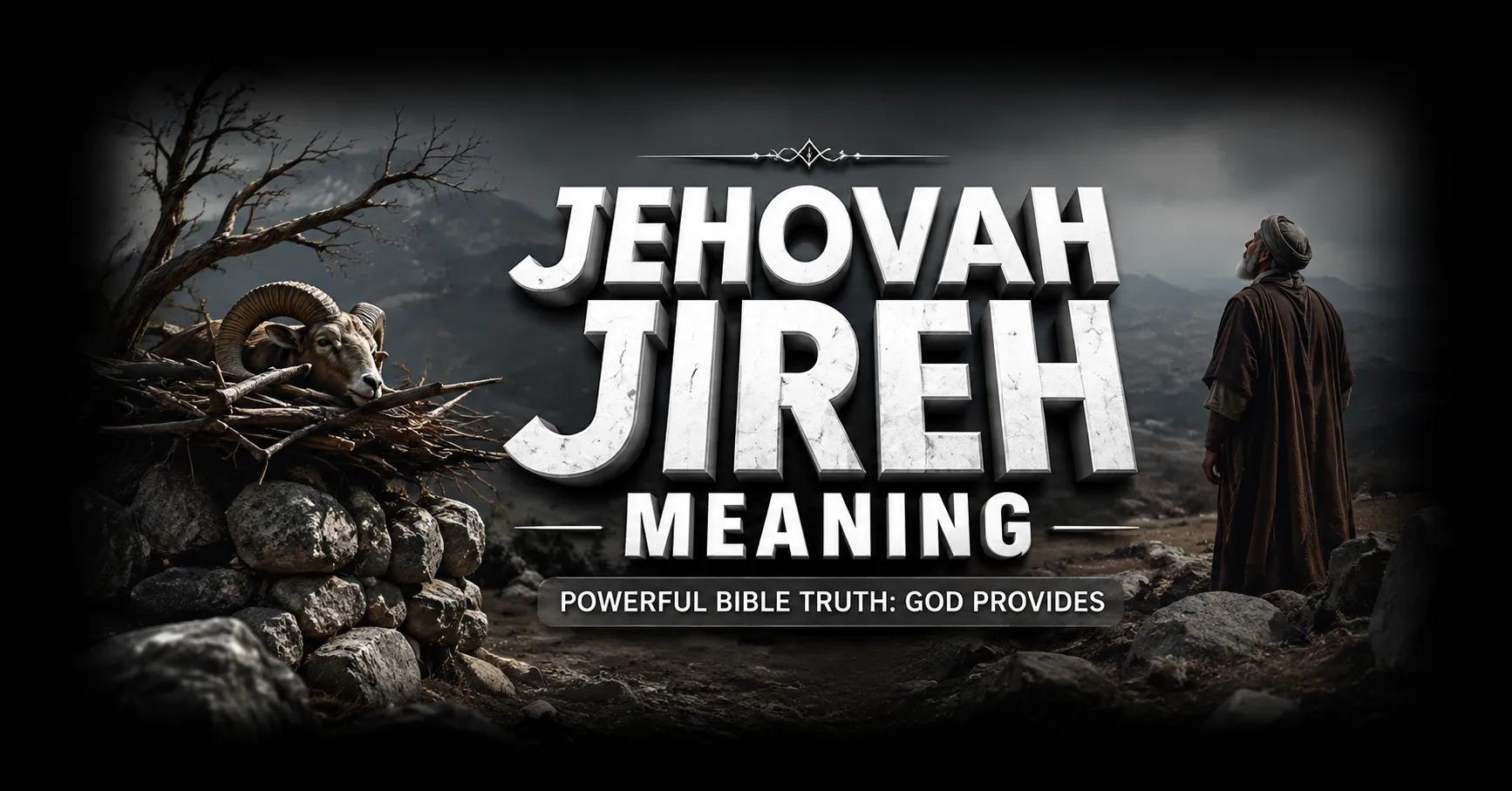
The name Jehovah Jireh came from a moment when Abraham could not see a way forward. On Mount Moriah, he trusted God with what mattered most, and at the critical moment, God provided a substitute. The deeper Jehovah Jireh meaning is not that God gives us everything we want. It is that He sees what we cannot see and remains faithful to provide according to His purpose and wisdom, even when the answer is still hidden.
What Does Jehovah Jireh Mean in Hebrew?
Before looking at the mountain story, it helps to understand the name itself. Jehovah Jireh is more than a phrase Christians repeat when they need help. Its Hebrew background is tied to the idea of seeing, and Genesis 22 shows why that idea became connected with God’s provision. That small detail makes the name richer than a simple statement about receiving things from God.
Jehovah Jireh is commonly connected with the Hebrew form Yahweh Yireh. “Yahweh” is God’s covenant name, often represented as “the LORD” in English Bibles. “Yireh” is related to the Hebrew root ra’ah, meaning “to see.”
Because of the way the words are used in Genesis 22, Jehovah Jireh is commonly translated “The LORD will provide.” The thought can also carry the sense of God seeing to a matter or seeing what is needed. These ideas fit the story because God saw Abraham’s situation and acted at the moment He had appointed.
This is important because the name does not present God as a distant source of blessings. It points to a God who knows what is happening and is able to act with wisdom.
His provision is connected to His character, not to a formula that guarantees a certain result.
The Story Behind Jehovah Jireh in Genesis 22
The meaning of Jehovah Jireh becomes much clearer when we return to the event that gave the name its place in Scripture. Genesis 22 is not a story about an easy answer. Abraham walks into a situation where the future seems impossible, yet the story shows that God’s promise and faithfulness are stronger than what Abraham can see in the moment. That tension is what makes the name so powerful.
God had promised Abraham that through him He would make a great nation (Genesis 12:1–3). Isaac was the son through whom that promise continued, and his birth was already a testimony to God’s faithfulness (Genesis 21:1–7).
Then Genesis 22:1–19 describes a severe test. God told Abraham to take Isaac to the land of Moriah and offer him as a burnt offering. Abraham rose early, prepared the wood, and began the journey with his son.
As they went, Isaac noticed that they had the fire and the wood but no lamb. He asked his father about it. Abraham answered, “God will provide for Himself the lamb for a burnt offering, my son” (Genesis 22:8).
When they reached the place, Abraham built the altar and arranged the wood. He bound Isaac and prepared to offer him. At the critical moment, the angel of the LORD called to him and stopped him (Genesis 22:11–12).
Abraham then looked up and saw a ram caught by its horns in a thicket. He took the ram and offered it instead of Isaac (Genesis 22:13). The ram was the substitute, and Isaac’s life was spared.
Hebrews 11:17–19 gives another important detail about Abraham’s faith. Abraham believed God could raise Isaac from the dead if necessary. James 2:21–23 also looks back at this event and shows how Abraham’s faith was demonstrated through obedience.
Why Did Abraham Name the Place Jehovah Jireh?
Abraham’s name for the place was a way of remembering what God had done there. In Scripture, names often carry the memory of an important event, and this one became a lasting reminder of God’s faithfulness. The name did not come from a comfortable season; it came from a moment when Abraham had no visible solution. That makes the name deeply connected to the event itself.
Genesis 22:14 says Abraham called the place Jehovah Jireh, commonly translated “The LORD will provide.” The verse continues with the statement, “In the mount of the LORD it shall be provided.”
Abraham had just seen God provide a ram in place of Isaac. Naming the place gave that moment a lasting witness. Whenever the name was remembered, it pointed back to the fact that God had not abandoned Abraham when the situation looked impossible.
There is also an important connection between Genesis 22:8 and Genesis 22:14. Abraham had said that God would provide the lamb, and afterward he named the place in light of what God had provided. The name therefore grows directly out of the story rather than being a detached title.
What Does Jehovah Jireh Teach Us About God’s Provision?
The ram is easy to remember, but the bigger lesson is about God’s character. Genesis 22 does not teach that believers can name a desired outcome and expect God to deliver it. It shows a God who remains faithful to His word and provides according to His purpose, even when His people cannot yet see how He will act. That difference keeps the meaning grounded in Scripture.
God’s provision for Abraham was specific. He provided a ram for the sacrifice when Isaac’s life was at stake. The answer was not simply “more” or “better” things. It was exactly what was needed in that moment.
Abraham’s obedience did not force God to provide. God was already faithful to His promise, and He provided at the time and in the way He had appointed. Abraham’s faith was shown by continuing to trust God before he could see the answer.
That matters for Christians today. Sometimes we pray for a particular outcome because we believe it would solve our problem. But trusting Jehovah Jireh means trusting God’s wisdom even when His answer does not match our first expectation.
Jesus made a similar point in Matthew 6:25–33. He taught His followers not to live controlled by worry about food, clothing, and tomorrow. Instead, they were to seek God’s kingdom and trust their heavenly Father.
Jehovah Jireh therefore points us toward trust, not entitlement. God’s provision is real, but it is never a promise that our preferred outcome must happen.
What Jehovah Jireh Does Not Mean
A comforting truth can become confusing when people turn it into a promise Scripture never made. The Jehovah Jireh meaning is sometimes used as if it means God will make every financial dream, personal goal, or desire come true. Genesis 22 does not support that idea, so this distinction matters. Understanding that boundary keeps this beautiful name from becoming a slogan for prosperity.
Jehovah Jireh does not mean guaranteed wealth. It does not mean every prayer will receive the exact answer we want. It does not promise a life without sickness, loss, waiting, disappointment, or hardship.
Look at the original story. God provided a ram for a specific purpose: it became the sacrifice in Isaac’s place. The provision was tied to the situation and God’s purpose, not to Abraham’s demand for comfort or material success.
Philippians 4:19 says God will supply the needs of His people according to His riches in glory in Christ Jesus. That verse gives believers confidence in God’s care, but it should not be turned into a promise that God will fund every desire.
So when Christians say “Jehovah Jireh,” they should not be using the name like a formula for getting more money or an easier life. They are remembering God’s faithfulness and choosing to trust Him with what they cannot control.
Jehovah Jireh and Jesus Christ
Genesis 22 is centered on Abraham and Isaac, but its picture of a substitute sacrifice becomes especially meaningful when the whole Bible is read together. The New Testament gives believers a fuller view of God’s saving work and shows why the idea of a provided sacrifice matters so deeply. The connection is meaningful, but it should always be explained with care.
In Genesis 22, Isaac is the beloved son, yet a ram is provided in his place. The ram does not equal Jesus, and Genesis 22 does not directly name Jesus. But the pattern of a substitute sacrifice becomes a meaningful part of the Bible’s larger story.
John 1:29 calls Jesus “the Lamb of God who takes away the sin of the world.” Romans 8:32 says that God “did not spare His own Son, but delivered Him up for us all.”
The difference is important. The ram spared Isaac’s life in that moment. Jesus gave His life for sinners. Genesis 22 therefore should not be treated as if Abraham already understood every detail of the gospel.
Instead, the New Testament helps Christians see how this earlier account fits into God’s greater plan of salvation. The connection between the substitute in Genesis 22 and Christ is a later biblical understanding, not a claim that Abraham was given the full New Testament picture.
This also makes Jehovah Jireh more than a lesson about material provision. God’s greatest provision is not simply something He puts into our hands. In Christ, God provides the way of salvation and reconciliation with Him.
What Jehovah Jireh Means for Christians Today
Jehovah Jireh still speaks to ordinary believers who are facing situations they cannot control. You may know what you need but have no idea where the answer will come from. Genesis 22 reminds us that not seeing the solution does not mean God has stopped working. That truth can steady our faith when tomorrow feels uncertain or when the next step is hard to see.

The name encourages us to trust God without pretending that hard situations are easy. Faith does not require us to deny fear, pain, or uncertainty. It means we bring those things to God while choosing to trust His character.
This also means we should be careful about telling someone, “God will give you exactly what you are asking for.” Scripture gives us a stronger hope than that. God is wise, faithful, and good, even when His answer takes a different form from what we expected.
For Christians, Jehovah Jireh can become a reminder during seasons of waiting. Pray honestly. Obey what God has clearly asked of you. Seek His wisdom. Then leave the outcome in His hands.
Abraham did not know what he would find on the mountain. He trusted God before he could see the ram. In the same way, believers can move forward in faith without having every detail of tomorrow.
Frequently Asked Questions About Jehovah Jireh
What are the 12 names of God?
The Bible uses many names and titles for God, and lists of “12 names” can vary by Christian tradition. Examples often include Yahweh, Elohim, El Shaddai, Jehovah Jireh, Jehovah Rapha, and Jehovah Shalom. The Bible does not give one official list of exactly 12 names.
What is Jehovah’s Rapha?
Jehovah Rapha is commonly understood as “The LORD who heals,” based on Exodus 15:26. The name points to God’s power and care as the healer of His people. It should not be used to promise that every physical illness will always be healed in the way or timing we want
What does Jehovah Shammah mean?
Jehovah Shammah means “The LORD is there.” The name appears in Ezekiel 48:35, where it describes the future name of the city in Ezekiel’s vision. It highlights God’s presence with His people, reminding believers that God’s presence is central to His relationship with them.
What does Jehovah literally mean?
“Jehovah” is an English form that developed from the Hebrew divine name represented by YHWH. Many scholars use “Yahweh” when discussing its likely ancient pronunciation. English Bibles often represent YHWH as “LORD,” while Jehovah remains familiar in Christian language.
Conclusion
Jehovah Jireh meaning points us to a God who sees our need and provides according to His wisdom, not according to every desire we have. Genesis 22 shows that faith means trusting God when the answer is not yet visible. For Christians today, this name is a reminder to pray, obey, wait, and trust His faithful care without turning His provision into a promise of wealth or comfort.

Juganta Kumbhar is a Christian pastor, blogger, and content creator who serves in ministry and a local church. He holds a postgraduate degree and has spent significant time writing and publishing Christian and Bible-related content across multiple websites. He also volunteers in social work, believing a life poured out for others is never wasted. He created ChristianPrayerLife to share the life of Christ honestly and warmly the way one friend talks to another hoping every reader who visits feels a little less alone and a little closer to God.