
If you have ever wondered whether “Christ” is Jesus’s last name, you are not alone. It is a common question about the Bible, and it has a simple answer.
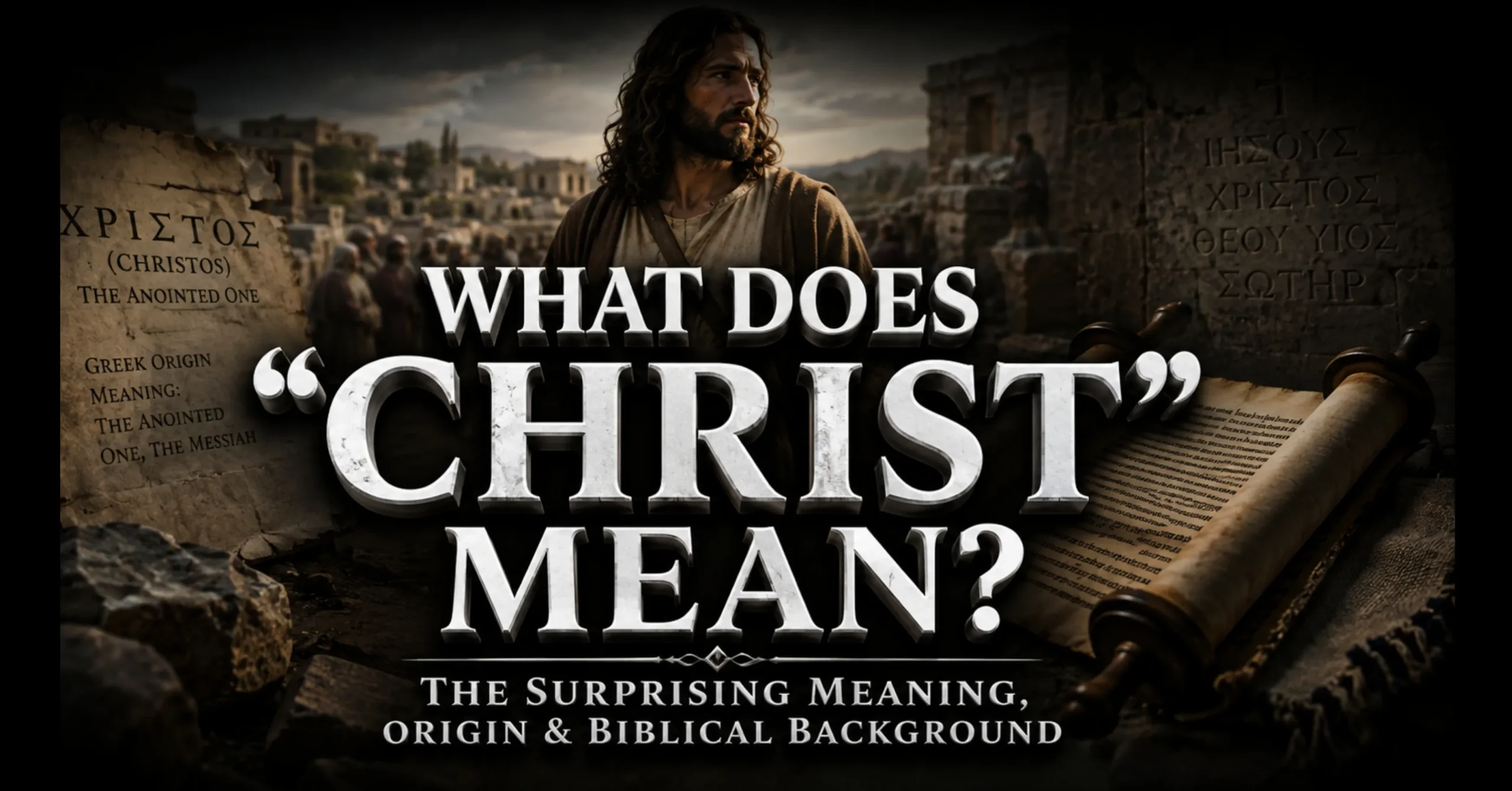
“Christ” is not a surname. It is a title. It comes from the Greek word Christos, which means “the anointed one.” The Greek word Christos was used to express the same idea as the older Hebrew word Mashiach, from which we get the English word “Messiah.” So when the Bible calls Jesus “the Christ,” it is describing who he is, not giving him a family name.
Where did the word come from? Why is it used for Jesus? And how is “Christ” different from “Jesus”? Let’s look at each one.
Is “Christ” a Title or Jesus’s Last Name?
It is easy to see why people assume “Christ” is a modern last name. We hear “Jesus Christ” so often as one phrase that it can sound like a first name followed by a family name, much like “John Smith.”
But that is not what is happening. Jesus was not known by a hereditary surname in the modern sense. “Christ” is a title that means “the anointed one.” When the New Testament calls Jesus “Christ,” it is making a statement about who he is, not identifying his family line.
So why does “Jesus Christ” sound like a full name to us today? One reason is that the two words appear together so often in early Christian writings. In Paul’s letters, for example, we find both “Christ Jesus” and “Jesus Christ.” Because the two words are used together so often, they can sound like one name. As a result, “Jesus Christ” came to be heard as a single name, even though “Christ” began as a title.
It is somewhat like “Alexander the Great.” “The Great” is closely associated with his name, but it describes him rather than functioning as his surname.
Where Does the Word “Christ” Come From?
To understand what “Christ” means, it helps to look at the words behind it and the languages in which the Bible was written.
The Greek Word Christos
The word “Christ” comes from the Greek word Χριστός, written in English letters as Christos. It comes from the Greek verb chrio, which means “to anoint.” So Christos means “the anointed one.” When the writers of the New Testament used this word for Jesus, they were identifying him as the one anointed and set apart by God for a specific purpose.
The Hebrew Word Mashiach
Long before the New Testament was written in Greek, the Hebrew Scriptures already used a word for this idea. That word is מָשִׁיחַ, written as Mashiach. It also means “anointed one.” The Hebrew word is the source behind the term “Messiah.” So “Messiah” and “Christ” point to the same underlying idea, but they come to us through different ancient languages.
How a Hebrew Word Became an English One
The Hebrew word Mashiach was translated into Greek in the Septuagint, a Greek translation of the Hebrew Scriptures. The Greek translators used Christos to express the meaning of “anointed one.” Later, when the New Testament was written in Greek, its writers used the same word, Christos, for Jesus.
The word then passed into Latin. In the Vulgate, Christos was written as Christus. Later, English Bible translations used “Christ.”
So the path can be traced as Hebrew Mashiach to Greek Christos, then to Latin Christus, and finally to English “Christ.” “Messiah” and “Christ” reached English through different paths, but both refer to the same meaning: “the anointed one.”
What About Latin and Aramaic?
You may also come across questions about what “Christ” means in Latin or Aramaic, since both languages are important when discussing Jesus and the Bible.
In Latin, as mentioned above, the word became Christus, which was carried over from the Greek Christos.
Aramaic is a little different. Aramaic was widely spoken in the time of Jesus, but “Christ” itself is a Greek word. The idea behind the title, “anointed one,” was also expressed in Aramaic. It was related to the same Semitic root behind the Hebrew word Mashiach, meaning “anointed one.”
So an Aramaic-speaking person would not have used the Greek word “Christ” in everyday speech. “Christ” became the form used in the Greek New Testament as the message about Jesus spread through the Greek-speaking world.
Hebrew translations of the New Testament also use Moshiach, the Hebrew word for Messiah, rather than the Greek word “Christ.” This fits the language history: “Christ” is a Greek word that came into English through the New Testament and later Bible translations.
Does “Christ” Mean the Same Thing as “Messiah”?
Yes. “Christ” and “Messiah” mean the same thing. Both refer to “the anointed one,” although the two words come from different languages. “Messiah” comes from Hebrew, while “Christ” comes from Greek.
You can see this connection directly in the Bible. In John’s Gospel, Andrew tells his brother Simon Peter, “We have found the Messiah” (which means Christ). The Gospel explains this for its readers by showing that “Messiah” and “Christ” refer to the same title. This is not simply an explanation added by later scholars; the connection is made in the New Testament itself.
So when you read “Jesus Christ” in the Bible, you can understand it as “Jesus the Messiah.” Both expressions identify Jesus with the title “the anointed one.”
Why Is Jesus Called “Christ”?
To understand why this title was given to Jesus, it helps to know what anointing meant in the Old Testament, long before Jesus was born.
In ancient Israel, anointing someone meant pouring oil on their head as a sign that God had chosen them for a particular role. It marked someone as set apart for a special purpose.
Kings were anointed. When Saul became Israel’s first king, the prophet Samuel anointed him with oil (1 Samuel 10:1). Later, David was anointed as well, even before he actually became king (1 Samuel 16:13). Priests were anointed too. Aaron, the first high priest, was anointed for that role (Leviticus 8:12). There is also an example of anointing being associated with a prophet: Elijah is told to anoint Elisha to succeed him as a prophet (1 Kings 19:16).
So anointing was associated with different roles in Israel, including kings, priests, and, in this case, a prophet, as people were set apart for their calling.
Alongside this, the Hebrew Scriptures also spoke of a coming anointed one, a promised deliverer. Isaiah 61:1 describes someone anointed by God’s Spirit to bring good news and freedom. Daniel 9:25-26 also speaks of “an anointed one” appearing at a particular point in history. These passages contributed to the expectation of an anointed figure.
The New Testament presents Jesus as the fulfillment of that expectation. In Luke’s Gospel, Jesus stands up in the synagogue, reads from Isaiah 61, and applies it directly to himself (Luke 4:18). Acts 10:38 says plainly that God anointed Jesus “with the Holy Spirit and power.” This wasn’t anointing with oil. It was anointing with the Holy Spirit and power, connecting Jesus with the biblical idea of being chosen and set apart by God.
There is also a well-known moment in Matthew’s Gospel where Jesus asks his disciples who they believe he is. Peter answers, “You are the Christ” (Matthew 16:16), and Jesus does not correct him. Instead, he affirms it. So while it isn’t that Jesus went around constantly declaring the title for himself in those exact words, the Gospels show him accepting and confirming it when others recognized it in him.
Put together, this is why Jesus is called “Christ.” He is presented in the New Testament as the anointed one, the promised Messiah and deliverer to whom the hopes of the Old Testament point.
What’s the Difference Between “Jesus” and “Christ”?
Since these two words are used together so often, it helps to understand what each one means.
“Jesus” is a personal name. It comes from the Hebrew name Yeshua, which means “the Lord saves.” This was the name given to him, the one the angel told Mary to use before he was even born (Luke 1:31). It is his given name.
“Christ,” on the other hand, began as a title. It tells us something about who Jesus is: he is the anointed one, the Messiah. So when you put the two words together as “Jesus Christ,” you are really saying “Jesus the Messiah” or “Jesus, the Anointed One.” It functions as a title attached to his name, rather than a modern first name and last name.
Keeping this distinction in mind can help when you read the Bible. “Jesus” tells you his personal name. “Christ” tells you that he is the anointed one, the Messiah.
Does “Christ” Mean “God”?
People sometimes wonder whether the word “Christ” itself means “God.” It does not.
“Christ” means “anointed one.” The word comes from the Greek Christos, corresponding to the Hebrew Mashiach. The word itself refers to the anointed one; it does not mean “God” or “divine.”
The Bible’s teaching about Jesus’s divinity comes from other passages and titles, not from the meaning of the word “Christ” itself. “Christ” identifies Jesus as the anointed one, the promised Messiah and deliverer. His divine nature is a separate question, one that is addressed through other biblical passages.
What “Christ” Means for Christians Today
For many Christians, the title “Christ” means more than a historical title. It points to Jesus as the promised Messiah and king, fulfilling the hopes of the Old Testament.
Because of this, Christians speak about living “in Christ,” having “the mind of Christ,” and being “Christ-like” in how they live. These expressions connect the title “Christ” with everyday Christian faith and life.
FAQ About what does christ mean?
What does Christ mean in Greek?
In Greek, “Christ” comes from Christos, meaning “the anointed one.” Christos comes from the verb chrio, meaning “to anoint.”
What does Christ mean in Hebrew?
The Hebrew word behind this idea is Mashiach, meaning “anointed one.” It is the word that gives us “Messiah” in English.
What does Christ mean in Latin?
In Latin, the Greek Christos became Christus. This is the form used in the Latin Vulgate.
What does Christ mean in Aramaic?
“Christ” is a Greek word, not an Aramaic one. An Aramaic speaker would have used an Aramaic word or expression for “anointed one” rather than the Greek Christos.
Does Christ mean God?
No. “Christ” means “anointed one.” Beliefs about Jesus’s divinity come from other biblical titles and passages, not from the meaning of this word itself.
What does Christ mean in the Bible?
Throughout the New Testament, “Christ” identifies Jesus as the anointed one, the Messiah. The New Testament uses the Greek word Christos, while the Hebrew Scriptures use Mashiach for the idea of an anointed one or Messiah.
What is “Christ consciousness”?
Some modern spiritual movements use the phrase “Christ consciousness” in a way that is different from the biblical meaning of “Christ.” It uses the same word but points to a different idea.

Juganta Kumbhar is a Christian pastor, blogger, and content creator who serves in ministry and a local church. He holds a postgraduate degree and has spent significant time writing and publishing Christian and Bible-related content across multiple websites. He also volunteers in social work, believing a life poured out for others is never wasted. He created ChristianPrayerLife to share the life of Christ honestly and warmly the way one friend talks to another hoping every reader who visits feels a little less alone and a little closer to God.