
Patience in the Bible is more than waiting quietly. It is a fruit of the Spirit that shapes how believers trust God, treat other people with grace, and hold steady through hard seasons. This guide walks through its meaning, types, biblical examples, and the verses that ground it in real, everyday faith.
What Is Patience in the Bible?
Before looking at examples or verses, it helps to start with a clear definition. Patience in the Bible is not a personality trait some people happen to have; it is a spiritual quality God grows in every believer who walks closely with Him.
At its root, biblical patience means staying steady in your trust toward God and gentle toward others, even when circumstances give you reason to give up or lash out. It’s a spiritual quality God grows in every believer who walks with Him, not a personality trait some people simply happen to have. Scripture often pairs it with words like longsuffering and endurance, showing that it’s active, not passive.
James 1:3-4 teaches that the testing of faith produces perseverance, meant to finish its work so believers become mature and complete. This differs from how the word gets used casually. Everyday patience often just means sitting through a slow line without complaining. The biblical kind goes deeper, touching the heart’s posture toward God’s timing and toward people who disappoint you.
Paul lists it as fruit the Holy Spirit produces, alongside love, joy, and peace, in Galatians 5:22-23. Restraint plays a role too. Proverbs 14:29 says whoever is patient has great understanding, while a quick temper displays folly.
What Are the Types of Patience in the Bible?
Once the basic meaning is clear, the next question is how it actually shows up in daily life. Patience in the Bible takes several distinct forms, and Scripture describes each one a little differently depending on the situation a person faces.
Scripture doesn’t describe patience as one single skill. It shows up in at least four recognizable forms, each suited to a different struggle.
Patience with God’s timing. This is the patience of waiting on the Lord, trusting His plan even when it moves slower than you’d like. Psalm 27:14 says simply: “Wait for the Lord; be strong and take heart and wait for the Lord.”
Patience in suffering. Job pictures this kind, enduring loss and pain while still trusting God’s character. James 5:10-11 points back to the prophets and to Job as models of patience under hardship.
Patience with people. Ephesians 4:2 calls believers to be “completely humble and gentle; be patient, bearing with one another in love,” the kind tested by difficult coworkers or slow-to-change family members.
Patience for spiritual growth. Hebrews 6:12 speaks of those who “through faith and patience inherit what has been promised,” tying patience to the long process of becoming more like Christ.
Why Is Patience Important in the Bible?
Knowing what patience is and how it appears still leaves one question unanswered: why does it matter so much? Patience in the Bible is treated as essential to Christian character, not as an optional or minor virtue for a select few.
Patience matters because it touches nearly every part of a Christian’s character. Here are five reasons Scripture treats it as essential rather than optional.
It proves faith is genuine. Romans 5:3-4 teaches that suffering produces perseverance, perseverance produces character, and character produces hope. Patience is often the visible evidence that faith is taking root.
It protects relationships. 1 Corinthians 13:4 opens its description of love by saying “love is patient, love is kind.” Without patience, love struggles to survive disagreement or delay.
It guards against sin. Proverbs 14:29 links a quick temper with foolishness. Impatience often leads straight into anger or harsh words spoken in frustration rather than wisdom.
It reflects obedience to God. Colossians 3:12 lists patience among qualities believers are told to “clothe” themselves with, alongside compassion and kindness, as a direct instruction.
It leads to spiritual maturity. James 1:4 says perseverance must “finish its work” so believers become “mature and complete, not lacking anything.”
What Does the Bible Teach About God’s Patience With Us?
Human patience has clear limits, but Scripture points to a far steadier example. Patience in the Bible is grounded first in who God is, and His own patience toward sinful people reveals something about His character worth understanding.
God’s patience toward humanity runs through the entire Bible, from His dealings with a rebellious Israel to His mercy toward believers today. Exodus 34:6 describes Him as “slow to anger, abounding in love and faithfulness,” a phrase repeated whenever His character is summarized.
This patience is not indifference; it has a purpose. 2 Peter 3:9 says the Lord is patient, “not wanting anyone to perish, but everyone to come to repentance.”
God’s delay in judgment is an act of mercy, giving people time to turn back to Him.
Romans 2:4 reminds readers that God’s kindness is meant to lead them toward repentance rather than being taken for granted. Paul describes himself in 1 Timothy 1:16 as an example of the “immense patience” Christ showed him, despite his past as a persecutor of the church.
Seeing how God treats human failure with patience, rather than instant punishment, gives believers both comfort and a pattern to imitate.
How Is Patience Different From Simply Waiting?
These two words often get used interchangeably, yet the Bible treats them differently. Patience in the Bible is not simply another word for waiting; it describes the heart and attitude a person carries while the waiting happens.
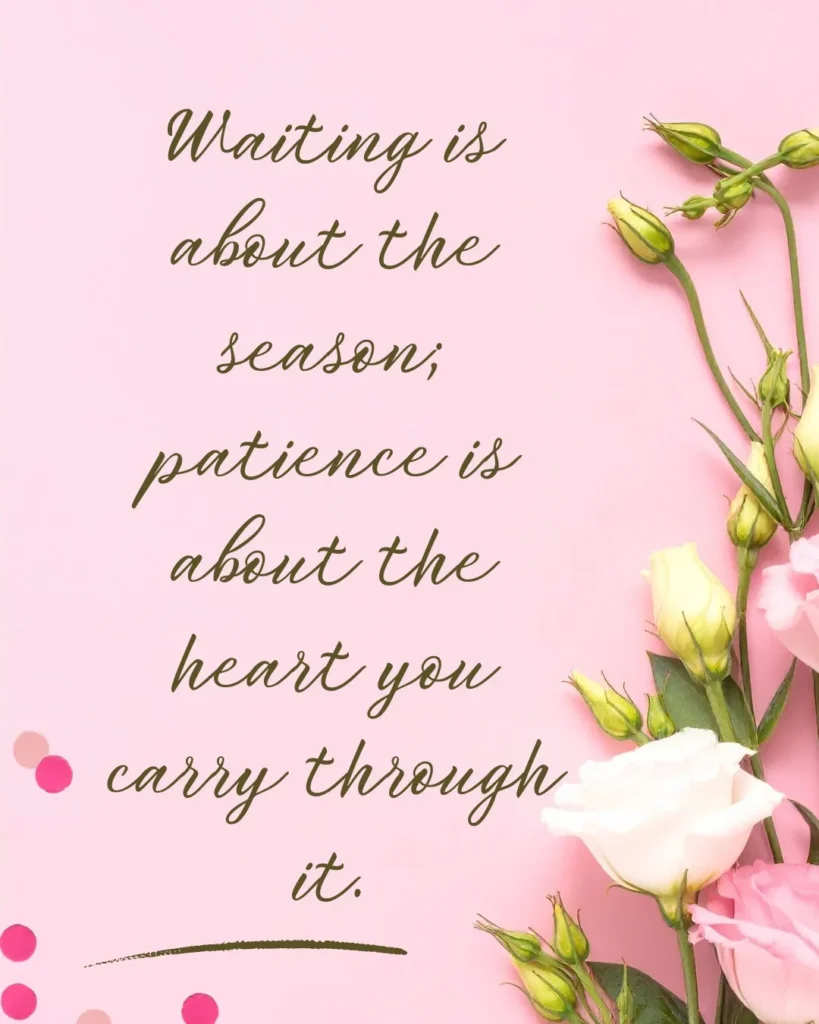
Waiting is a circumstance. Patience is how you respond to it. You can wait for years and still be bitter or anxious the entire time, which shows that waiting by itself doesn’t produce spiritual growth.
Psalm 40:1 shows the difference: “I waited patiently for the Lord; he turned to me and heard my cry.” The waiting and the patience are named as two separate things working together.
Isaiah 40:31 goes further, describing those who “hope in the Lord” as renewing their strength and running without growing weary. That’s not passive stalling; it’s active trust that keeps a person steady while circumstances stay unchanged.
Lamentations 3:25-26 puts it plainly: “The Lord is good to those whose hope is in him… it is good to wait quietly for the salvation of the Lord.” The word “quietly” points to an inward calm, not simply the passing of time.
How Does the Bible Teach Us to Have Patience in Hard Times?
Trials test patience in ways ordinary waiting never does, especially when prayers seem to go unanswered. Patience in the Bible was written largely for people in exactly that position, offering real direction for difficult, uncertain seasons.
Trials test patience most, and the Bible speaks to that reality with unusual honesty. James 1:2-3 tells believers to consider it pure joy when facing trials, “because you know that the testing of your faith produces perseverance.” The joy isn’t in the pain itself; it’s in knowing the trial has a purpose.
Romans 12:12 offers three commands that work together: “Be joyful in hope, patient in affliction, faithful in prayer.” Affliction, hope, and prayer are meant to move together, not as separate coping tools.

Unanswered prayer is one of the hardest forms of hard-times patience. David wrestled with this honestly in Psalm 13:1-2, crying “How long, Lord? Will you forget me forever?” before ending the same psalm with renewed trust in God’s unfailing love.
2 Corinthians 4:16-17 reframes present suffering as “light and momentary” compared to what it’s producing, an “eternal glory that far outweighs them all.” That long view gives patience during hard seasons a clear, hopeful direction.
Patience during hard seasons often grows into quiet acceptance trusting God’s plan even when the outcome isn’t what you hoped for.
What Are the Biblical Examples of Patience?
Definitions and principles become clearer through real lives. Patience in the Bible is best understood by watching how specific men and women actually lived it out, often across years of waiting, hardship, and unanswered questions.

Job faced the loss of his children, wealth, and health, yet refused to curse God even in his grief. James 5:11 points to him directly, noting “what the Lord finally brought about,” His compassion after the trial ended. Lesson: patience doesn’t require understanding why suffering happens, only trusting God through it.
Abraham waited roughly 25 years between God’s promise of a son and Isaac’s birth. Hebrews 6:15 says that “after waiting patiently, Abraham received what was promised.” Lesson: God’s promises can take far longer than expected without becoming less certain.
Joseph endured slavery, false accusation, and prison before becoming second-in-command of Egypt. Genesis 50:20 shows his patience bore fruit in forgiveness, not bitterness. Lesson: patience can preserve character through betrayal and delay alike.
Simeon spent his old age waiting for the Messiah, promised he wouldn’t die before seeing Him (Luke 2:25-26). Lesson: patient hope can span a lifetime and still be rewarded.
Jesus modeled patience under false accusation; 1 Peter 2:23 says that “when they hurled their insults at him, he did not retaliate.” Lesson: patience under unjust treatment is possible when you trust God as the righteous judge.
How Can Christians Develop Patience According to the Bible?
Understanding patience is one thing; growing in it is another. Patience in the Bible is presented as something God cultivates in believers over time, through practical, Scripture-grounded habits rather than sheer willpower alone.
Growing in patience isn’t about trying harder to stay calm it’s a Spirit-led process that unfolds through daily surrender, much like other Christian teachings on patient faith describe.
Pray honestly and often. Philippians 4:6-7 links prayer with peace, promising that bringing requests to God “with thanksgiving” guards the heart and mind.
Remember God’s past faithfulness. Lamentations 3:22-23 recalls that God’s mercies are “new every morning.” Looking back at how God has already come through builds confidence for the waiting ahead.
Stay in Scripture. Romans 15:4-5 ties endurance and encouragement to what “was written in the past,” teaching that Scripture is a tool God uses to build patience and hope.
Let trials do their work instead of resisting them. James 1:2-4 encourages believers to welcome trials, trusting that perseverance is producing maturity.
Practice patience toward specific people. Ephesians 4:2 calls for “bearing with one another in love.” Patience grows through small choices, like a soft answer instead of a sharp one.
Depend on the Holy Spirit rather than willpower. Since patience is listed as fruit of the Spirit in Galatians 5:22-23, it grows through abiding in Christ, not gritted teeth alone.
What Are the Best Bible Verses About Patience?
With the meaning, types, and examples in view, it helps to gather the Scripture itself in one place. Patience in the Bible is best remembered through its own words, organized here by the situations believers face most often.
Patience in hard times
- James 1:2-3 — “Consider it pure joy… whenever you face trials of many kinds, because you know that the testing of your faith produces perseverance.”
- Romans 12:12 — “Be joyful in hope, patient in affliction, faithful in prayer.”
- Romans 5:3-4 — suffering produces perseverance, character, and hope.
Patience while waiting on God
- Psalm 27:14 — “Wait for the Lord; be strong and take heart and wait for the Lord.”
- Isaiah 40:31 — those who hope in the Lord “will renew their strength.”
- Lamentations 3:25-26 (KJV) — “The LORD is good unto them that wait for him… it is good that a man should both hope and quietly wait for the salvation of the LORD.”
Patience with others
- Ephesians 4:2 — “Be completely humble and gentle; be patient, bearing with one another in love.”
- Colossians 3:12-13 — clothe yourselves with patience, “bearing with each other and forgiving one another.”
God’s patience toward us
- 2 Peter 3:9 — the Lord is patient, “not wanting anyone to perish, but everyone to come to repentance.”
- Exodus 34:6 — the Lord is “slow to anger, abounding in love and faithfulness.”
Patience, faith, hope, and love
- 1 Corinthians 13:4 — “Love is patient, love is kind.”
- Hebrews 6:12 — through faith and patience believers “inherit what has been promised.”
- Galatians 5:22-23 — patience listed among the fruit of the Spirit.
Patience in the Bible isn’t about gritting your teeth until a hard season passes. It’s a trust that grows through waiting, suffering, and everyday relationships, shaped by a God who has already shown His own patience toward you. Whatever you’re waiting on right now, Scripture doesn’t ask you to wait alone. It invites you to wait well, holding onto a God who is faithful even when the timing feels slow.

Juganta Kumbhar is a Christian pastor, blogger, and content creator who serves in ministry and a local church. He holds a postgraduate degree and has spent significant time writing and publishing Christian and Bible-related content across multiple websites. He also volunteers in social work, believing a life poured out for others is never wasted. He created ChristianPrayerLife to share the life of Christ honestly and warmly the way one friend talks to another hoping every reader who visits feels a little less alone and a little closer to God.